
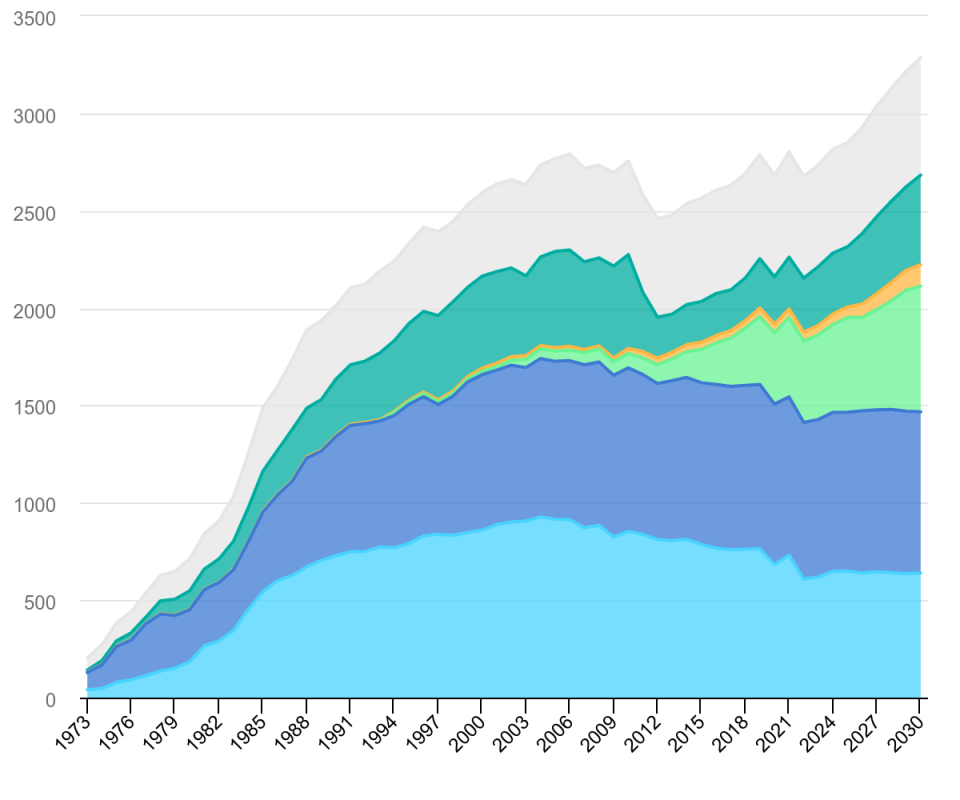
Behind the growing consumption: The IEA report noted that electricity consumption growth is being driven by “some of the most dynamic segments of global economies, such as artificial intelligence (AI), data centers, and evolving technological innovations.” It also cites the increasing electricity uptake by electric vehicles, air conditioning, and general industrial usage.
Emerging and developing economies remain “the main engines of electricity demand growth,” but consumption by advanced economies is also now increasing “after 15 years of stagnation.” One-fifth of the power demand increase through 2030 is expected to come from advanced economies.
Rapid expansion of grids: Because of this growing demand, along with “an increasingly weather-dependent mix of power generation sources,” Electricity 2026 stated that “power systems will need greater flexibility to securely and cost-effectively integrate an increasingly diverse mix of electricity generation sources while accommodating evolving demand patterns and technologies.” It called for a rapid and efficient expansion of electricity grids, the deployment of grid-enhancing technologies, and regulatory reforms that allow for more flexible connections and usage.
With such steps, as much as 1,600 GW of the more than 2,500 GW of currently stalled, queued projects could be integrated into the grid system in the near term, according to the report.
Outlook for nuclear: As described in the IEA report’s executive summary, the outlook for nuclear energy is positive around the world:
Nuclear generation set a new record in 2025 and is set to continue rising steadily through 2030. Nuclear power output in 2025 was supported by reactor restarts in Japan, higher generation in France, and new capacity additions in China, India, and other countries. While most of the growth in nuclear generation through 2030 is expected to occur in emerging economies, with China alone accounting for around 40 percent of the global increase, nuclear energy is also regaining strategic importance in many advanced economies, underpinned by supportive policy frameworks to extend the lifetime of reactors and add new capacity.
Affordability: Another topic covered in Electricity 2026 is energy affordability, which is a worsening problem as household electricity prices have been rising faster than incomes in many countries since 2019. The high electricity costs are also adding financial pressures to industries and businesses.
According to the report, the non-energy components of costs—“such as network charges, taxes, and other levies—continue to account for a large, and often growing, share of household bills. In addition, electricity is also taxed more heavily than natural gas in many countries, weakening incentives for households to electrify heating, cooking, or hot water use. As a result, policymakers are increasingly focusing on policy frameworks, market designs, and regulation to improve affordability and encourage electrification.”
A main challenge will be “ensuring prices remain affordable while still reflecting costs and incentivizing demand‑side flexibility.”
Electricity security: Electricity security remains a crucial issue for modern economies, the report said, citing blackouts in Chile, the Iberian Peninsula, and Mexico in 2025, as well as “the EstLink-2 cable outage between Finland and Estonia, the Heathrow substation fire and the Berlin arson attack.” All of those incidents “exposed critical vulnerabilities” that suggest “strengthening the physical protection of critical infrastructure and deploying advanced monitoring and early‑detection systems will be essential to guard against threats.”
Ultimately, ensuring a reliable supply of electricity “depends on strong grids, resilient supply chains and diverse flexibility resources,” the report stressed.