
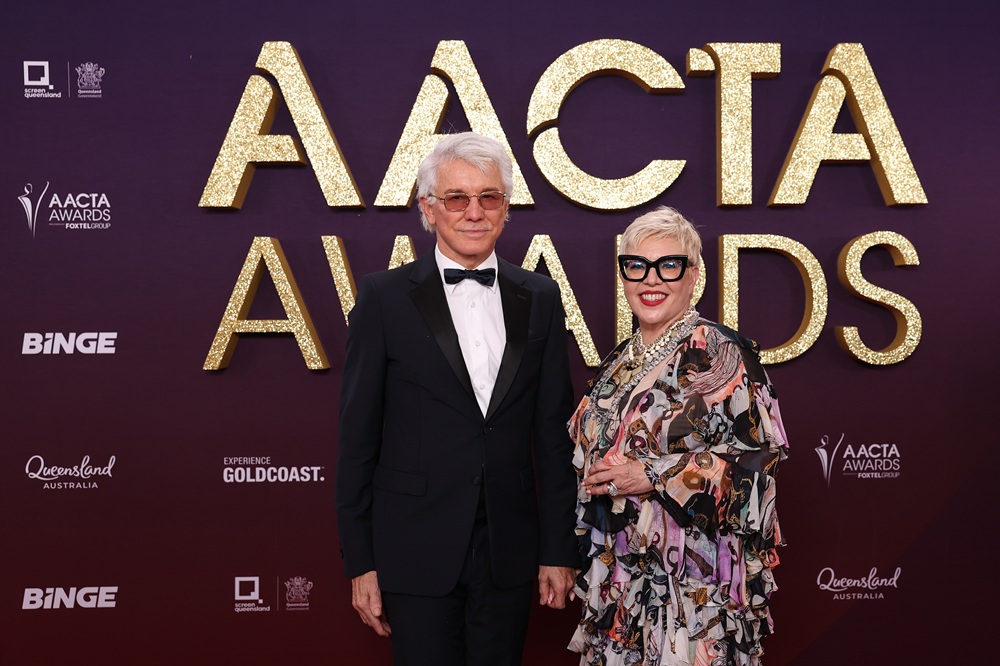
When Baz Luhrmann went searching for Elvis Presley, he didn’t just find an icon – he found a voice. Premiering to Australian audiences at the AACTA Festival, EPiC: Elvis Presley in Concert unveils long-lost footage painstakingly uncovered and restored by the Academy Award–nominated filmmaker, offering an intimate, unguarded portrait of the King that feels both revelatory and deeply human.
More than a concert film or a historical archive, it plays like a dream told by Elvis himself; part memoir, part meditation on legacy, faith, fame and performance. In conversation with our Peter Gray during the AACTA Festival, Luhrmann reflects on the surprises hidden within the material, the responsibility of preservation, and what it means for a new generation to encounter Elvis through his lens, while collaborator Catherine Martin speaks to the power of visual storytelling, restoration, and how the past continues to shape the future.
Given your background in visual storytelling and production design, how did that influence your approach to shaping a documentary built around archival material?
Catherine Martin: To be honest, I was somewhat adjunct to this process. I was an executive producer, but this was very much Baz’s passion project, his desire to share all of this incredible footage he encountered while making the film, and also to give Elvis the opportunity to tell his own story, which Baz felt he owed him.
What’s so powerful about this documentary is that we really hear Elvis speaking in his own voice, which is quite extraordinary and deeply human. You also get a clear sense of his musical sophistication and the breadth of his taste – how remarkably in tune he was with what was happening in music during the 1970s.
He performed a lot of contemporary songs in his shows, and you see how effortlessly he could move from one piece to another. Elvis loved a medley, he loved a mash-up, and he was so musically confident that he could do that with such aplomb.
As you said that Baz feels like he owes a debt to Elvis, is there an artist that you would like to personally explore?
Catherine Martin: Oh, my God, I have a debt to so many artists. It’d be a long list. I’d be making a lot of documentaries. My one documentary passion project, if I ever get time to do it, is to do a history of fashion through my own perspective. (Something) much more thematic, rather than being chronological. Let’s just say never say never.
And this film is a restoration of something that was lost, but it’s bringing it to new eyes with a new voice. It has completely new meaning to it. I’m curious to know, with costume design, what does restoration give you as an artist, and what does that mean to you when you are creating from something older?
Catherine Martin: I’m incredibly grateful. The internet is filled with pitfalls, of course, but one of the great things it has given visual artists and practitioners is access to vast amounts of research and imagery that we simply would never have had before. When images are restored in this way, you actually get to see what is truly happening within them – details that would have been lost or obscured in the past – and that’s enormously valuable.
I also think one of the internet’s real benefits is that people are now far more visually educated and sophisticated than ever before. They understand references, layers, and nuances that might have been missed previously, including by people like me, who once had to photocopy black-and-white images from library books.
We’re incredibly lucky to have so many rich visual resources available to us now. I’m very much in favour of honouring the past, because without a past, we don’t have a future. But I also believe the past must be generous to what comes next and actively encourage the future of visual storytelling.
 Universal Pictures
Baz, Catherine mentioned that this film was, in a way, made because you felt a kind of debt to Elvis. I’m curious – can you remember the very first Elvis song you ever learned?
Baz Luhrmann: It’s probably not going to be a classic. We were running the local cinema for a while, and I distinctly remember going in as a kid when we were showing an Elvis matinee. The film was Easy Come, Easy Go, and he sang a song called “Yoga Is as Yoga Does.”
I remember thinking, “Look at this guy in the black turtleneck, this is style.” In hindsight, it’s probably not one of his best numbers; it’s a bit funny and silly. But I was fascinated by him, and also thinking, “What is yoga?”
I feel like there’s going to be a whole generation of people who only know Elvis through your film. For those viewers, what do you hope they take away?
Baz Luhrmann: I think it’s about not preaching, it’s about me getting out of the way. Elvis is often talked about in documentaries, but what’s different here is that we found all this audio of him speaking for himself, telling his own story without being interrogated. People, even lifelong fans, have come up to me and said they feel like they’re meeting him again in a new way. But what’s been really striking is that, since the film, we’ve seen a huge younger audience discover him. Little kids literally bounce up and down in front of the screen.
What they connect with is, yes, his playful, goofy side, but also his deep empathy and humanity. If you look at the lyrics to “Walk a Mile in My Shoes” and think about the world we’re living in, it’s incredibly relevant. Elvis was taught very early on by Colonel Parker not to speak too openly. He was actually a very shy speaker. When he once accepted an award, he rehearsed for weeks just to say a few lines, even though he looked effortlessly cool. But his music was where he truly expressed himself.
In fact, nobody wanted him to record “In the Ghetto.” His team told him, “Do not do it. Don’t cross that line.” But he insisted. At the time, the media called it his first “message song.” So if you want to know what Elvis really thought or felt, you don’t just listen to what he said, you listen to what he sang.
Given how much research you must have done for Elvis, was there anything in the process of making this documentary that genuinely surprised you? Something you hadn’t come across before?
Baz Luhrmann: Many things. His sense of humour, for one – his almost goofiness. There’s a young man in the film, Sam Bell, who I tracked down after a long search. The opening of the film follows those kids running around and going to the juke joint and the gospel. Sam told me that what you see in the film is exactly as he remembered it. He very sadly passed away recently, but before that, he showed me where they lived.
He told me his grandparents loved Elvis, and he said something that really stayed with me: that no white person – man, woman or child – ever said “sir” or “ma’am” to them, except Elvis.
I think Elvis carried a deep sense of shame about his father being sent to what was considered the worst jail in the country. Sam told me, “We had a nice house,” but Elvis came from East Tupelo, which was desperately poor. I think he always carried that with him. And then he becomes this globally idolised, impossibly handsome figure with this extraordinary gift. As Whitney Houston once said, because her mother sang with The Sweet Inspirations in 1969, when Elvis walked into a room, it wasn’t like you just politely said hello. You were struck by him. You just looked. You didn’t know what to say.
But I think when you have that effect on people and yet still feel insecure inside, that’s where some of his playfulness and goofiness comes from. Almost like he was always slightly sending himself up. He seemed aware that he was this vessel for something bigger than himself, almost like a curator of his own legend. He was also a deeply spiritual person. One of my favourite sections in the film is the gospel segment, where he talks about how, after a show, he would often sing gospel music until six in the morning just to find peace.
 Universal Pictures
I’m curious about the journey of this documentary. Between finishing Elvis in 2022 and this film now, was it a case of feeling like there was more of the story you hadn’t told?
Baz Luhrmann: Partly, but it was also sparked by something very specific. I’d heard from Ernst Jorgensen, who is one of the world’s leading Elvis experts, that there might be lost reels of footage from the Vegas shows, but no one knew where they were. Because of the film, I had access to MGM’s archives, which are stored in a salt mine in Kansas City. It felt a bit like Raiders of the Lost Ark. I sent a team down there – we spent about $100,000 just to explore – and they opened this dusty room full of boxes piled everywhere, some mixed up, some misplaced.
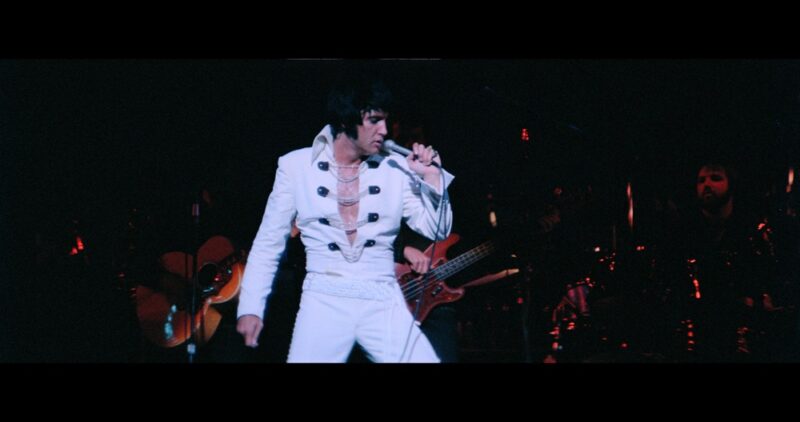
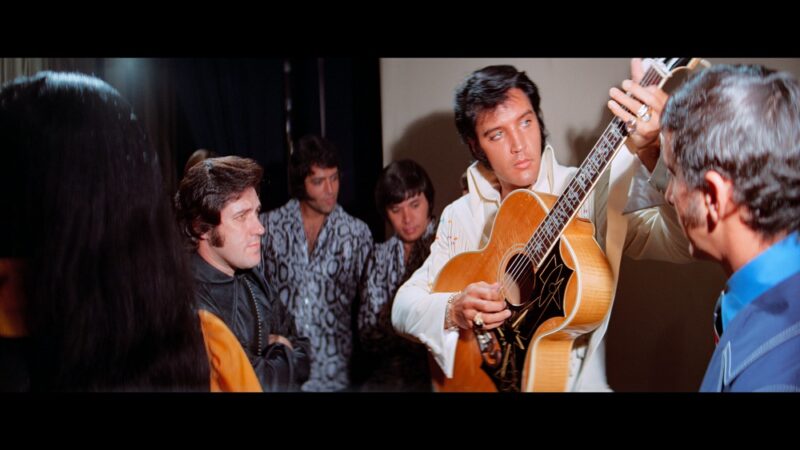
In the end, we found 68 boxes containing footage from both the Vegas concert and the tour. We also came into possession of additional 8mm material. Then began a two-year process of restoration, with one dedicated technician painstakingly syncing sound from different sources to the image. What you hear in the film is Elvis’s actual voice from the stage. Occasionally you hear The Sweet Inspirations, sometimes the band or orchestra, and in some places we enhanced the orchestral sound so it could be mixed properly. Like Elvis, we wanted to be innovative, so we mixed the audio in 5.1 and 5.7 surround sound so you really feel like you’re in the room.
We ended up with hours and hours of complete shows that no one had ever seen. When fans found out, I started getting endless messages saying, “Release the footage.” They would never stop, but if we released everything, the film would have been 12 hours long. So instead, I decided to shape it more like a poem or a dream, as if Elvis himself is coming to you, telling his story, singing to you, speaking to you as a friend. That approach was possible because we had this incredibly unguarded audio of him reflecting on his own life.
What does restoration and preservation mean to you? Not just in terms of cinema, but more broadly?
Baz Luhrmann: I’ve been very fortunate to work with the best in the world at this. Peter Jackson and his team at Park Road Post in New Zealand. Some of them are even here tonight. They’re extraordinary. What Peter achieved with The Beatles: Get Back is, to me, the gold standard of restoration, not just technically, but in how it reveals the creative process. There is nothing quite like it.
And importantly, there is not a single frame of AI in this Elvis film. There are no digital visual effects, apart from the emotional effect the footage has on the audience. When you see this film on a proper screen – especially IMAX – it’s stunning. I’ve seen it on an IMAX screen that was at least one and a half times as tall as this room, projected from original 8mm footage. It’s extraordinary.
I think we have a responsibility to do this with all of these lost cultural treasures. Restoration isn’t just about nostalgia, it’s about ensuring that when we’re gone, these works, these performances, these moments in history are preserved at the highest possible quality for future generations.
EPiC: Elvis Presley in Concert is screening in Australian theatres from February 19th, 2026.
Image credit: Baz Luhrmann and Catherine Martin attend the 2026 AACTA Awards at HOTA (Home of the Arts) on February 06, 2026 in Gold Coast, Australia. (Photo by Don Arnold/Getty Images for AACTA)