
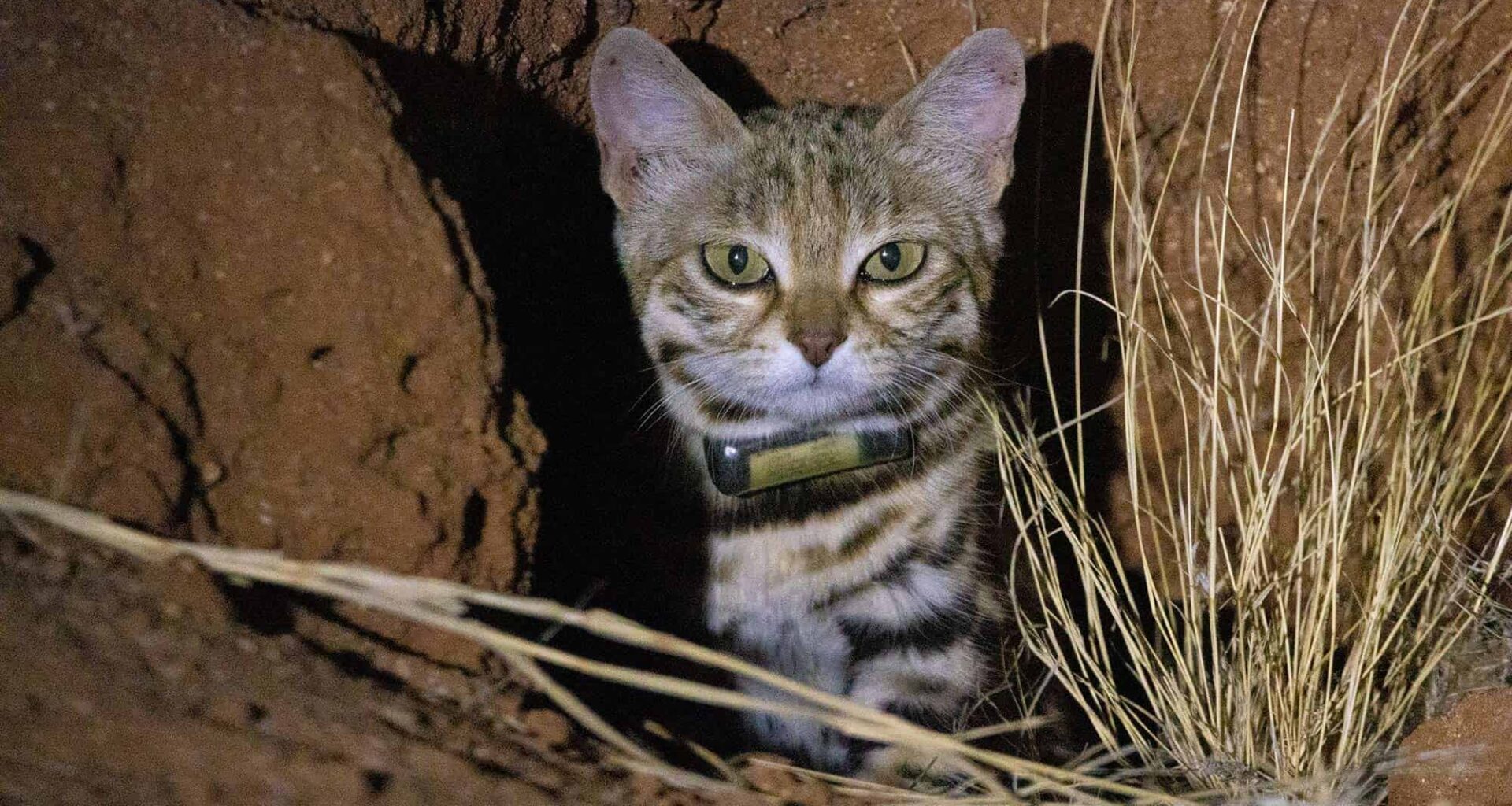
 Black-footed cats (Felis nigripes) in southern Namibia. Image courtesy of Alex Sliwa.
Under cover of night, a black-footed cat moves almost invisibly through the grasses of southern Namibia, hunting small rodents, birds and insects. Barely a third the size of a domestic cat, its tawny coat speckled with dark spots helps it disappear into the darkened landscape. By day, the cat disappears underground, folding its small body into abandoned burrows and tunnels — a rare behavior among felines.
Female Felis nigripes patrol territories covering anywhere from 10 to more than 80 square kilometers (4-31 square miles), depending on prey availability, while males roam areas between 15 and 90 km² (6 and 35 mi2). Their energy and activity, despite their small size, continue to surprise researchers. Alexander Sliwa, project leader for the Black-footed Cat Working Group, an international network monitoring wild populations, notes, “It’s really small, but very active and unique in its nocturnal behavior.”
Newly published research, focused on the cats’ daytime activity, has uncovered their heavy reliance on burrows dug by springhares (Pedetes capensis), a large rodent, to raise their young. Female black-footed cats rotate among multiple dens, and once the kittens start moving, the mothers change shelters almost daily, likely to reduce predation risk and avoid leaving traces that predators could follow.
Survival in this harsh, semiarid landscape depends not just on stealth and hunting skill, but also on these hidden interdependencies.
 Black-footed cats range extends across semi-arid landscapes in Namibia, Botswana and South Africa. Image courtesy of Hal Brindley.
Surviving in borrowed burrows
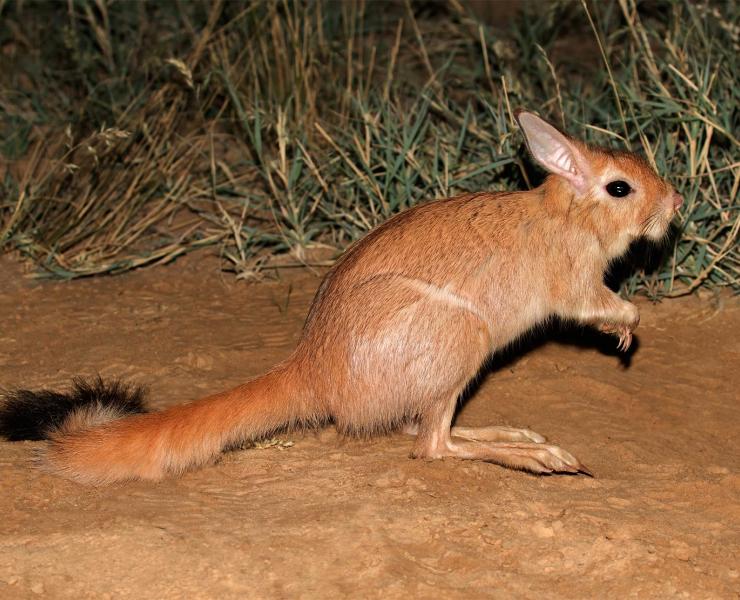 Springhares usually live in burrows, the entrance of which they plug up with sand once inside. They have a strange resting posture. Springhares sit with their hind legs stretching forward and bodies bent between them, with the flat top of the head and ears in direct contact with the ground. This position seems to enable them to detect vibrations. Credit: African Wildlife Foundation.
Famously more efficient hunters than lions or leopards, and capable of a surprisingly powerful growl, these tiny cats — they weigh 1-2.5 kilograms (2.2-5.5 pounds), with males on the larger end — still need to find a safe refuge for their even tinier kittens while they’re out hunting.
A recent study led by researcher Harold Brindley, from the Institute for Communities and Wildlife in Africa at the University of Cape Town, South Africa, found that female black-footed cats rely heavily on burrows excavated by springhares, a rodent often described as a mix between a kangaroo and a rabbit.
Slightly larger than the cats themselves, springhares aren’t on the black-footed cat’s menu.
Because springhares frequently dig and abandon burrows, they create a constantly renewed network of underground refuges that also helps buffer temperature extremes. That’s fortunate, because female black-footed cats like to move house.
×
Thank you! One more thing…
Please check your inbox and confirm your subscription.
Brindley and his team, including Sliwa, tracked five female cats fitted with radio collars, and scanned more than 50 burrows in southern Namibia using laser-based lidar technology. They found each cat used an average of 12 different shelters over the 138-day study, staying in each den for a mean of two consecutive days. Mothers raising kittens followed a different rhythm: before the young reached about six weeks of age, females typically remained in the same den for around six days. Once the kittens began traveling with their mothers at night — around six to seven weeks — they changed shelters almost daily.
 F. nigripes in a springhare burrow. Image courtesy of Hal Brindley.
This frequent rotation likely serves both convenience and safety, says Brindley: mothers select the nearest suitable burrow at sunrise rather than retracing long distances to previous dens, while avoiding shelters that might bear the scent of other cats. Predation risk is highest when the kittens start exploring the world, making this strategy a practical way to reduce exposure to jackals, caracals and other potential threats, the study authors write. The pattern may also vary depending on local predator density, with shorter stays per den in areas with many jackals.
“I can make the obvious assumption that predation risk is high when those little furballs first start exploring the world and playing with everything while mom is trying to hunt and keep them safe,” Brindley said.
Black-footed cats are not the only beneficiaries of springhares’ willing excavations. The burrows also provide shelter for numerous other mammals, reptiles, birds and invertebrates. And while springhares aren’t the only species digging up the dry soil of southern Namibia — the study area also offered plenty of burrows considerably larger than springhare ones, dug by aardvarks and ground squirrels — researchers only found male black-footed cats used the holes dug by these other species.
“I can’t prove black-footed cats would disappear without springhares,” Brindley said, “but at this site they would be much more vulnerable.”
He also highlighted the age-old cat-and-mouse trope as it pertains to the black-footed cat and the springhare: “This is just another way cats depend on rodents — first for food, and now for shelter!”
F. nigripes has a low reproductive rate: a female produces at most two kittens per year, so each loss is difficult to compensate for. Many individuals are also affected by a kidney disease known as AA amyloidosis, which weakens them and increases their risk of being killed by predators.
“It’s very sensitive,” Sliwa said. The population is small — around 10,000 individuals — and it cannot recover quickly from mortality.”
 A black-footed cat in a burrow. Image courtesy of Hal Brindley.
Sharing habitat with humans
Protecting this tiny predator also means protecting the animals that dig the burrows it depends on. For now, springhares remain abundant across most of the F. nigripes range in Namibia, Botswana and South Africa, although localized declines have been reported in some areas. But hunting pressure and land-use changes could threaten this, potentially reducing shelter availability for the cat.
Sliwa said protecting the black-footed cat depends as much on relationships with the people who share its habitat as it does on scientific research. Much of the species’ range lies within privately owned livestock farms, making cooperation with landowners essential to maintaining functional habitats and avoiding practices that indirectly harm the species.
Shooting or poisoning predators to protect livestock can accidentally kill black-footed cats, while overgrazing or hunting of springhares reduces the availability of the small burrows that the female cats need to raise their kittens safely.
Such practices fragment habitats and isolate populations, undermining the resilience of black-footed cats in an environment shaped by highly variable rainfall and prey availability. Small, disconnected populations become more vulnerable to predation, environmental fluctuations and inbreeding.
“If you understand the farmer, you know many are struggling to survive,” Sliwa said. “A black-footed cat doesn’t affect their daily income — it doesn’t prey on livestock — so it’s hard for them to see why they should change certain practices [to accommodate the species].”
And because the species is rare, elusive and difficult to observe, raising public awareness about it remains a challenge.
Martina Küsters, coordinator of the Black-footed Cat Research Project Namibia, has a clear message for the landowners she engages with: “If you ever see one, you fall in love. They’re tiny, full of character, and very unique. They’re beautiful, like miniature leopards. When we talk about unique biodiversity, this is a perfect example.”
This article originally appeared in Mongabay.
Citations:
Brindley, H., O’Riain, M. J., & Sliwa, A. (2024). The underground cat: Burrow use by female black-footed cats (Felis nigripes). African Zoology, 60(4), 286-297. doi:10.1080/15627020.2024.2402249
Sliwa, A., Lai, S., Küsters, M., Herrick, J., Lawrenz, A., Lamberski, N., … Wilson, B. (2022). Causes of mortality in a population of black‐footed cats in central South Africa. African Journal of Ecology, 60(4), 1311-1317. doi:10.1111/aje.13033
Lai, S., Warret Rodrigues, C., O’Donnell, H., Küsters, M., Herrick, J., Lawrenz, A., … Sliwa, A. (2024). Assessing the effect of predator control on black‐footed cat survival in central South Africa. African Journal of Ecology, 62(3). doi:10.1111/aje.13316