
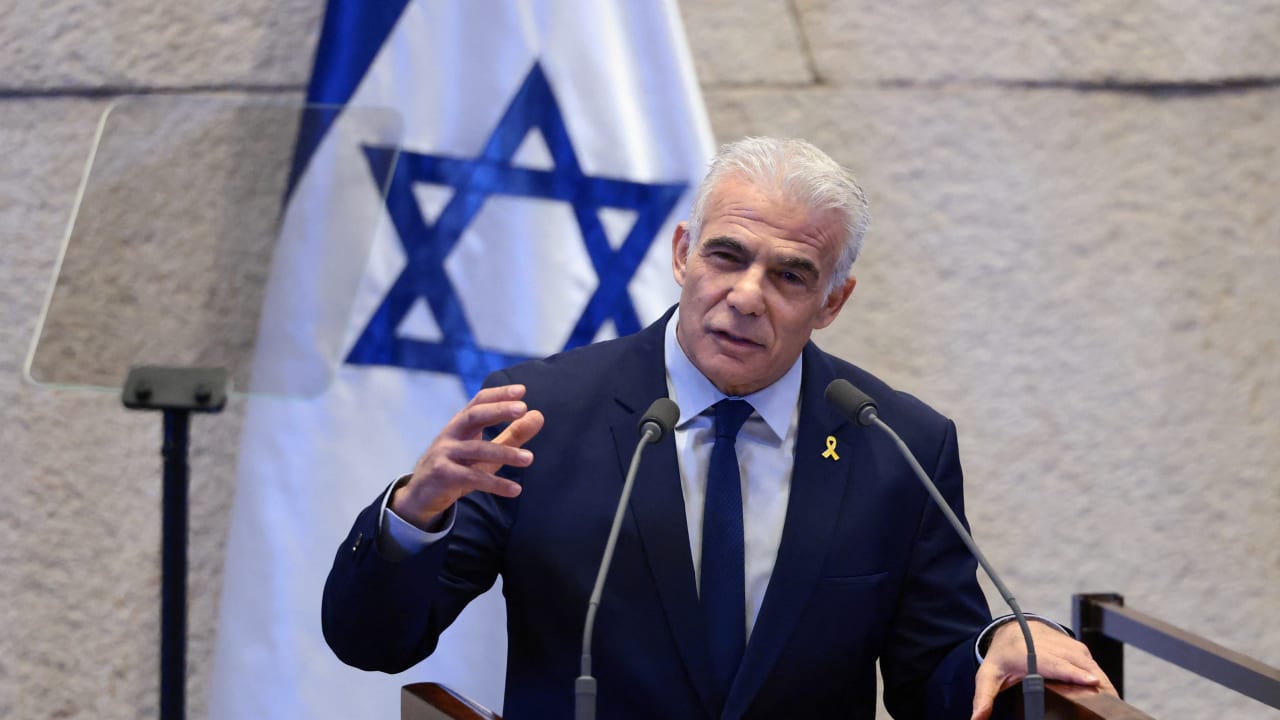
Opposition leader Yair Lapid on Tuesday called for a criminal investigation into figures within Prime Minister Benjamin Netanyahu’s inner circle, accusing them of falsifying official security protocols and manipulating intelligence materials in the lead-up to the October 7 Hamas attacks.
“The very strange and dangerous thing he published, he didn’t write it alone. We need to know who wrote the security protocol reports, lied, and distorted them. In the end, someone took these intelligence materials and turned them into a false version,” Lapid said in a 103FM interview on Tuesday morning.
He also claimed that individuals close to Netanyahu distorted sensitive information and presented it to the public in a misleading manner.

Lapid pushed back against Netanyahu’s attempts to shift blame exclusively to the military establishment for the failures of October 7.
“It’s not that anyone says the IDF didn’t fail, the IDF failed, and the government failed as well,” he said. “But the idea that the prime minister thinks he can present us with snippets of distorted documents and say, ‘I had only been prime minister for half a year,’ when six days before October 7, he issued an instruction to raise the number of workers from Gaza to an all-time high, is unacceptable.”
Lapid argued that selectively using intelligence while omitting the views of the professional security echelon undermines democratic accountability.
“Taking security discussions, cutting out what’s convenient for you, erasing the views of the security echelon, and then saying you’re just a guest on security matters is something that must not be done,” he said.
Response to Ehud Barak’s ties to Epstein
The interview also addressed recent revelations involving former prime minister Ehud Barak, including leaked correspondence and a recording tied to the Jeffrey Epstein documents. While distancing himself from Barak, Lapid condemned what he described as racist discourse emerging from the fallout.
“It’s outrageous. The very act of bringing this discourse back, whether from the podium or in internal discussions, doesn’t matter to me. The entire purpose of Zionism is to create unity here. Barak was a prime minister from the Left, and I’m from the Center,” he said.
Lapid added that his contact with Barak in recent years had been minimal.
“During the protest movement, we spoke on the phone once every few months, and I haven’t spoken to him in a long time. He’s not an oracle and not a shmoracle. The central movement in Israeli society is people who make kiddush on Friday night and don’t distinguish between colors.”
Lapid also commented on the representation of Mizrahim, Jews of Middle Eastern and North African descent, in Israeli politics.
“Meir Cohen once went up to the Knesset podium and told David Amsalem: check whether at the top of Yesh Atid there are more Mizrahim than in Likud—and they were stunned,” he said. “It doesn’t matter whether it’s Karhi and Amsalem or Ehud Barak in a quote. It’s complete nonsense.”
Asked about recent remarks by Yair Golan, who suggested retiring the term “Left,” Lapid chose not to engage publicly.
“I’m not going to quarrel with other parts of the opposition on the radio,” he said.
‘What kind of state will this be?’
Lapid went on to say that Israel faces a crossroads looking ahead.
“We’re at a point where there’s a question of what kind of state this will be: will it be a successful, advanced, prosperous state with a welcoming Judaism, or a dark and racist state?” he asked.
He argued that many Israelis feel their quality of life has declined.
“I don’t think there’s a single Israeli citizen who says their life is better today than it was three years ago, when I was prime minister. I don’t want to blacken Israelis’ lives in their ears, but they know how they’re living. Either go to the supermarket or turn on CNN.”
On the question of whether Israel’s strategic position has improved amid the war, Lapid was skeptical.
“There are areas in which Israel’s security has improved, but if you create a major disaster and then fix part of it, that’s not a compliment to your leadership,” he said. “Your lives were cheaper, and the poison in Israeli society was much lower.”
Despite his criticism of Netanyahu, Lapid said he wished him well ahead of the prime minister’s expected meeting with the American president in Washington.
“I wish him success. When an Israeli prime minister goes to meet an American president at such a moment, you want him to succeed,” he said.
He also stressed that negotiations with Iran should address more than just the nuclear issue.
“The most important thing is that the Americans’ discussion with the Iranians not focus only on the nuclear issue, but also on ballistic missiles.”
Regarding Yesh Atid’s lagging poll numbers, Lapid said he was unconcerned.
“I’ve been in those places seventy times. When you have values, in the end it always pays off electorally too, because people know who’s working for them,” he said, pointing out that several of his political rivals are no longer in office. “Bennett isn’t in the Knesset, Golan isn’t in the Knesset, Eisenkot isn’t in the Knesset—we are.”
Lapid concluded by reiterating his position on Iran and Israel’s security doctrine.
“Israel needs to maintain the principle that decisions about our security are made by us. I’m not beating the drums for war on the radio, but the principle that we manage our own security has been seriously eroded—see what’s happening now in Kiryat Gat.”