
birds: Warm-blooded dinosaurs with wings that first showed up at least 150 million years ago. Birds are jacketed in feathers and produce young from the eggs they deposit in some sort of nest. Most birds fly, but throughout history there have been the occasional species that don’t.
Cretaceous: A geologic time period that included the end of the Age of Dinosaurs. Spanning 145 million to 66 million years ago, it was a time when the whole planet had a relatively mild climate, with forests growing near both the North and South Poles. It marked the emergence of flowering plants and massive volcanic eruptions, which triggered big shifts in ocean ecosystems. And some regions cooled, leading dinosaurs there to adapt by evolving a coat of insulating feathers. Finally, it all came to an end 66 million years ago when a giant meteorite crashed into Earth, changing the global climate overnight. This wiped out all the dinosaurs (except those that would survive as birds), along with half of all plant and animal species.
dinosaur: A term that means terrible lizard. These reptiles emerged around 243 million years ago. All descended from egg-laying reptiles known as archosaurs. Their descendants eventually split into two lines. For many decades, they have been distinguished by their hips. The lizard-hipped line are believed to have led to the saurischians, such as two-footed theropods like T. rex and the lumbering four-footed Apatosaurus. A second line of so-called bird-hipped, or ornithischian dinosaurs, appears to have led to a widely differing group of animals that included the stegosaurs and duckbilled dinosaurs. Many large dinosaurs died out around 66 million years ago. But some saurischians lived on. They are now the birds we see today (and who have now evolved that so-called “bird-hipped” pelvis).
family: A taxonomic group consisting of at least one genus of organisms.
force: Some outside influence that can change the motion of an object, hold objects close to one another, or produce motion or stress in a stationary object.
fossil: Any preserved remains or traces of ancient life. There are many different types of fossils: The bones and other body parts of dinosaurs are called “body fossils.” Things like footprints are called “trace fossils.” Even specimens of dinosaur poop are fossils. The process of forming fossils is called fossilization.
insight: The ability to gain an accurate and deep understanding of a situation just by thinking about it, instead of working out a solution through experimentation.
Jurassic: Lasting from about 200 million to 145.5 million years ago, it’s the middle period of the Mesozoic Era. This was a time when dinosaurs were the dominant form of life on land.
paleontologist: A scientist who specializes in studying fossils, the remains of ancient organisms.
predator: (adjective: predatory) A creature that preys on other animals for most or all of its food.
prey: (n.) An organism hunted by another, often for food. (v.) To attack and eat another organism.
species: A group of similar organisms capable of producing offspring that can survive and reproduce.
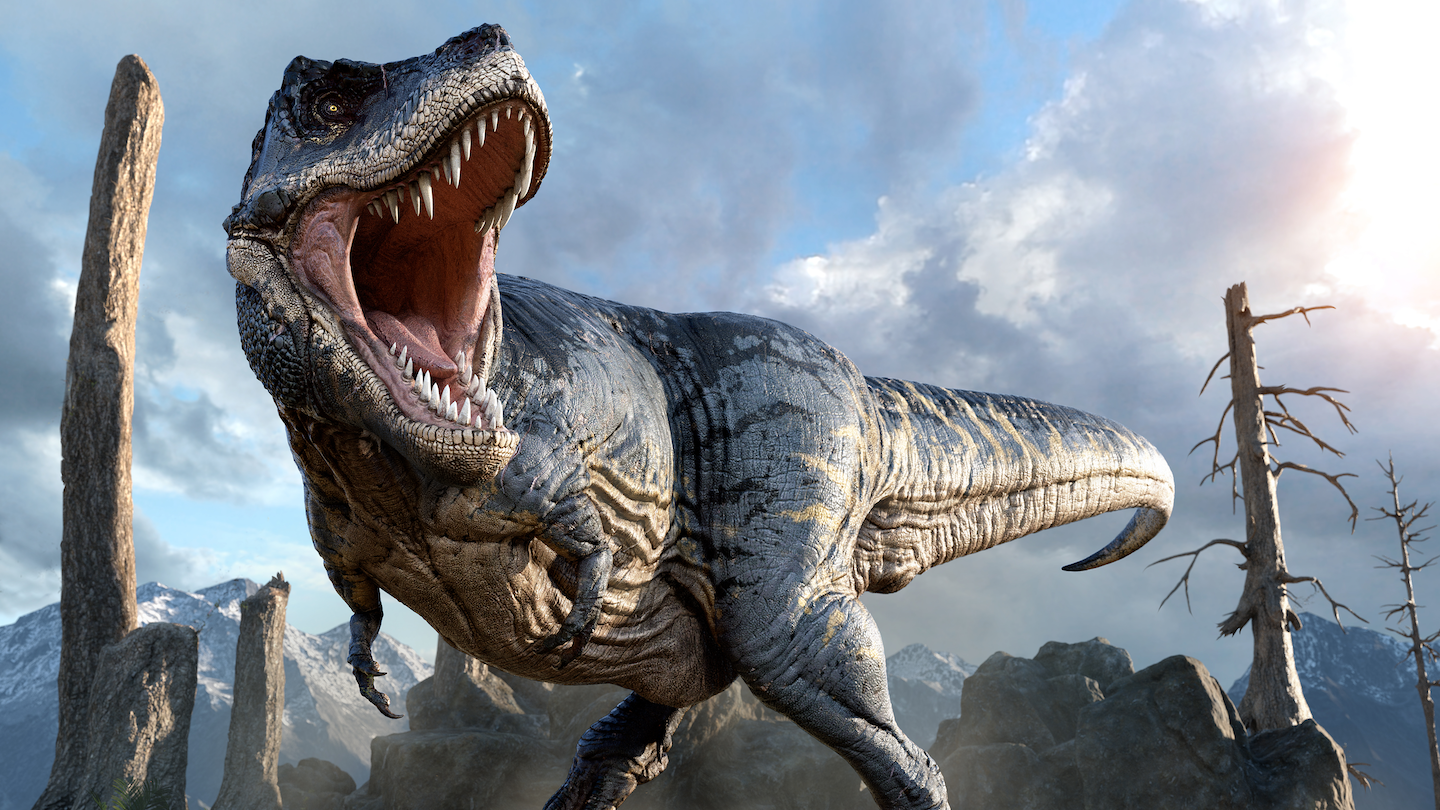
tyrannosaur: A line of meat-eating dinosaurs that began during the late Jurassic Period, about 150 million years ago. These species persisted into the late Cretaceous Period, about 65 million years ago. The best known member of these species: the late Cretaceous’ Tyrannosaurus rex, a 12-meter (40 foot) long top predator of its time.
Tyrannosaurus rex: A top-predator dinosaur that roamed Earth during the late Cretaceous period. Adults could be 12 meters (40 feet) long.