
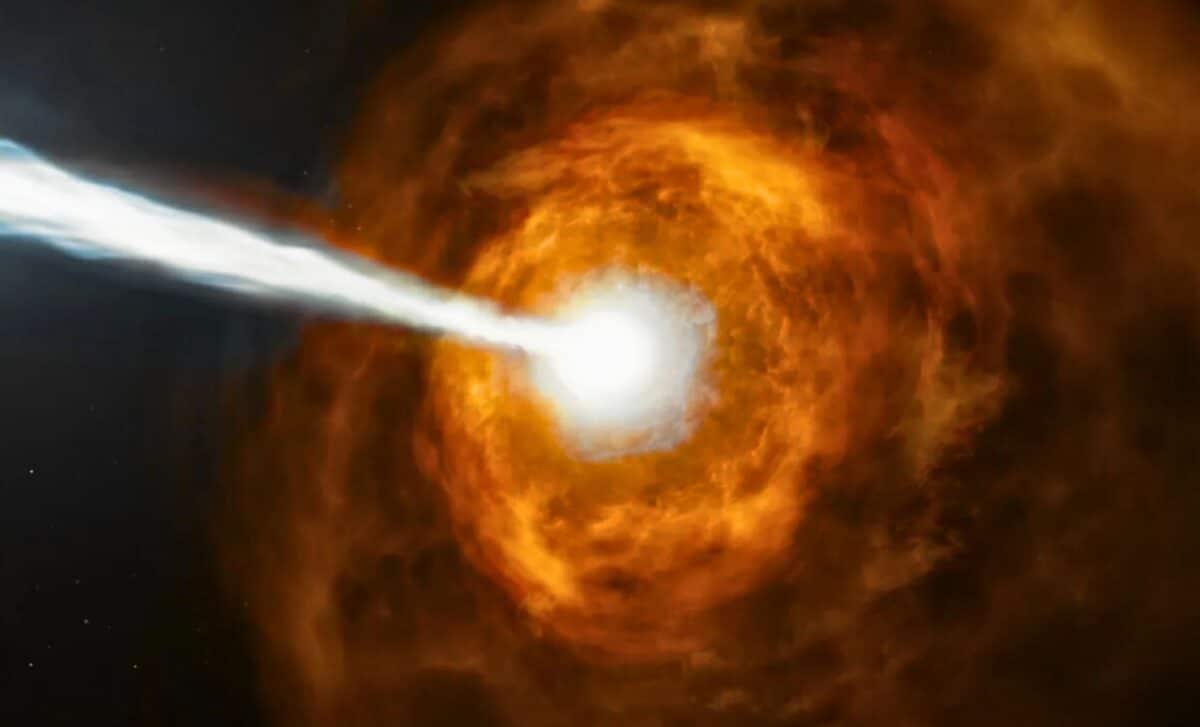
A high-energy signal lasting over seven hours, first observed in mid-2025, has drawn intense scrutiny from astrophysicists tracking rare cosmic phenomena. Detected by multiple space-based observatories, the event, cataloged as GRB 250702B, set a new record for gamma-ray burst duration.
Its scale and duration immediately set it apart. Most gamma-ray bursts (GRBs), typically caused by massive stellar collapses or neutron star mergers, release their energy in less than a few minutes. GRB 250702B extended far beyond that, displaying a signal profile unlike any seen in decades of monitoring.
Initial findings prompted a global response. Data-sharing channels across NASA, the European Space Agency (ESA), and multiple research centers activated within hours of the first alert. The burst’s complexity raised fundamental questions about how such events originate and whether current classification systems remain adequate.
A Seven-Hour Gamma-Ray Burst Shatters All Previous Records
The gamma-ray burst was first flagged on 2 July 2025 by the Gamma-ray Burst Monitor aboard NASA’s Fermi Space Telescope. The system issued an automated trigger to monitoring teams when it registered what appeared to be three distinct high-energy flashes from the same celestial region.
Instrument logs from Fermi, combined with detections from at least four additional space-based observatories, confirmed the event spanned approximately 25,000 seconds. That duration makes GRB 250702B the longest gamma-ray burst ever recorded, far surpassing the previous record-holder of roughly 15,000 seconds.
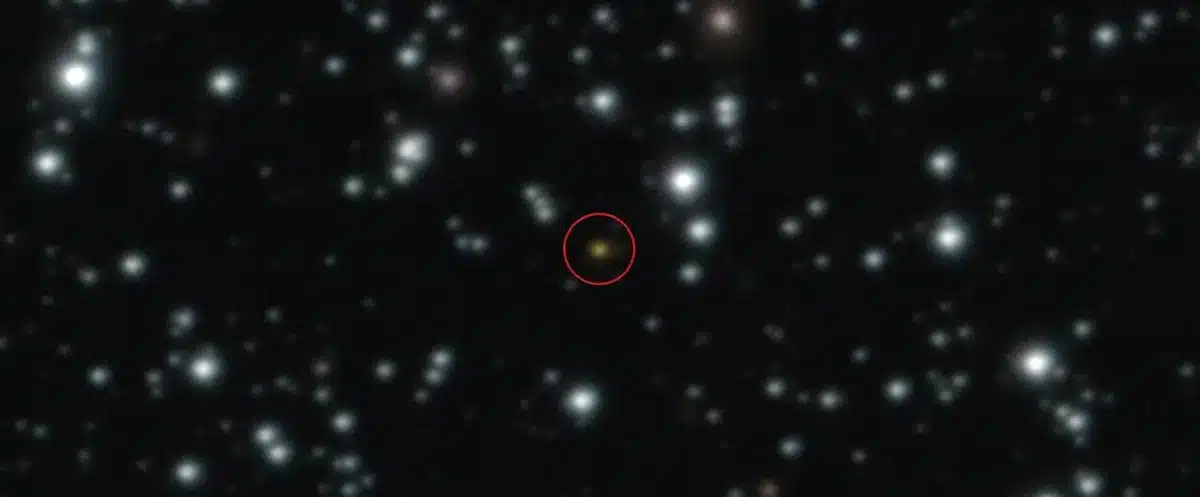 Gamma-ray burst GRB 250702B, as seen by ESO’s Very Large Telescope. Credit: ESO/A. Levan, A. Martin-Carrillo et al.
In an interview published by BBC Sky at Night Magazine, Eliza Neights, a researcher at NASA’s Goddard Space Flight Center and a burst advocate on duty at the time, described the signal’s detection process. Neights confirmed the gamma-ray pattern was initially interpreted as three separate events before being reclassified as a single, sustained burst from a consistent origin.
The five observatories involved, including instruments from NASA, ESA, and partner institutions, collaborated to track the signal’s characteristics. Combined light curve data indicated sustained energy release, raising the likelihood that GRB 250702B stemmed from a fundamentally different progenitor than typical GRBs.
No direct redshift measurement has yet been published, and the host galaxy remains unidentified. Optical afterglow was either absent or too faint to observe, consistent with predictions for some lower-luminosity merger events.
A Black Hole Consuming a Helium Star May Explain the Anomaly
Gamma-ray bursts are typically categorized into short-duration (under 2 seconds) and long-duration (2 to 300 seconds) classes. Short bursts are generally linked to compact object mergers, such as neutron star collisions. Long bursts, by contrast, are associated with the deaths of massive stars forming black holes.
Neither framework comfortably explains a burst lasting seven hours.
 Eliza Neights, high-energy astrophysicist at NASA. Credit: Eliza Neights
The research team working on GRB 250702B identified a potential fit in a less conventional model: the helium star merger scenario. This involves a stellar-mass black hole in close orbit with a helium-rich star that has lost its hydrogen envelope. As the helium star expands, the black hole spirals inward, entering the star’s envelope and accreting material at a high rate.
This interaction can produce a long-lived relativistic jet, generating gamma-ray emissions observable for hours. The characteristics of GRB 250702B, extended duration, moderate brightness, and spectral signature, closely match what simulations predict for this class of event.
This scenario remains theoretical. However, researchers now consider it the most viable explanation consistent with the data gathered across observatories. It also opens a new avenue in understanding stellar evolution in binary systems, particularly those involving black holes and evolved stars.
Telescope Systems May Be Missing More of These Bursts
The exceptional nature of GRB 250702B has highlighted limitations in how current gamma-ray observatories detect and classify long-duration events. Most instruments are tuned to identify brief, high-intensity flashes. This favors short or average-duration GRBs and may result in underreporting of longer, lower-luminosity phenomena.
Extended GRBs like 250702B can register below standard detection thresholds, especially in automated systems optimized for short transients. Since these events often unfold more gradually and appear dimmer in peak flux, many may be missed altogether.
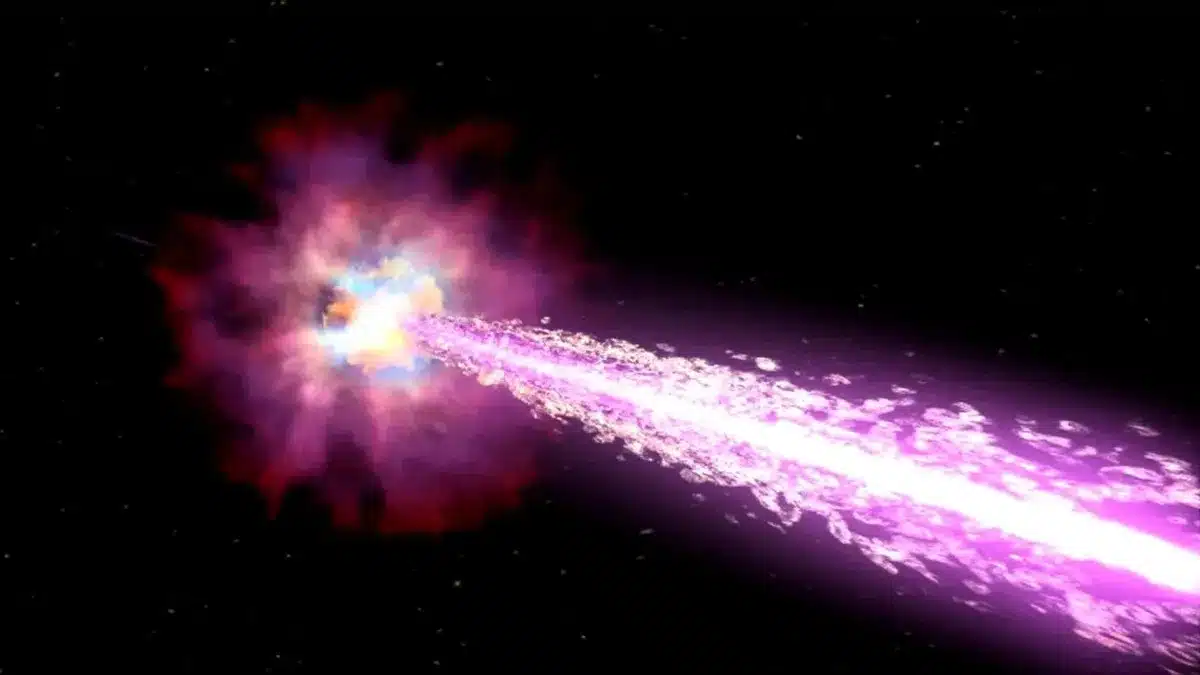 Artist’s impression of a gamma-ray burst. Credit: NASA/Swift/Cruz deWilde
To address this, NASA’s team has begun integrating long-duration burst criteria into mission planning for the upcoming Compton Spectrometer and Imager (COSI), scheduled for launch in 2027. COSI will operate in the MeV gamma-ray range, allowing for greater sensitivity to low-intensity, extended emissions. The 2025 event is now being used as a reference scenario for algorithm testing and detection model updates.
Researchers have also initiated a retrospective search of archival datasets to identify potentially overlooked long-duration bursts. Preliminary scans have revealed several candidates warranting further investigation under the revised criteria.