
Long before a star ignites, its birth is shaped by invisible particles racing through space at near-light speed.
These cosmic rays quietly alter the chemistry and temperature inside dark clouds, helping determine when the clouds can collapse and begin forming stars.

For the first time, astronomers have directly measured the influence of these particles inside a dense, starless cloud, providing a long-sought reading from the heart of a stellar nursery.
The discovery offers a more precise way to understand how stars – and eventually planets – begin.
A measurable stellar cloud
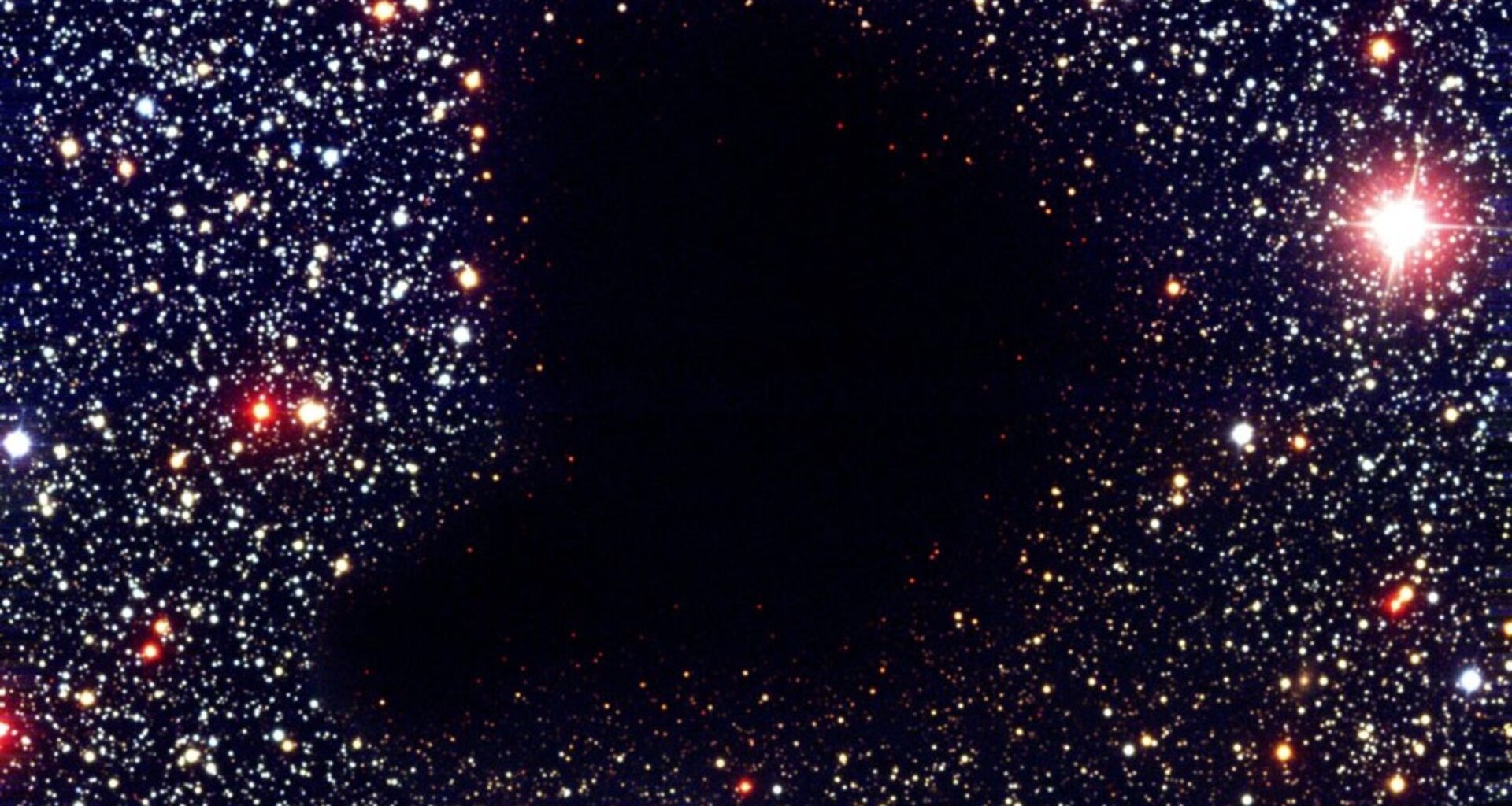
Barnard 68 is a small, cold cloud of gas and dust with no stars inside, making it an unusually quiet place to isolate the influence of those particles.
By tracing their imprint within this cold, opaque cloud, scientists at the Technion-Israel Institute of Technology were able to document the effect directly rather than infer it from distant byproducts.
The observation marked the first time this signature had been seen inside a dense star-forming core rather than along the galaxy’s more exposed edges.
That confinement set clear limits on what the signal could be attributed to, opening the door to broader comparisons across other clouds.
Cosmic rays leave a fingerprint
In this story, cosmic rays – charged particles that zip through space – serve as the invisible cause behind the glow.
Scientists first identified these particles through balloon experiments in 1912, and physicist Victor Hess later highlighted the discovery in his 1936 Nobel lecture.
The particles are mostly stripped-down bits of atoms, including protons and heavier nuclei that can travel near the speed of light.
Magnetic fields twist their paths as they move through the galaxy, making it difficult to predict how strongly they affect any single cloud.
Inside dense clouds, the particles interact with gas through ionization, knocking electrons off atoms or molecules. These collisions cause hydrogen molecules to vibrate and emit a faint infrared glow.
“This infrared radiation serves as a unique fingerprint of the interaction between cosmic rays and hydrogen in the nebula,” said Dr. Bialy.
Because starlight barely reaches the cloud’s core, the glow carries information directly from regions that older chemistry-based clues could only indirectly reveal.
Direct measurements replace guesses
Earlier studies inferred ionization by tracking rare molecular ions – charged molecules formed in reactions – instead of observing hydrogen directly.
Those ions appeared in thin gas along a few lucky sight lines, so models supplied the unseen density and chemistry.
Small errors in reaction rates or cloud structure could push the estimated particle impact up or down by huge factors.
Reading the hydrogen glow sharply reduced that uncertainty, though nearby starlight can still complicate the picture in busier regions.
An ideal test cloud
About 400 light-years, roughly 2.3 quadrillion miles, from Earth, Barnard 68 sits in front of distant stars and blocks their light from view. The gas inside remained extremely cold, so ordinary heat could not produce the measured signal.
A collision scenario in an earlier preprint predicted that the core would collapse in about 200,000 years.
The slow countdown left the cloud unusually calm, giving the James Webb Space Telescope (JWST) time to pick out a very faint infrared trace.
Webb spots an infrared fingerprint
Webb’s Near-Infrared Spectrograph, an instrument that splits light into colors, separated the cloud’s faint glow into distinct infrared lines for analysis.
Researchers hunted for four even-numbered hydrogen lines expected from cosmic-ray impacts and spotted three of them.
“The signals detected by the space telescope matched perfectly with the predictions of the theoretical model we developed,” said Amit Chemke, a master’s student in Dr. Bialy’s group at the Technion-Israel Institute of Technology.
That detection let the researchers calculate the ionization rate inside the core, giving star formation models a firm number.
Ruling out other culprits
To confirm that the signal truly came from cosmic rays, the researchers first had to rule out other possible energy sources.
Nearby stars’ ultraviolet light could not explain the glow because the cloud’s outer layers absorb these high-energy photons and prevent them from reaching the dense interior.
Cosmic rays, in contrast, are able to penetrate much deeper and produce the specific pattern of hydrogen emissions the team observed.
The extremely cold gas inside the cloud also meant that ordinary heat could not generate the signal, and the measured pattern did not match what scientists would expect from shock waves or X-ray activity.
Even so, observations of more crowded clouds in the future – where bright stars and turbulent gas are more common – may prove more challenging. In these environments, additional energy sources could blur the same fingerprint.
Mapping a hidden current
With one cloud measured, the next step is mapping how cosmic-ray activity changes from region to region across the Milky Way.
Scientists use the same hydrogen signal in each measurement, allowing them to compare clouds without depending on rare background stars.
Because the glow depends on low-energy particles, the method can test how those particles propagate and lose power.
Large surveys should reveal real variation, but they will also demand consistent calibrations so different clouds stay comparable.
Cosmic rays and star creation
Star-formation models require a clear ionization rate because charged gas clings to magnetic fields, slowing the collapse that eventually creates stars.
The new measurement from Barnard 68 defines the heating and chemical conditions inside a dense core, sharpening predictions for when gravity can finally take over.
Ionization also triggers reaction chains that build molecules such as water, ammonia, and methanol, directly linking incoming particle activity to the ingredients that later seed planets.
Because cosmic-ray intensity varies across space, however, a cloud recipe that works in one region may not apply elsewhere, limiting one-size-fits-all theories of star formation.
By directly tying a faint infrared line to particle activity, researchers have turned previously “dark” clouds into measurable systems rather than environments shaped largely by guesswork.
Future observations with the James Webb Space Telescope will test how widespread this clear ionization signal is and whether other clouds show stronger or weaker readings.
These measurements will help scientists map how cosmic-ray conditions shape star birth across the galaxy.
The study is published in the journal Nature Astronomy.
—–
Like what you read? Subscribe to our newsletter for engaging articles, exclusive content, and the latest updates.
Check us out on EarthSnap, a free app brought to you by Eric Ralls and Earth.com.
—–