
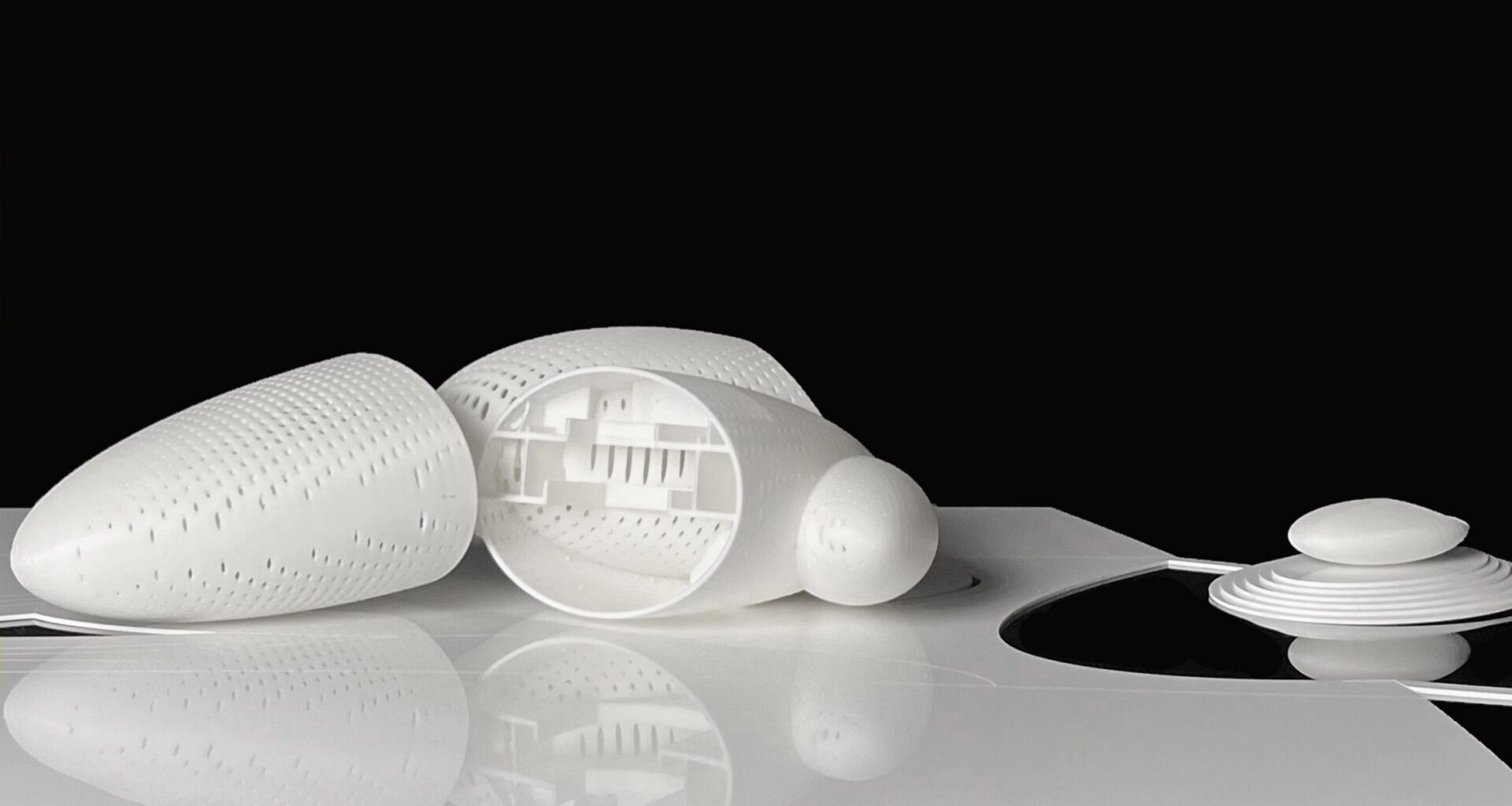
Dezeen School Shows: a building that creates calmer microclimates by responding to wind behaviour is among the architecture proposals from American University in Dubai.
Also featured is a proposal for a project designed to adapt to its desert environment, and another featuring self-shading and thermal protection in response to sun and heat exposure.
Institution: American University in Dubai
Course: ARCH 302 – Architectural Studio VI
Tutor: Nicolas Turchi
School statement:
“This design studio positions architecture as an active environmental agent by asking students to develop an environmentally responsive cultural building in Dubai’s Jaddaf Waterfront, adjacent to the Jameel Arts Centre and the Dubai Creek.
“The project explores how architecture can mediate between extreme climatic conditions, public space and emerging sustainable paradigms within a rapidly transforming urban context.
“Through the design of the Museum of Desert Innovation, students investigate bioclimatic principles, passive strategies and regenerative approaches tailored to arid environments.
“The studio emphasises the integration of environmental performance, material logic and spatial organisation from the earliest stages of design, encouraging architecture to operate simultaneously as infrastructure, exhibition space and climatic mediator.
“Precedent analysis, site-driven research and iterative design development form the core of the studio methodology. International sustainability frameworks, including LEED, Estidama and Dubai Green Building Regulations, inform the projects, grounding speculative proposals in measurable environmental and social criteria.
“Collectively, the studio frames sustainability not as an add-on or aesthetic layer, but as a fundamental design driver, challenging students to articulate how contemporary architecture in desert cities can move beyond mitigation towards long-term ecological resilience and cultural relevance.”
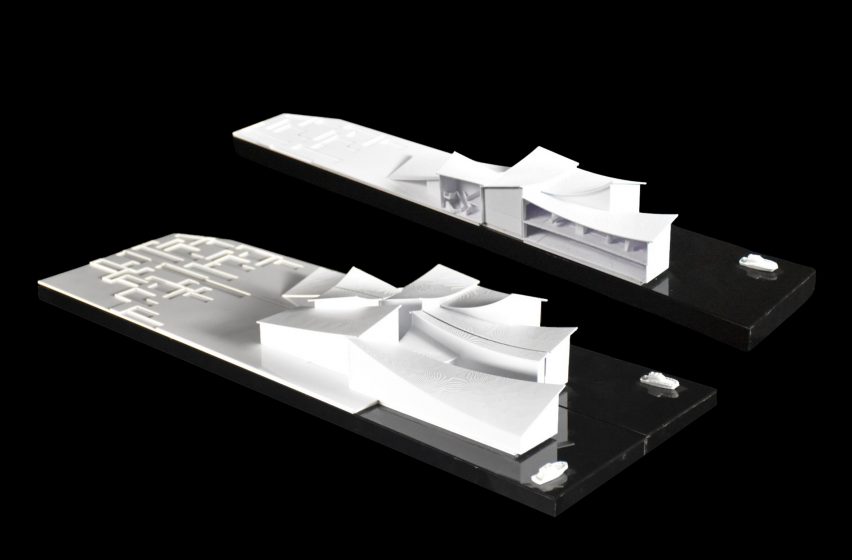
Al Jaddaf Museum of the Desert by Alia Alsuwaidi
“The project is rooted in an exploration of sustainability as a design driver, where environmental performance, cultural identity and architectural form are developed simultaneously.
“Located along the Al Jaddaf waterfront, the design responds to the desert climate and coastal conditions through careful analysis of sun paths, wind patterns and microclimates, allowing environmental forces to inform massing decisions.
“The architectural concept draws inspiration from traditional UAE weaving and the movement of ocean waves, translating layered patterns and fluid curves into a form that promotes self-shading, diffused daylight and reduced heat gain.
“The building volumes are organised to support passive environmental strategies, including controlled solar exposure, chimney effects for natural ventilation and moderated wind flow, reducing dependence on mechanical systems.
“Material selection reinforces this sustainable approach, combining high-performance, low-carbon construction with durable, recyclable finishes suited to the region’s climate, resulting in a museum that functions as an environmentally responsive and culturally grounded landmark.”
Student: Alia Alsuwaidi
Course: ARCH 302 Architectural Design Studio VI
Tutor: Nicolas Turchi
Email: alia.alsuwaidi[at]mymail.aud.edu
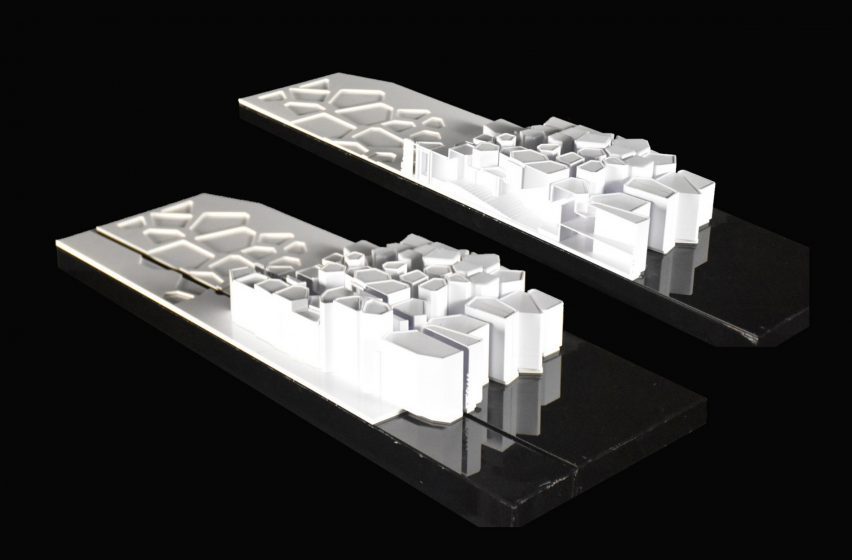
Fractured Dunes by Habiba Elsayed
“The project originates from an investigation into desert resilience, where natural fractures formed by heat, wind and erosion become a model for sustainable architectural thinking.
“Set within the Al Jaddaf context, the design responds to extreme climatic conditions by breaking the mass into fragmented volumes that reduce solar exposure, create shaded zones and encourage cooler microclimates.
“The architectural form is shaped through controlled cracks and voids that allow daylight to penetrate deep into the building while guiding prevailing winds to naturally ventilate interior spaces.
“The spatial organisation supports passive sustainability strategies, integrating rainwater collection, planted crevices and earth-toned materials that enhance thermal performance and reduce dependence on mechanical systems.
“Together, these strategies transform the building into a living environmental system, where form, climate and landscape work collectively to express sustainability as adaptation, endurance and coexistence with the desert.”
Student: Habiba Elsayed
Course: ARCH 302 Architectural Studio VI
Tutor: Nicolas Turchi
Email: habiba.elsayed[at]mymail.aud.edu
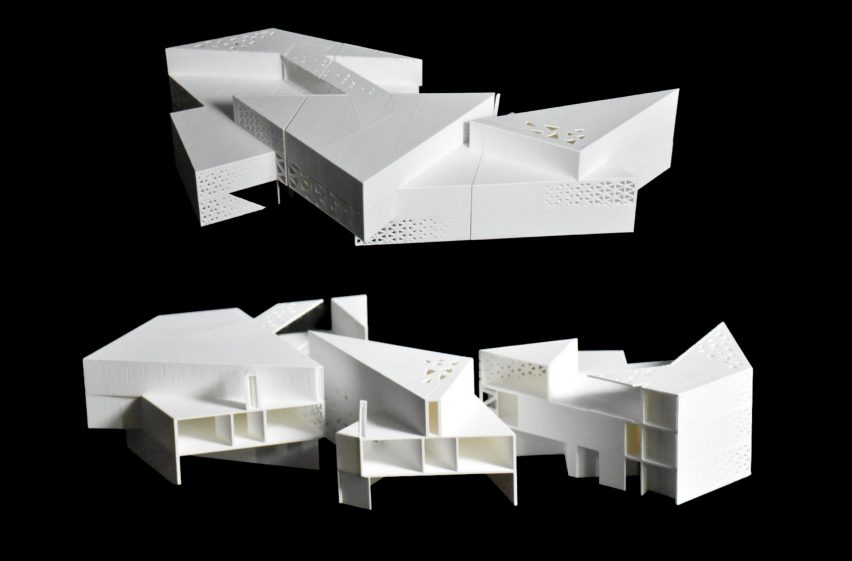
Tri Front by Malak Attia
“The project concept originated from exploring how geometry, environment and sustainability can shape contemporary educational spaces in Dubai.
“Located along the Al Jaddaf Waterfront, the design responds to the site’s relationship with water, climate, and movement, using fragmented triangular geometries inspired by the natural flow of the waterfront.
“The architectural concept transforms these triangular fragments into layered massings that converge toward the water, creating interconnected spaces and continuous horizontal circulation.
“The design integrates zones for education, research, innovation, reflection and social interaction.
“These spaces support learning, technological exploration, wellness and community engagement, forming a sustainable hub that merges geometric expression with environmental performance and waterfront identity.”
Student: Malak Attia
Course: ARCH 302 Architectural Design Studio VI
Tutor: Nicolas Turchi
Email: malak.attia[at]mymail.aud.edu
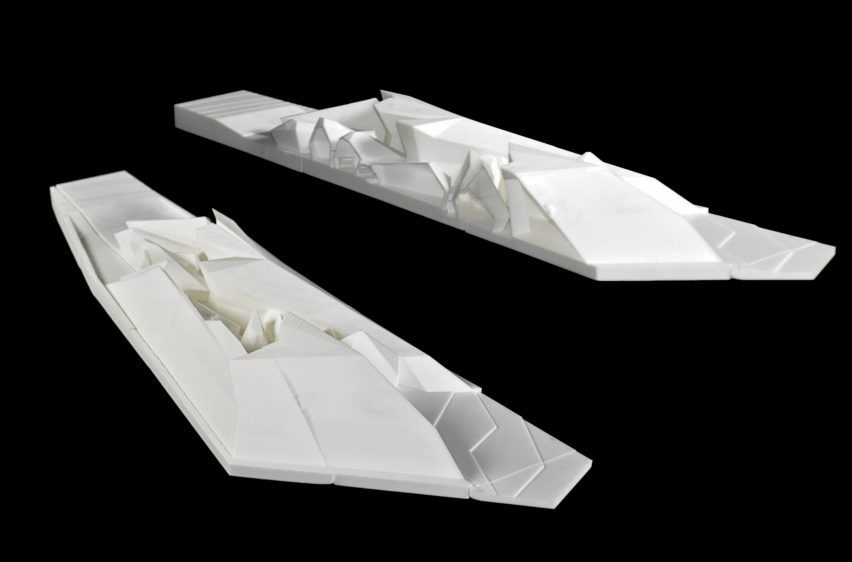
Coriolis by Nidal Al Ashhab
“The project is driven by an exploration of sustainability as an active architectural force, examining how buildings can adapt to environmental conditions rather than rely on mechanical solutions.
“Positioned along the Al Jaddaf waterfront, the design responds to solar exposure, prevailing winds and proximity to water to create cooler microclimates and reduce heat accumulation across the site.
“The building form evolves through layered and fluid geometries combined with perforated envelopes that control daylight penetration, limit solar gain and enhance passive ventilation strategies.
“The spatial organisation brings together innovation spaces, public programmes and circulation paths within a low-energy framework that emphasises material efficiency, thermal performance and long-term adaptability.
“Collectively, these strategies result in an environmentally responsive hub where architecture, climate and landscape operate as a unified system, reducing energy demand while promoting sustainable awareness and user comfort.”
Student: Nidal Al Ashhab
Course: ARCH 302 Architectural Design Studio VI
Tutor: Nicolas Turchi
Email: nidal.alashhab[at]mymail.aud.edu
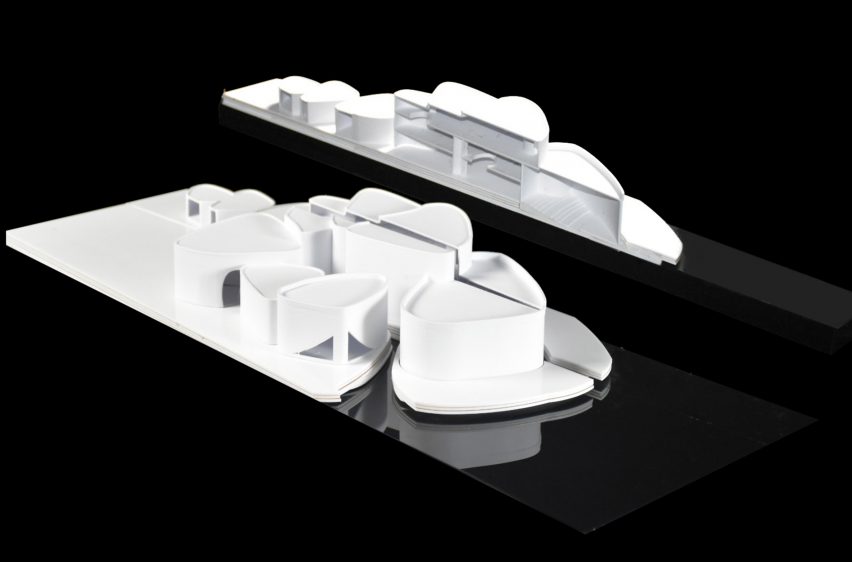
Urban Oasis by Noor Shanableh
“The project is conceived as a sustainable response to the desert environment, where architecture is shaped by climate, landscape, and long-term environmental responsibility.
“Situated in Al Jaddaf, the design responds to intense heat and solar exposure through compact massing, curved forms and layered volumes that promote self-shading and thermal protection.
“The architectural form is inspired by natural desert stones, translated into smooth, continuous geometries that reduce surface heat gain while guiding daylight softly into interior spaces.
“The spatial organisation supports passive environmental strategies, including controlled openings, shaded circulation paths and roof forms that enhance ventilation and reduce reliance on mechanical cooling.
“Together, these strategies create a resilient museum that balances cultural expression with sustainable performance, allowing the building to operate in harmony with its desert context while minimising its environmental footprint.”
Student: Noor Shanableh
Course: ARCH 302 Architectural Design Studio VI
Tutor: Nicolas Turchi
Email: noor.shanableh[at]mymail.aud.edu
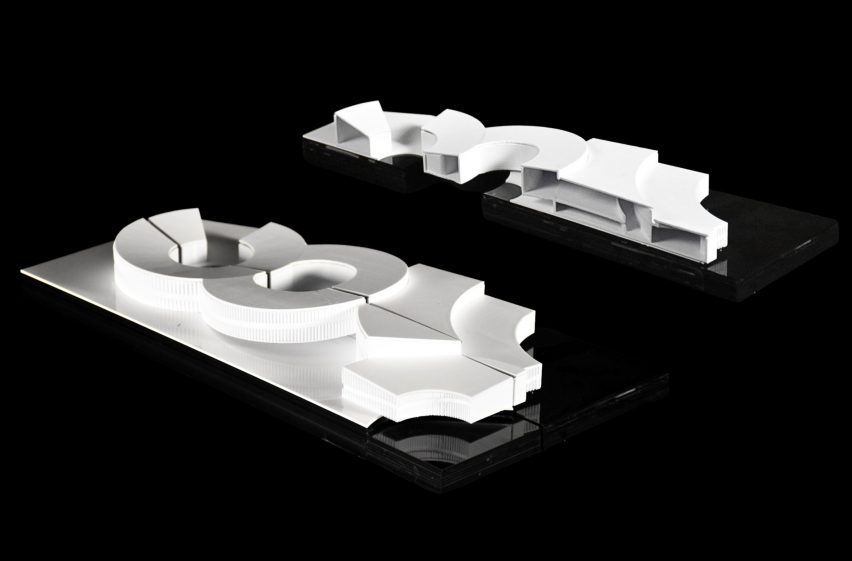
Continuum by Rawan Zawaideh
“The project is conceived as an exploration of sustainability through time, examining how Dubai’s environmental awareness has evolved alongside its urban growth.
“Located along the creek, the design establishes a strong dialogue between desert and water, using site orientation, massing and landscape to respond to climate while framing the city’s historical and future trajectories.
“The architectural form is shaped as a continuous loop, allowing visitors to move through past, present and future while benefiting from passive cooling strategies, shaded circulation and controlled daylight.
“The programme integrates exhibition spaces, ramps and gathering areas within a climate-responsive framework that prioritises natural ventilation, reduced heat gain and energy efficiency.
“Together, these elements create a museum that operates as both a cultural narrative and an environmental system – demonstrating how respect for natural resources and sustainable design principles can guide Dubai’s future development.”
Student: Rawan Zawaideh
Course: ARCH 302 Architectural Design Studio VI
Tutor: Nicolas Turchi
Email: rawan.zawaideh[at]mymail.aud.edu
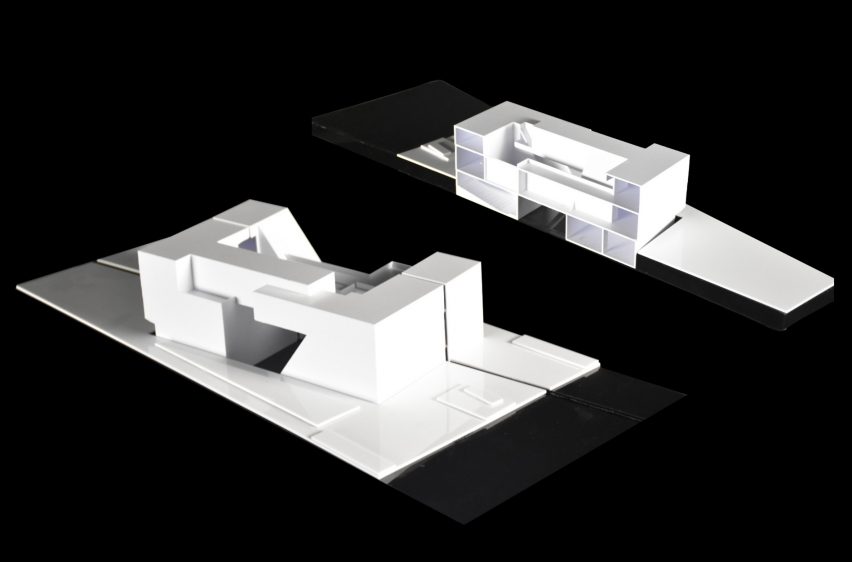
The Fracture by Rayan Abuklal
“The project explores sustainable architecture in arid environments, proposing a museum that responds to the desert climate as a generative design driver rather than a constraint.
“Positioned along the waterfront, the building is oriented and massed to mitigate solar exposure, capture prevailing breezes and establish a sequence of shaded outdoor and semi-outdoor spaces that contribute to the formation of cooler microclimates across the site.
“The architectural composition is defined by a series of solid volumes articulated through precisely carved voids, which regulate daylight penetration, enhance cross-ventilation and frame controlled visual connections between interior spaces and the surrounding landscape.
“This interplay between mass and aperture reduces dependence on mechanical cooling systems while reinforcing a passive environmental strategy embedded within the form itself.
“Exhibition, educational and circulation spaces are organised as a continuous spatial network that supports both public engagement and environmental performance.
“The museum operates as an integrated climatic system, where architecture, landscape, and orientation work collectively to minimise energy demand and environmental impact, offering a culturally immersive experience grounded in principles of thermal comfort, efficiency and long-term sustainability.”
Student: Rayan Abuklal
Course: ARCH 302 Arcitectural Design Studio VI
Tutor: Nicolas Turchi
Email: rayan.abuklal[at]mymail.aud.edu
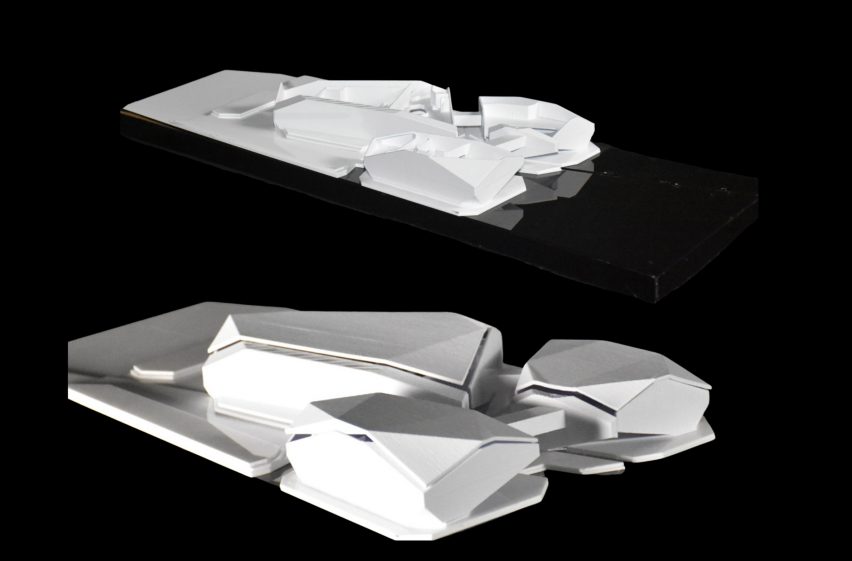
The Desert Crystals by Roudha Alzaabi
“The project examines the desert environment as a formative agent in the generation of architectural form, positioning climate, terrain and environmental forces as primary drivers of spatial and formal decision-making.
“Rather than adopting a singular mass, the building is conceived as an assemblage of articulated volumes that respond to solar orientation and prevailing winds. This produces a layered composition of shaded thresholds and protected exterior spaces.
“Referencing fractured geometries of mineral formations found in arid landscapes, the architecture employs faceted surfaces and recessed voids to modulate daylight, temper heat exposure and promote passive airflow across the site.
“These strategies establish a network of microclimatic conditions that support thermal comfort while reducing the operational demand for mechanical cooling.
“Public, exhibition and circulation spaces are arranged as an interconnected spatial sequence embedded within this environmental logic, allowing programmatic requirements to align with performance-driven design principles.
“The resulting museum functions as a cohesive environmental system, where architectural expression and sustainability converge to reframe the desert context as an active and generative framework for resilient cultural architecture.”
Student: Roudha Alzaabi
Course: ARCH 302 Architectural Design Studio VI
Tutor: Nicolas Turchi
Email: roudha.alzaabi[at]mymail.aud.edu
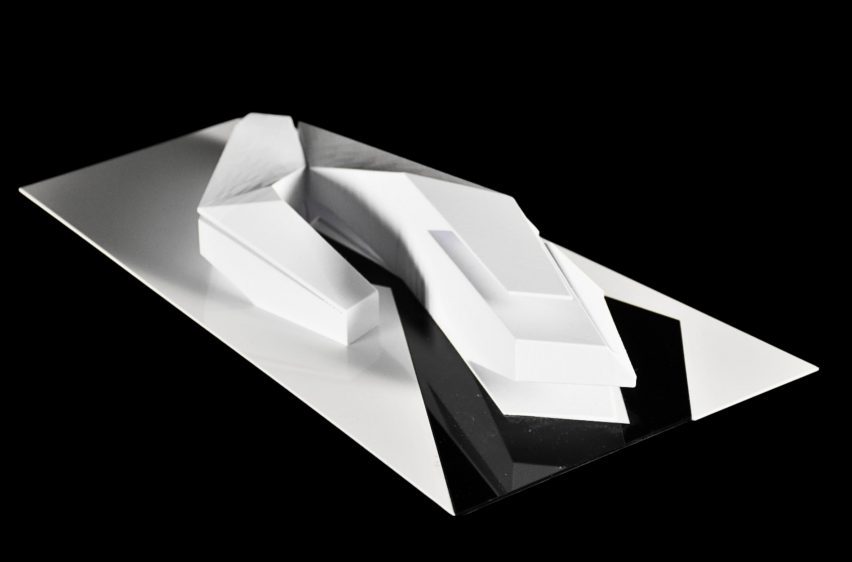
Cybercore – Sharp Edge of Sustainable Innovation by Sahar Sheikh
“The project explores the convergence of environmental performance and architectural expression, positioning sustainability as both a technical framework and a formal language.
“The project responds to site-specific conditions, solar trajectories and prevailing wind patterns through a composition of angular, faceted volumes that shape light, mitigate heat exposure and improve wind comfort across both building and pedestrian scales.
“The massing strategy is defined by a sequence of incisions and layered planes that generate self-shading facades, calibrated daylight penetration and opportunities for passive airflow, embedding climatic intelligence directly into the architectural form.
“This allows the building to operate efficiently within its environmental context while reinforcing its technological identity.
“Programmatic and public spaces are organised within a hybrid environmental system that combines passive design principles with active strategies, including on-site energy generation, ventilated envelope assemblies and thermally responsive material layers.
“The resulting architecture presents a forward-looking model in which innovation, performance and environmental responsibility are integrated into a cohesive and expressive sustainable framework.”
Student: Sahar Sheikh
Course: ARCH 302 Architectural Design Studio VI
Tutor: Nicolas Turchi
Email: sahar.sheikh[at]mymail.aud.edu
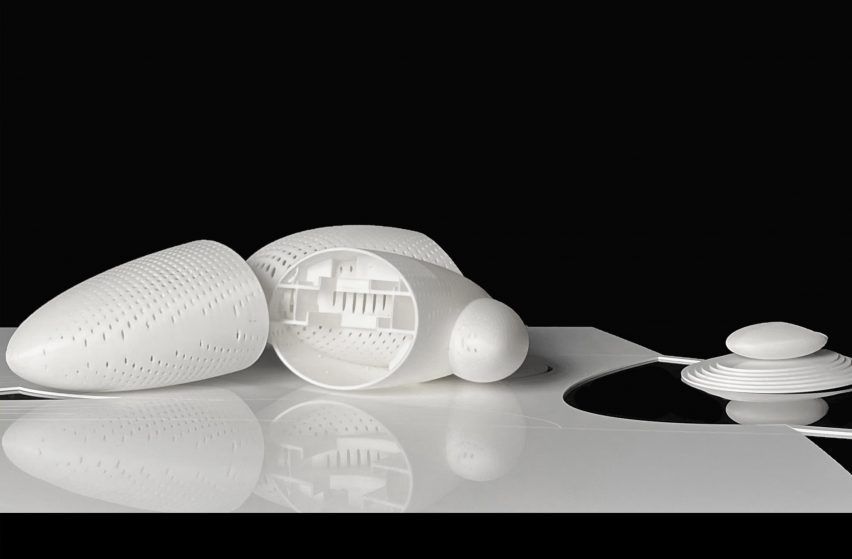
Sustainable Hub by Naya Sarraj
“The project originates from an exploration of sustainability through form, landscape and environmental performance, where architecture is shaped by natural forces rather than imposed upon them.
“Located along the waterfront, the design responds to prevailing wind patterns by shaping the massing so that wind velocity gradually decreases as it moves downward, improving pedestrian comfort and creating calmer microclimates at ground level.
“The architectural form is developed through layered, rounded volumes that deflect, slow and redirect wind flow while promoting self-shading and diffused daylight across interior and exterior spaces.
“The spatial organisation reinforces this strategy by positioning public zones and circulation paths within areas of reduced wind intensity, allowing natural ventilation without discomfort or turbulence.
“Together, these strategies form a holistic sustainable system in which wind behaviour, form and landscape work collectively to enhance environmental comfort, reduce energy demand and support a resilient waterfront architecture.”
Student: Naya Sarraj
Course: ARCH 302 Architectural Design Studio VI
Tutor: Nicolas Turchi
Email: naya.sarraj[at]mymail.aud.edu
Partnership content
This school show is a partnership between Dezeen and American University in Dubai. Find out more about Dezeen partnership content here.