
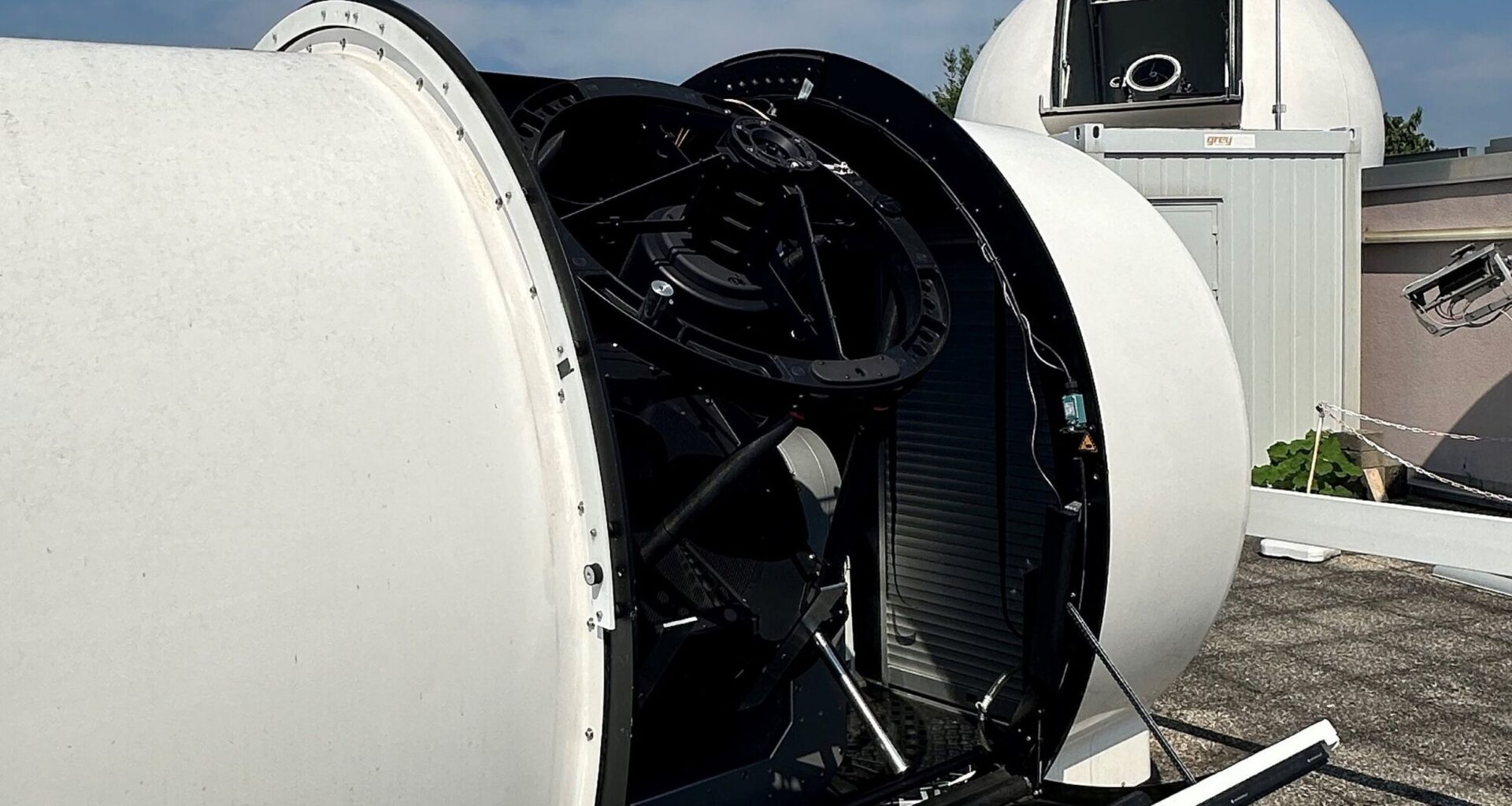
A single ground-based laser system has now measured distances to both cooperative satellites and uncooperative space debris at megahertz speeds for the first time.
That capability collapses a long-standing divide in space tracking, allowing precision science targets and collision threats to be monitored within the same observing window.
One system, two targets

At a hilltop observatory outside Graz, a mid-size city in southeastern Austria, the same laser pulses locked onto a retired research satellite. The system then returned usable distance signals from drifting debris.
The demonstration came from experiments led by Dr. Franz Steindorfer at the Institute of Space Research (IWF) within the Austrian Academy of Sciences (OeAW).
Engineers timed returns from multiple orbital objects without changing the setup.
Those observations showed that the system could preserve millimeter-level precision for satellites while still collecting diffuse reflections from bare debris surfaces.
That dual performance sets the stage for understanding why debris has remained harder to track and what limits still shape these measurements.
Limits of debris visibility
European Space Agency statistics list 14,200 working satellites and around 1.2 million debris pieces between 0.4 and four inches (one to ten centimeters).
Even a small fragment can punch through a spacecraft, and operators cannot dodge what they cannot locate precisely.
Debris rarely carries mirrors, so a ground laser catches only a smeared glow that blends into background light.
When a station swaps hardware to chase that weak reflection, it loses time that could refine another risky orbit.
Two lasers for two jobs
Most stations use satellite laser ranging, timing pulses to reflector-equipped satellites for precise distance checks.
Those satellites carry retroreflectors, corner mirrors that send the laser beam back toward the telescope.
To reach debris without mirrors, stations rely on stronger pulses that return fewer clean timestamps across the object.
Longer pulses blur each range, so debris distances often land within a few feet rather than millimeters.
One laser with many pulses
Steindorfer’s team brought in a megahertz laser, firing up to 1,000,000 pulses each second at high power.
Each pulse lasted about ten picoseconds – one trillionth of a second – so timing stayed sharp even with rapid firing.
High output made enough light bounce off bare metal, and the short pulse kept satellite returns crisp.
By changing repetition rate in software, the station moved between satellite and debris targets without swapping lasers or detectors.
Beating the atmosphere’s glare
At very high firing rates, air molecules create backscatter, stray reflections that can flood a sensitive photon detector.
In a one-telescope design, observers must pause the laser and wait, which cuts usable power about in half.
The observatory solved the issue by sending from one telescope and receiving with another about 33 feet (ten meters) away on the same site.
With the receiver outside the backscatter cone, the team kept full power and ran true megahertz tracking.
Extreme precision in orbit
During one pass, the system logged up to two million ranges in 15 seconds, pushing averages toward micrometers – one millionth of a meter.
Analysts compress those shots into a normal point, an average range used for orbit solutions and geodesy.
“With our system, we have succeeded in reducing the normal-point accuracy to just a few micrometers,” said Steindorfer.
Those tighter ranges help calibrate satellite altimeters and keep long-term sea level records from drifting over years.
Debris gets a shape
On uncooperative debris, the same timing stream split reflections from nearer panels and farther structures along the line of sight.
That depth pattern forms a target signature, a range profile shaped by the object’s surfaces and angles.
By tracking how those depths changed over time, analysts inferred rotation rates that affect how drag and sunlight nudge debris.
Better spin information helps removal missions, since tumbling debris is more difficult to capture and increases the risk of further fragmentation.
Expanding global coverage
More than 40 stations feed data into the International Laser Ranging Service (ILRS), but few also track debris.
A megahertz-capable upgrade would let many ILRS sites follow the approach tested at OeAW, while keeping routine satellite work.
When several stations range the same object, orbit analysts can cut uncertainty faster, especially after a break or fragmentation event.
That extra confidence reduces false alarms and keeps fuel-saving avoidance maneuvers reserved for passes that truly threaten working satellites.
Noise still sets limits
At the megahertz rate, the detector logged more background counts, especially when debris flashed bright sunlight into the receiver.
For weaker targets, dropping to 100 kHz improved signal-to-noise, the balance between real returns and random background photons.
That option lets observers tune the firing rate to the target, rather than forcing every object into one mode.
Even with tuning, tiny debris may still hide in noise, which keeps orbit improvements focused on higher-risk pieces.
New capabilities in orbit
The OeAW team showed that one station can range cooperative satellites and drifting debris, then share stronger orbits through ILRS.
More stations could adopt the same design, though the faintest debris will still demand better detectors and smarter filters.
The study is published in Nature.
Image credit: IWF/Steindorfer.
—–
Like what you read? Subscribe to our newsletter for engaging articles, exclusive content, and the latest updates.
Check us out on EarthSnap, a free app brought to you by Eric Ralls and Earth.com.
—–