
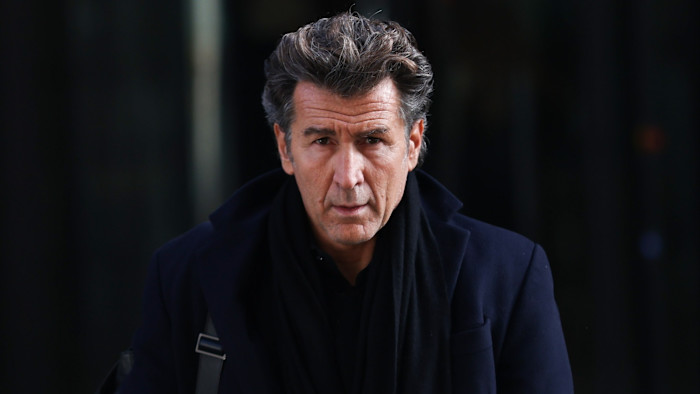
One thing to start: Canada’s second-largest pension fund said it would halt future deals with Dubai’s DP World following revelations of ties between the logistics company’s chief executive Sultan Ahmed bin Sulayem and sex offender Jeffrey Epstein.
Welcome to Due Diligence, your briefing on dealmaking, private equity and corporate finance. This article is an on-site version of the newsletter. Premium subscribers can sign up here to get the newsletter delivered every Tuesday to Friday. Standard subscribers can upgrade to Premium here, or explore all FT newsletters. Get in touch with us anytime: Due.Diligence@ft.com
In today’s newsletter:
AI fears hit data empires
Europe’s hottest VC deals
Santander’s latest US push
Is Andrea Pignataro the next Patrick Drahi?
Software groups have been the biggest losers in global markets this year, as investors fear new AI tools will upend the sector.
Highly levered software businesses, which aggressive sponsors bought with other people’s money, have been hit hardest by the sell-off.
Their lenders — concerned that AI’s disruption could leave them on the hook for steep losses — are dumping investments quickly, causing bond and loan prices around the world to plummet.
In Europe, one junk bond issuer has borne quite a bit of the pain. It’s owned by a secretive Italian bond maven billionaire whose fintech empire underpins vital parts of trading of shares, debt and derivatives across the globe.
Andrea Pignataro, a maths wiz turned Salomon Brothers bond trader, launched Ion Group in 1999 before embarking on a two-decade-long debt-fuelled acquisition spree that has turned him into one of Italy’s richest men.
But in recent weeks credit investors have been dumping bonds issued by Ion, a roll-up of financial data companies including Mergermarket, Fidessa and Dealogic, as AI fears have swept across markets.

It has not helped Pignataro that he’s drawing comparisons to fellow European junk debt royalty Patrick Drahi, owner of the heavily indebted telecoms group Altice. For its part Ion is more than eight times levered with a $13bn debt pile. About $2.5bn of Ion’s financing is made of private credit at its holding company.
Drahi, a Franco-Israeli billionaire, is known for using aggressive tactics against creditors when finances are stretched. It’s a playbook that much of Europe’s high-yield market believes Pignataro would be willing to deploy.
As investors have sold out of Ion its bond prices have crashed, meaning some of its debt now pays a yield of more than 10 per cent.
The investors that dumped Ion’s debt will be feeling lucky. Some of their counterparts — higher up in Ion’s capital structure and further afield — don’t have that luxury.
Meanwhile, the AI threat trade is spreading across Wall Street.
Among the losers are also listed private credit funds that have built a large concentration of software company bets.
Shares of Blue Owl Technology Finance Corp, which has more than half of its loan book exposed to software companies, according to Barclays, had fallen about 11 per cent from the beginning of the year as of noon on Monday.
Financial data groups FactSet, S&P Global, Morningstar and the London Stock Exchange Group have also fallen sharply this year, while ratings agency Moody’s plunged on Tuesday.
DD reckons that while many investors are surely feeling the pain, the stock plunges are also allowing PE investors to ready new investments given the industry’s hundreds of billions of dollars in so-called dry powder.
Europe’s haves and have-nots
For European AI and defence start-ups, venture capital funding is coming fast and furious.
Last year total European VC investment rose 5 per cent to €66bn, a post-pandemic high, according to PitchBook.
And several companies in those sectors are in talks to raise fresh funding at sharply higher valuations, the FT reports.
Among them are Swedish legal AI start-up Legora, which is in talks to raise funding at about a $4bn valuation, more than doubling its $1.8bn valuation reached last October, said people familiar with the matter.
In the defence tech sector, Munich-based satellite launcher Isar Aerospace, which is valued at $1bn, is discussing raising significant new funds.
While defence deals are rapidly on the rise, AI has been the main driver of activity.
AI-related deals last year accounted for more than 35 per cent of all European venture capital transactions, worth €23.5bn. That marked an increase from €17.7bn for such deals in 2024.
“The market has clearly decided that AI is the future,” said Matt Miller, the founder and managing partner of Evantic Capital. “Companies that are doing the playbook from 10 years ago are just not interesting.”
Defence and AI groups are benefitting from a push by European officials to increase their tech and security independence.
European start-ups focused on defence and related technologies had investment soar 55 per cent year on year to a record $8.7bn in 2025, according to the Nato Innovation Fund and research group Dealroom.
“The sovereignty tailwind is not to be underestimated,” said Siraj Khaliq, a senior adviser at the €1bn European deep-tech fund Kembara.
Santander’s bet on the US
Santander chair Ana Botín has capped off an M&A spree with what may be her most audacious acquisition yet.
Last week the Spanish bank announced its $12.2bn purchase of Webster Financial, which could make it a big retail player in the US and especially the north-east where Santander already has branches.
“If one is not in the United States, one cannot aspire to be a global bank,” Botín said.
The deal is the biggest acquisition of a US bank by a continental European lender and was reached after just nine weeks of formal discussions, the FT reports.
It will vault Santander, the most valuable bank in the EU, into the top-10 biggest retail and commercial banks by assets in the US.
Webster’s 5mn customers will allow Santander to more than double its existing 4.5mn customer base in the US.
Webster’s presence in US commercial banking was also a big attraction, Botín said. She has expanded Santander’s corporate and investment bank and the US is now the unit’s largest market, accounting for nearly a fifth of its revenues last year.
But investors, taken by surprise by the deal, weren’t enthused. Santander’s share price fell as much as 4 per cent after the announcement.
The US market has been tough for European entrants, with BNP Paribas, HSBC and BBVA all exiting retail banking in the country in recent years.
Now Botín’s focus will be on execution, as the chair has said she will not pursue further deals for at least three years.
Job moves
Apollo Global Management has hired Diego De Giorgi, Standard Chartered’s chief financial officer, as head of Emea. StanChart deputy chief financial officer Peter Burrill will replace De Giorgi while the bank searches for a successor.
The Ontario Municipal Employees Retirement System has parted ways with two top infrastructure executives, Alastair Hall, senior managing director for Europe, and Chris Hogg, a director who led the firm’s digital infrastructure investments.
Baker McKenzie has announced that Mark Hamer will rejoin as a partner after serving as deputy assistant attorney-general of the US Department of Justice antitrust division. Hamer was previously the firm’s global chair of antitrust and competition.
Latham & Watkins has hired Taj Clayton and Scott Thomas as partners in its complex commercial litigation practice in Texas. Clayton joins from Kirkland & Ellis and Thomas joins from Winston & Strawn.
Vitol’s long-serving chief financial officer Jeff Dellapina is retiring and will be replaced by its Asia finance chief Jay Ng.
Smart reads
Moonshot Space, with its abundant solar and natural frigidity, seems the perfect environment for energy guzzling and heat generating data centres, the FT reports. But is operating AI infrastructure from orbit actually an idea that Elon Musk can pull off?
Myth busted While mysteries swirl around Jeffrey Epstein’s finances, at least one has been solved by the release of masses of his communications, FT Alphaville writes. The deceased paedophile did not cause the Bear Stearns collapse.
Mystery intelligence Anthropic has an entire team dedicated to “interpretability”, The New Yorker reports. As in, figuring out how its AI chatbot Claude actually works.
News round-up
Paramount sweetens takeover offer for Warner Bros Discovery (FT)
Goldman Sachs CEO says Trump’s populist policies should aid growth (FT)
Daniel Ek and Peter Thiel-backed start-ups win German military drone contracts (FT)
McKinsey hands over control of controversial in-house asset manager (FT)
Ryanair signs multibillion-dollar deal to bring engine maintenance in-house (FT)
Barclays vows to return £15bn to shareholders after profit boost (FT)
Due Diligence is written by Arash Massoudi, Ivan Levingston, Ortenca Aliaj, Alexandra Heal and Robert Smith in London, James Fontanella-Khan, Sujeet Indap, Eric Platt, Antoine Gara, Amelia Pollard, Kaye Wiggins, Oliver Barnes, Tabby Kinder and Julia Rock in New York, George Hammond in San Francisco and Arjun Neil Alim in Hong Kong. Please send feedback to due.diligence@ft.com
Recommended newsletters for you
The AI Shift — John Burn-Murdoch and Sarah O’Connor dive into how AI is transforming the world of work. Sign up here
Unhedged — Robert Armstrong dissects the most important market trends and discusses how Wall Street’s best minds respond to them. Sign up here