
Key insights
Benzene was first discovered 200 years ago by Michael Faraday; it would become a cornerstone of organic chemistry by the mid-19th century.
Aromatic chemistry became a big commercial success even as benzene’s true structure remained elusive until 1929.
Understanding science history helps us understand current challenges that chemists face.
There are few molecules more iconic than benzene.
“It’s everyone’s favorite hexagon,” says Katy Duncan, a postdoctoral fellow in science history at the Royal Institution, where Michael Faraday first isolated benzene just over 200 years ago. In a 2025 essay for Chemistry World, science writer Philip Ball said benzene’s brand recognition rivals DNA’s.
Although benzene rings are found in nature—and in space—they’ve become inextricably tied to humans’ efforts to not just study the natural world but manipulate it on a molecular level.
“Somehow he battled against the oil gas and got benzene.”
Katy Duncan, Postdoctoral fellow, Royal Institution, on Michael Faraday’s isolation of benzene
The story of how benzene came to be everyone’s favorite hexagon is the story of how chemistry came into its own as a science over the course of the 19th century, against the backdrop of industry and imperialism. It’s also a story about the value of careful research, the importance of basic science, and whose contributions are remembered by history.
Celebrating benzene’s bicentennial is fun, but focusing too hard on a single discovery or person “effaces so much about how science is done and who is doing that science,” says science historian Catherine Jackson, who is currently writing a book about the history of the benzene ring. It’s important to look at these moments through a wider lens and be “a little bit more real about what it takes to do science.”
---329547.webp)
A black-and-white drawing shows Michael Faraday at work in his laboratory at the Royal Institution.
Michael Faraday made far-reaching contributions to chemistry and physics from his laboratory at the Royal Institution in London, which is now preserved as a museum.
Credit:
Alamy
The beginning of benzene
All things considered, the initial discovery of benzene was “not the most significant thing that Faraday did, [but] it has resonances with chemists” because of what followed, says James R. Voelkel, a historian and curator of rare books at the Science History Institute.
Faraday is best known for discovering electromagnetic induction, which would now be considered more physics than chemistry. But disciplinary boundaries were still largely in flux at the time, Voelkel says, because “there were just an exceptionally small number of people who did science as a profession.”
In the early 1800s, chemical research was still done by medical doctors or independently wealthy men, though it would become a laboratory-based academic discipline by the middle of the century, Jackson says.
Faraday was not independently wealthy; he spent 7 years as a bookbinder’s apprentice before landing a job at the Royal Institution in 1813, working for then-director Humphry Davy. Davy was an early pioneer of electrochemistry and was the first person to isolate sodium and potassium. Faraday became assistant superintendent in 1821 and took over as laboratory director in 1825, the same year he isolated benzene.
---350151.jpg)
A clear glass bottle holds a clear glass tube of clear liquid. The tube is capped on both ends with cork.
Michael Faraday’s sample of “bi-carburet of hydrogen,” which would later come to be known as benzene.
Credit:
Paul Wilkinson/Royal Institution
Benzene’s discovery came about thanks to an industry partnership. The Portable Gas Company asked Faraday to help identify an oily by-product from the production of lamplighting gas from whale and fish oil.
An exceptionally thorough experimentalist, Faraday used fractional distillation to separate the components of the oil. He ended up with a peculiar clear liquid that he called “bi-carburet of hydrogen” because he calculated that it was composed of carbon and hydrogen in a 2:1 ratio. Chemists’ understanding of atomic weights was still very much under construction back then, and the most popular model at the time gave carbon a relative weight of 6.
He managed to get the liquid more than 99% pure, which given the technological limitations of the era is a testament to just how good Faraday was at lab work, Duncan says. “He battled against the oil gas and got benzene.”
Faraday published his characterization of bi-carburet of hydrogen in June 1825 in the Philosophical Transactions of the Royal Society and moved on to other explorations. It was unlikely that anyone thought it was a significant discovery at the time, Voelkel says. But it would be only a couple of decades before that all changed, thanks to coal tar and a Victorian craze for purple fabric.
Dawn of the age of aromatics
By 1833, Faraday’s mystery liquid had a new name—benzene, from gum benzoin, a tree resin from Southeast Asia that was an early source of benzoic acid. As chemistry developed into an academic science, analyzing medicinal alkaloids and other natural substances was a major way for the field to demonstrate value, Jackson says. The other big driver of mid-19th-century chemistry was finding uses for coal tar. Benzene turned out to be important on both fronts, but especially the latter.
Chemists figured out how to get benzene from coal tar in 1845. Coal also yielded a bunch of other “aromatic” compounds—so named because they shared a similar odor. Industrial-scale production followed a few years later.
Aromatic chemistry’s big break came in 1856, when 18-year-old William Henry Perkin serendipitously invented the first synthetic dye, mauveine, while trying to make the antimalarial drug quinine from coal-derived aniline. The vivid purple pigment quickly became a commercial success, proving that organic chemistry could be high fashion and high tech. New chemical methods and new products quickly accumulated from there.
“A lot of very good chemists spent a lot of years of their life trying to make structure work for benzene.”
Catherine Jackson, science historian, University of Oxford
Faraday was retroactively dubbed the father of aromatic chemistry in 1862. Perkin’s former mentor August Wilhelm Hofmann pointed to Faraday’s “pure research” on benzene as a standard for Royal Institution chemists to strive for.
By the end of the 19th century, research in aromatics was thriving in academia and industry. Companies were busily turning coal tar into synthetic dyes and medicines such as aspirin. Chemists figured out the true molar masses of elements and were able to come up with accurate empirical formulas for organic compounds. A Swedish pharmacologist had already found evidence of benzene’s carcinogenicity.
But the molecule’s true structure remained a mystery.
Solving the structure
August Kekulé is often credited with figuring out benzene’s structure, the famous hexagon with alternating single and double bonds. As the story goes, Kekulé came up with that depiction of the molecule in 1865 after dreaming about a snake eating its tail. But in fact, people continued debating the structure for decades.
“A lot of very good chemists spent a lot of years of their life trying to make structure work for benzene,” Jackson says. Kekulé himself knew that the alternating-bond structure didn’t fully explain how benzene and its aromatic cousins behave in the lab. Yet German chemists coalesced on Kekulé’s idea as the best available theory in 1890 at a meeting in Berlin called Benzolfest.
That’s more or less how things remained until Irish crystallographer Kathleen Lonsdale solved the crystal structure of hexamethylbenzene in 1928. It’s thanks to Lonsdale that we know the molecule’s central ring is a flat hexagon with equal-length sides.
---329548.webp)
Kathleen Lonsdale holds a ball-and-stick model of an organic molecule.
Crystallographer Kathleen Lonsdale solved the structure of the benzene ring in 1928, more than a century after the molecule was first isolated.
Credit:
Pictorial Press/Alamy
Lonsdale had studied under William Henry Bragg at the Royal Institution and had moved to the University of Leeds in 1927, where she completed her work on hexamethylbenzene. Her work gave chemists a better understanding of molecular structure and electron delocalization.
“She had such deep understanding of X-ray crystallographic techniques” and the underlying math, Duncan says. And she directly paved the way for future crystallography discoveries including Dorothy Crowfoot Hodgkin’s solution of the structures of penicillin and vitamin B12 in the 1940s.
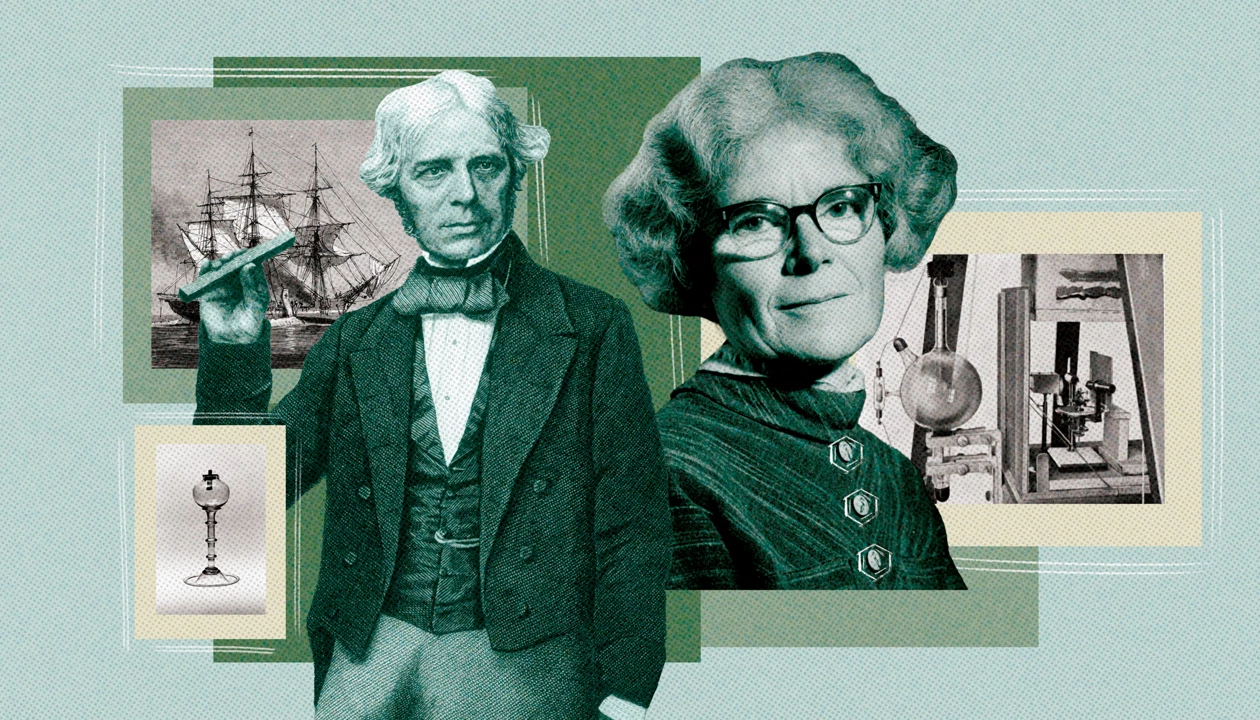
In a way, Faraday and Lonsdale are a neat set of bookends for benzene’s origin story: both talented experimental scientists working at the intersection of chemistry and physics, both connected to the same institution, albeit a century apart. One largely remembered by history, the other not.
History often falls by the wayside in modern science education, Jackson says. But she believes we lose something important when we de-emphasize understanding how a subject came to be. History helps us understand how we know what we know, and ultimately “the place of science in the world,” she says. Especially given that “the place of chemistry in the world is very problematic in many ways” nowadays, it’s useful to know how we got here.
Benzene is a great case study for understanding chemistry’s place in the world: it’s “a wonderful tool that’s helped chemists generate ideas in lots of different ways,” Duncan says. Scientists have used it to make fundamental discoveries, develop lifesaving medicines, and create novel materials that have transformed people’s quality of life. But it’s also important to acknowledge this iconic ring’s dark side: its toxicity, its entanglement with the fossil fuel industry, and its presence in environmental pollutants.
To solve today’s scientific problems, we need chemists who understand where those problems came from and how past scientists approached big problems, Jackson says. And anniversaries provide a great opportunity to reflect on exactly that.

Chemical & Engineering News
ISSN 0009-2347
Copyright ©
2026 American Chemical Society