
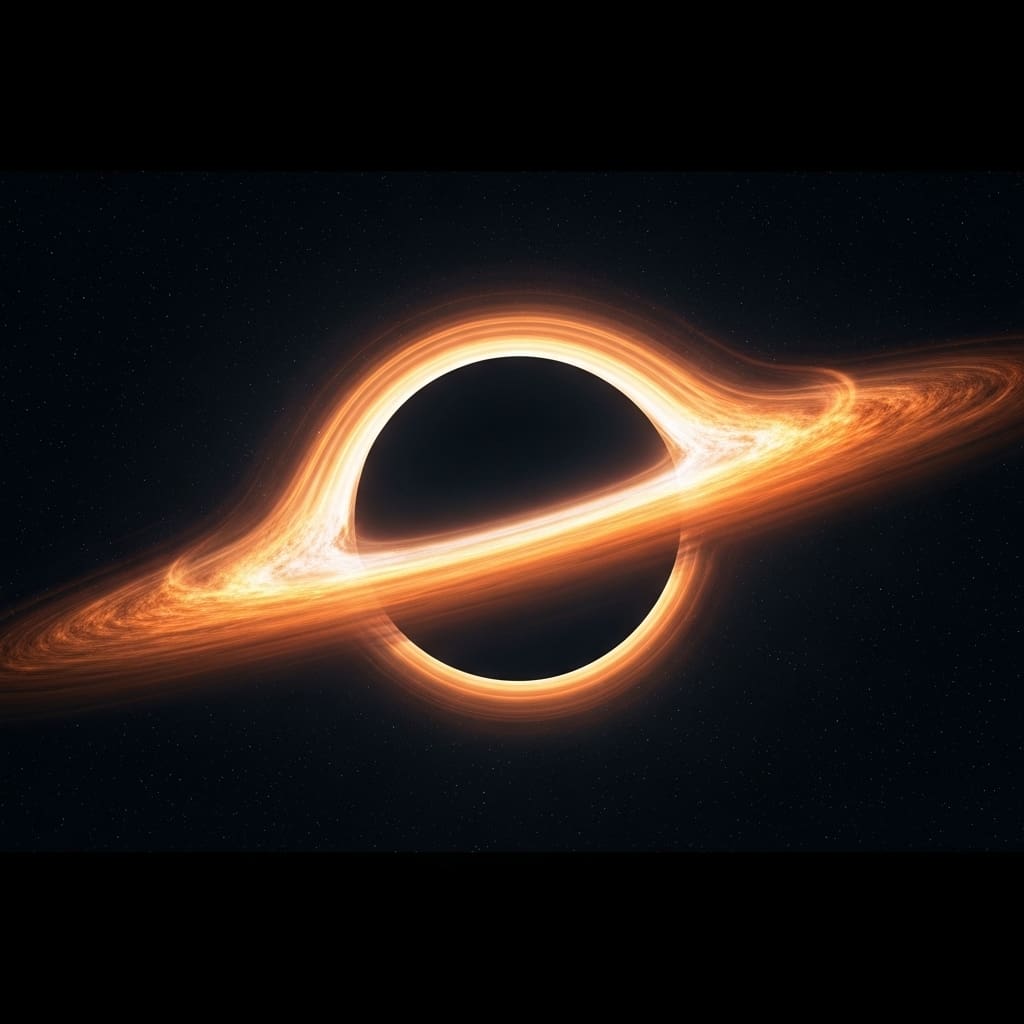
Researchers are increasingly focused on understanding the complex dynamics of material surrounding black holes. Pablo Ruales from Wake Forest University, Delilah E. A. Gates from the Center for Astrophysics | Harvard & Smithsonian, and Alejandro Cárdenas-Avendaño from Wake Forest University et al. present a new framework for simulating polarized emission from hotspots spiralling into Kerr black holes. This work is significant because it moves beyond standard models assuming fixed orbits, instead exploring inspiralling trajectories and their unique observational signatures. The team demonstrate that such motion generates a distinctive precessing pattern in polarized light, differing from the closed loops expected from stable orbits, and offering a novel method to investigate both accretion physics and the spacetime around these enigmatic objects.
Current models explaining multiwavelength flares observed in Sgr A* commonly assume hotspots orbiting on geodesic, Keplerian trajectories. However, these hotspots may instead follow an inspiraling path, potentially culminating in a plunge toward the black hole.
This work introduces a general framework to simulate polarized emission from generic equatorial inspiraling hotspots in Kerr spacetime, utilising a parametric four-velocity profile. This parametrization defines a continuous range of flows, extending from Cunningham’s disk model, encompassing fixed radius orbits outside the innermost stable circular orbit and plunging motion within it, to purely radial motion, thereby broadening the scope of standard assumptions.
Within this framework, inspiral motion generates a distinctive observational signature: a precessing, unwinding evolution of the polarimetric Stokes Q, U looping pattern. This contrasts sharply with the closed Q, U loops typically associated with stable orbits at a fixed radius. Researchers then investigated how the morphology of these signatures is influenced by black hole spin, observer inclination, and magnetic-field configuration.
The resulting model is applicable to current and forthcoming interferometric observations of linear polarization, offering a novel approach to probe the physics of spiraling matter and the relativistic velocities of plunging plasma. The landmark images of M87 and Sgr A* produced by the Event Horizon Telescope collaboration have revealed a rich phenomenology in the strong-gravity regime that requires further characterisation.
In these extreme environments, matter within the inner accretion flow is accelerated to relativistic velocities, leading to complex interactions and the occurrence of flares. These flares are often interpreted as localized, over-dense regions, or “hotspots”, emitting intensely against the background flow, potentially originating from magnetic flux tubes, plasmoids generated by magnetic reconnection, or even tidal stripping of orbiting substellar objects.
For Sgr A*, such events have been observed across millimeter, infrared, and X-ray wavelengths. Because directly resolving the coupled plasma physics and general relativistic effects governing these processes is exceptionally challenging, linear polarization provides a powerful diagnostic tool that probes both magnetic-field structure and spacetime geometry.
Unlike total intensity, which is a scalar quantity, polarization carries vector information, allowing the electric vector position angle observed at infinity to be used to study dynamics. This angle is directly related to the magnetic-field orientation in the emitting material’s rest frame and the geometry of spacetime, highlighting the importance of characterising how polarimetric signatures are influenced by magnetic-field geometry and strong gravity.
The Stokes parameters Q and U describe the polarized intensity on the observer’s screen and are directly related to the electric vector position angle and the total polarized intensity. Observed signal flux is modulated by a redshift factor accounting for Doppler boosting and gravitational redshift. Millimeter and near-infrared light curves of Sgr A* exhibit loops in the Stokes parameters, known as Q, U loops, with morphology resembling a limaçon-like curve or, in some cases, highly elongated trajectories lacking a prominent inner loop.
Modelling Polarized Emission from Inspiralling Hotspots in Kerr Spacetime
Polarimetric interferometry serves as a powerful technique for investigating both black hole accretion physics and the surrounding spacetime. This work presents a general framework to simulate polarized emission from equatorial inspiraling hotspots within Kerr spacetime, utilising a parametric four-velocity profile to define a continuous family of flows.
This parametrization extends standard assumptions by ranging from Cunningham’s disk model, encompassing fixed radius orbits and plunging motion inside the innermost stable circular orbit, to purely radial motion. The core of the methodology involves connecting the local astrophysical description of the disk to the global Kerr black hole background through the application of tetrads, orthonormal basis vectors defining a local coordinate transformation and specifying the frame of a moving object with four-velocity u.
Specifically, the research establishes a mathematical relationship between the coordinate Kerr frame and a local Lorentz frame using equations ensuring special relativity holds at each spacetime point. Covariant and contravariant tetrads are defined to facilitate the transformation of tensor components between these frames, enabling the projection of fields and particle motion.
The construction of the fluid frame, an orthonormal frame of the emitting material, is achieved by relating it to a zero-angular-momentum observer (ZAMO) frame, as illustrated in a detailed diagram outlining the analytical steps. This intermediate ZAMO frame provides a consistent method for projecting quantities defined in the fluid frame into the Kerr frame.
The ZAMO frame’s tetrads are explicitly defined using the Kerr metric functions, Δ, Σ, and A, in Boyer, Lindquist coordinates, minimising frame-dragging effects and allowing observers to effectively co-rotate with the geometry. This meticulous frame transformation is crucial for accurately modelling the observed polarization signatures. The study demonstrates that inspiral motion generates a distinctive observational signature: a precessing, unwinding evolution of the polarimetric Stokes -U looping pattern, contrasting with the closed -U loops associated with stable orbits at a fixed radius, and this is made possible by the precise geometric calculations performed within the established framework.
Polarimetric signatures differentiate inspiralling hotspots from stable orbits around Kerr black holes
Simulations demonstrate that inspiral motion generates a distinctive observational signature: a precessing, unwinding evolution of the polarimetric Stokes -U looping pattern. This contrasts with the closed -U loops typically associated with stable orbits at a fixed radius. The research establishes a general framework to simulate polarized emission from generic equatorial inspiraling hotspots within Kerr spacetime, utilising a parametric four-velocity profile.
This parametrization encompasses a continuous range of flows, extending from Cunningham’s disk model to purely radial motion. The detailed morphology and timescales of these signatures depend on black hole spin, observer inclination, and magnetic-field configuration. The model accommodates a wide range of magnetic-field prescriptions, ultimately relying on the source four-velocity and the specific inspiral profile of the emitting region.
Computing the Q, U loops requires an astrophysical model for emission and motion, alongside the background Kerr spacetime geometry. The overall procedure involves projecting photon momentum into the fluid frame and transforming synchrotron polarization back to the background. The study constructs orthonormal tetrads to connect the radiating source’s local description to the global Kerr background.
These tetrads are defined by relationships ensuring adherence to special relativity at each spacetime point. Covariant vectors are transformed between the Kerr frame and the local orthonormal frame using specific equations. The fluid frame, or local frame of the emitting material, is constructed by relating it to the zero-angular-momentum observer (ZAMO) frame.
The ZAMO frame is defined by tetrads that minimise frame-dragging effects, providing a locally flat, orthonormal basis. The angular velocity of these observers is determined by frame dragging in the rotating spacetime. The calculations utilise geometric units where G= 1 = c. The presented model offers a new avenue to probe the physics of matter spiraling inward and the relativistic velocities of plunging plasma, applicable to current and near-future interferometric observations of linear polarization.
Detecting inspiral dynamics via precessing Stokes U loops
Polarimetric interferometry offers a means of investigating both black hole accretion physics and the surrounding spacetime. This work presents a general framework for simulating polarized emission from hotspots spiraling into a Kerr black hole, employing a parametric four-velocity profile that extends beyond standard assumptions of fixed radius orbits.
The model demonstrates that inspiral motion generates a distinctive observational signature, a precessing, unwinding evolution of the Stokes -U looping pattern, distinguishing it from the closed loops expected from stable, fixed-radius orbits. The simulations explore the influence of black hole spin, observer inclination, and magnetic field configuration on the observed polarization patterns.
This approach provides a novel method for probing the dynamics of matter as it spirals inward and the relativistic velocities of plasma plunging towards the black hole. The framework is sufficiently flexible to accommodate a variety of magnetic field configurations, though detailed morphology and timescales are ultimately determined by the specific inspiral profile of the emitting region.
A limitation acknowledged by the researchers is the dependence of detailed results on the source four-velocity and the chosen inspiral profile. Future research will likely focus on refining the four-velocity parametrization and applying the model to specific astrophysical scenarios, potentially incorporating more complex emission physics. These findings offer a new avenue for interpreting current and forthcoming interferometric observations of linear polarization, thereby enhancing understanding of black hole accretion processes and the spacetime in their vicinity.