
For millions of years, the vast and mysterious North Pacific Ocean has hidden secrets about how marine life migrated across its waters. Recent discoveries have unveiled the incredible journeys of cold-water species that once traveled between the distant coasts of Asia and North America. These revelations, based on fossilized crustaceans found in ancient sediments, challenge what we thought we knew about ancient ocean currents. The findings, published in the Journal of Paleontology, shed light on long-forgotten ocean routes and reveal a dynamic world where migration patterns were far more complex than we imagined.
Unveiling Ancient Marine Routes
The discovery of fossilized crustaceans in marine sediments from the Takikawa Formation in Japan has provided a unique glimpse into the ancient connections between Asia and North America. These fossils, preserved in cold, deep-sea sediments, are key to understanding how cold-water species navigated the vast expanses of the North Pacific millions of years ago. Researchers at Kumamoto University, who conducted the study published in Journal of Paleontology, found that the fossils of tiny crustaceans,primarily ostracodes, demonstrated that these organisms once traveled long distances along cold-water routes that linked the shores of Asia and North America.
What makes this discovery so important is that it sheds light on how these marine species adapted to shifting climates during the Early Pliocene, a time when global temperatures were higher but northern ocean currents still provided a connection between distant coasts. These findings challenge the traditional view that ocean currents and marine ecosystems remained relatively stable, offering new evidence that ancient oceans were far more dynamic than previously believed. As Tanaka, one of the study’s lead researchers, puts it,
“Our findings indicate that ocean circulation patterns in the North Pacific were more dynamic than previously thought.”
This statement underscores the complexity of ancient ocean currents and how they influenced marine life in ways we are only beginning to understand.
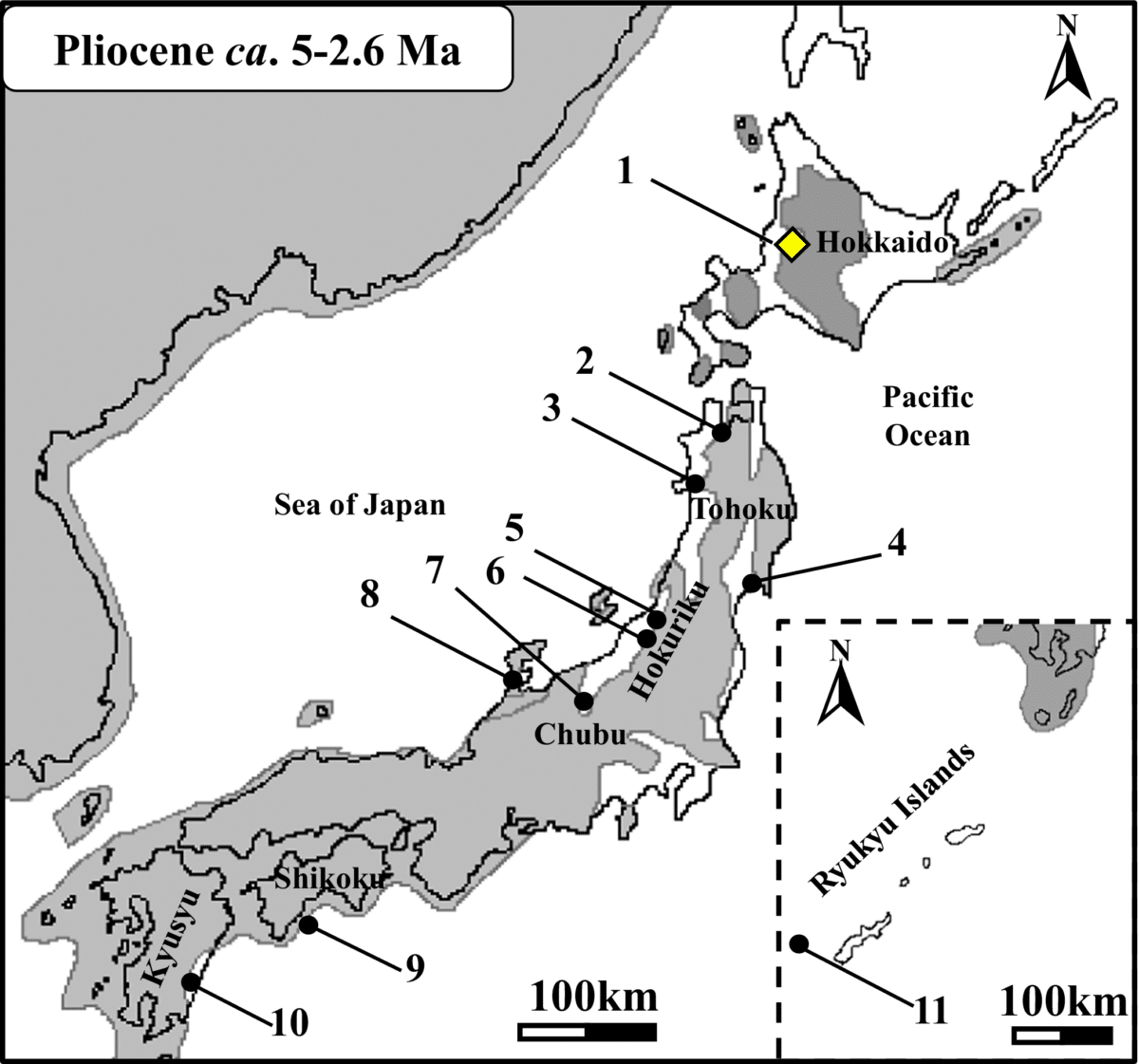 Paleogeographical map of the Japanese Islands during the Pliocene (ca. 5–2.6 Ma). 1, Takikawa Formation (this study; Mukai and Tanaka, Reference Mukai and Tanaka2024); 2, Daishaka Formation (Tabuki, Reference Tabuki1986); 3, Sasaoka Formation (Ishizaki and Matoda, Reference Ishizaki, Matoda and Ikeya1985; Irizuki, Reference Irizuki1989; Yamada et al., Reference Yamada, Irizuki and Tanaka2002; Yamada, Reference Yamada2003; Irizuki and Ishida, Reference Irizuki and Ishida2007); 4, Tatsunokuchi Formation (Ishizaki, Reference Ishizaki1966; Tanaka, Reference Tanaka2009); 5, Kuwae Formation (Shoji et al., Reference Shoji, Irizuki, Yamada and Tanaka2003; Yamada, Reference Yamada2003; Yamada et al., Reference Yamada, Tanaka and Irizuki2005; Irizuki and Ishida, Reference Irizuki and Ishida2007; Irizuki et al., Reference Irizuki, Kusumoto, Ishida and Tanaka2007); 6, Yabuta Formation (Cronin et al., Reference Cronin, Kitamura, Ikeya, Watanabe and Kamiya1994); 7, Ogikubo Formation (Ozawa et al., Reference Ozawa, Nagamori and Tanabe2008); 8, Omma Formation (Cronin and Ikeya, Reference Cronin and Ikeya1987; Ikeya and Cronin, Reference Ikeya and Cronin1993; Ishizaki et al., Reference Ishizaki, Irizuki, Sasaki, McKenzie and Jones1993; Ozawa, Reference Ozawa1996; Ozawa and Kamiya, Reference Ozawa and Kamiya2001, Reference Ozawa and Kamiya2005); 9, Ananai Formation (Ishizaki, Reference Ishizaki1983); 10, Sadowara Formation (Iwatani and Irizuki, Reference Iwatani and Irizuki2008); Takanabe Formation (Iwatani and Irizuki, Reference Iwatani and Irizuki2008; Iwatani et al., Reference Iwatani, Irizuki and Goto2011); Ikime Formation (Yano and Iwatani, Reference Yano and Iwatani2023); 11, Shimajiri Group (Tanaka and Nomura, Reference Tanaka and Nomura2009).
The Role of Ostracodes in Tracking Ancient Currents
Ostracodes, tiny crustaceans with two hinged shells, have long been prized by paleontologists for their ability to fossilize easily in marine sediments. These fossils serve as important indicators of past ocean conditions, offering clues about the temperature, depth, and salinity of ancient waters. The study of ostracode fossils has revealed that the species found in Japan’s Takikawa Formation were uniquely suited to cold, deep-sea environments. The diversity of these fossils suggests that these creatures not only survived in cold waters but actively thrived in a specific ecological niche that was shaped by ocean circulation.
By comparing the shells and internal structures of the fossils, the researchers were able to trace the lineage of the ostracodes found in Japan to other fossils discovered in Alaska, indicating that there was once a direct connection between these regions. This finding points to the possibility that ancient ocean currents allowed marine life to travel between distant coasts, much like modern currents do today. The researchers even identified a new genus of ostracodes, Woodeltia, based on the unique characteristics of the fossils. This discovery highlights the significance of the study, as it provides not only new species but also new insights into how ocean currents functioned in the ancient world.
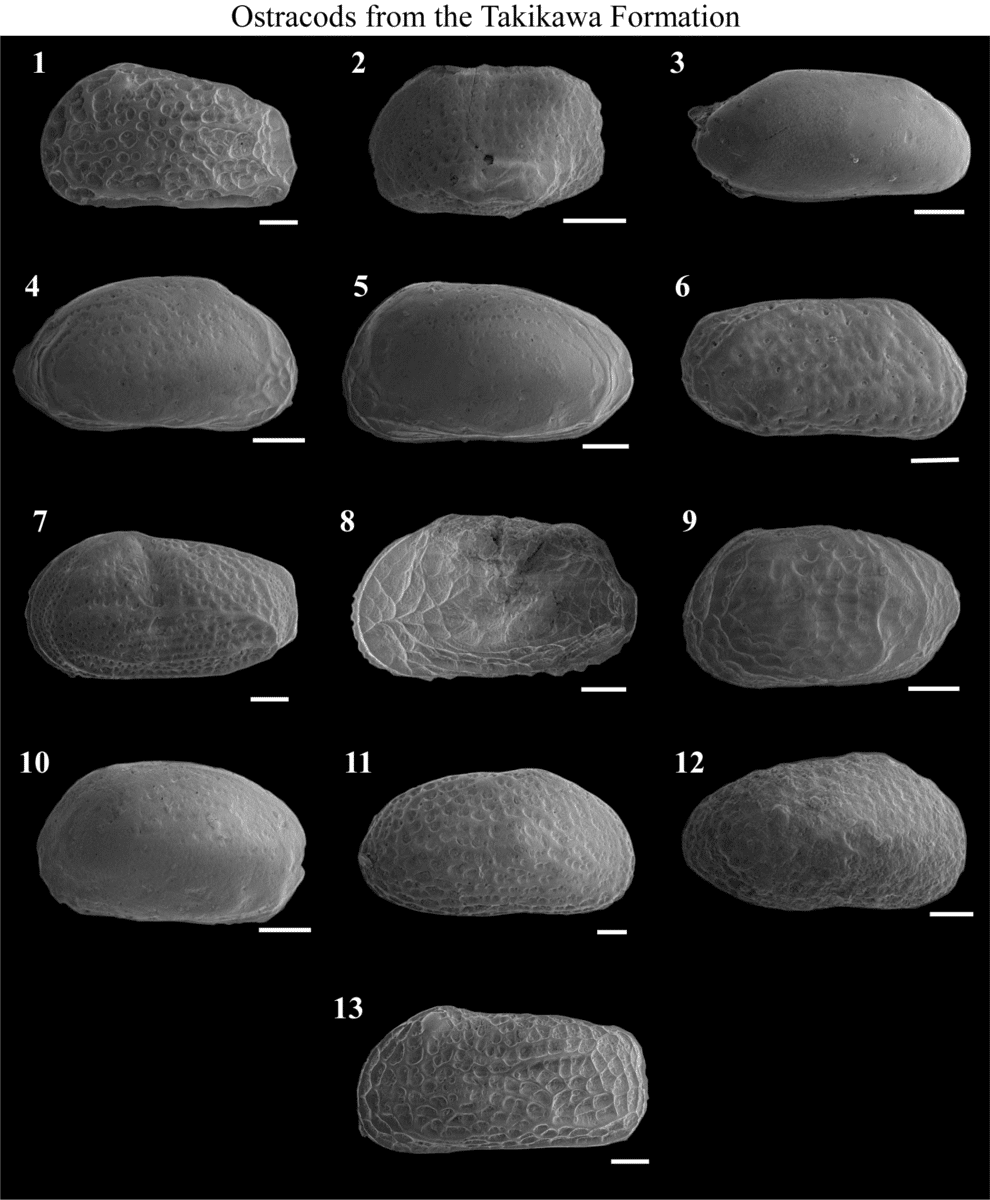 SEM images of fossil ostracodes from the Takikawa Formation. (1) Baffinicythere robusticostata Irizuki, Reference Irizuki1996, male LV, from USr-01. (2) Bythoceratina sp. female LV, from USr-01. (3) Cytherois sp. male RV, from LSr-01. (4) Howeina sp. A. Schornikov and Zenina, Reference Schornikov and Zenina2014, male LV, from USr-01. (5) Howeina sp. A. Schornikov and Zenina, Reference Schornikov and Zenina2014, female, LV, from USr-01. (6) Kotoracythere tatsunokuchiensis Ishizaki, Reference Ishizaki1966, male RV, from LSr-03. (7) Neomonoceratina tsurugasakensis (Tabuki, Reference Tabuki1986), male LV, from USr-01. (8) Palmenella limicola (Norman, Reference Norman1867, female LV, from USr-01. (9) Semicytherura mainensis (Hazel and Valentine, Reference Hazel and Valentine1969), female RV, from USr-01. (10) Semicytherura? sp. female LV, from LSr-03. (11) Woodeltia sorapuchiensis Mukai and Tanaka n. gen. n. sp. male RV, from LSr-03. (12) Woodeltia sp. male RV, from USr-01. (13) Yezocythere hayashii Hanai and Ikeya, Reference Hanai and Ikeya1991, male LV, from LSr-03. LV = left valve; RV = right valve. Scale bars = 100 μm.
New Insights into Ancient Ocean Circulation
The study, published in the Journal of Paleontology, has major implications for our understanding of ancient ocean circulation patterns. While previous research has suggested that the North Pacific was isolated during certain periods, this study challenges that assumption by providing evidence that cold-water species could have traveled across the ocean, facilitated by ancient ocean currents. By documenting these ancient pathways, scientists are able to reconstruct the dynamic nature of ocean currents during the Early Pliocene.
Tanaka and his team suggest that these cold-water species didn’t just survive in isolated pockets; instead, they likely migrated across the North Pacific, moving in response to shifting ocean conditions. The findings demonstrate that the marine ecosystems of the past were not static, but were instead shaped by changing ocean currents and climate conditions. “Our findings indicate that ocean circulation patterns in the North Pacific were more dynamic than previously thought,” Tanaka notes, reinforcing the idea that ocean systems have always been more fluid and interconnected than we might have imagined.
How Fossilized Crustaceans Help Us Understand Climate Change
The fossilized crustaceans found in Japan’s Takikawa Formation offer a critical window into the climate and environmental conditions of the Early Pliocene. During this time, Earth’s temperatures were warmer than they are today, but still within a range that would allow for significant shifts in ocean circulation. This warmer period, combined with the presence of cold-water species, provides researchers with a unique opportunity to study how marine life adapted to climate change and how it might respond to similar shifts in the future.
The fossils in this study suggest that these ancient marine species were able to survive in cooler, deeper waters while still benefiting from the larger ocean currents that connected distant coasts. By studying the adaptations of these species, scientists can learn more about the resilience of marine ecosystems and the ways in which they respond to environmental stresses. The study of these fossils thus serves as a valuable tool for understanding how modern oceans, which are currently experiencing significant changes due to climate change, might behave in the future.