
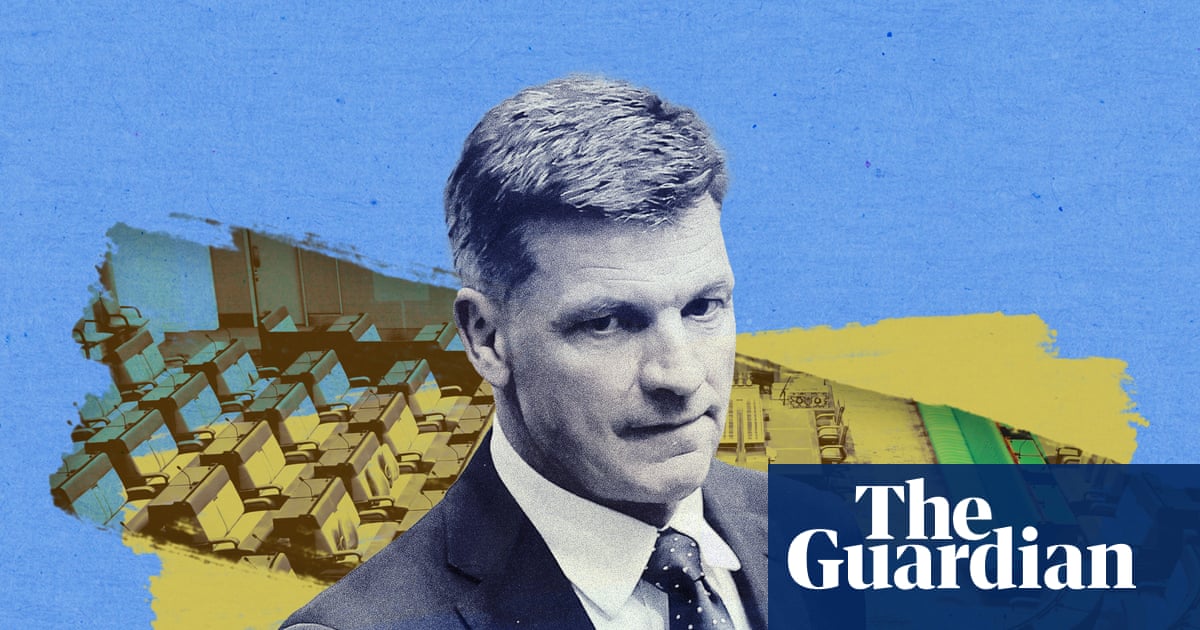
Even before he entered federal parliament in 2013, Angus Taylor was touted as a future leader of the Liberal party, and a future prime minister.
“Smart, rich and handsome,” one headline dubbed the incoming member for Hume. A Rhodes scholar, management consultant and scion of one of the New South Wales Monaro region’s founding families, Taylor was described as having a CV almost “too good to be true”. One enthusiastic journalist even suggested he had “the looks and the charm of a young Kennedy”.
Announcing a run to replace Sussan Ley as opposition leader on Thursday, it could fall to Taylor to restore the down and out Liberal party.
Having quit the frontbench to bring on the spill and end Ley’s nine-month tenure as opposition leader, Taylor promised strong and decisive leadership “that gives Australians clarity, courage and confidence”.
It took Taylor weeks to cobble together the numbers to topple Ley, who had beaten him for the leadership by a handful of votes after last year’s federal election. At the end of January, Taylor was photographed attending talks in Melbourne with his potential rival and fellow conservative Liberal Andrew Hastie, who subsequently conceded he did not have enough support to take on Ley.
But Taylor’s critics – including many of his colleagues – doubt he can revive the ailing party, pointing to his limited policy achievements and a record of scandal and controversy.
“Sure Angus is presentable, a great CV. But does he have the rhetorical skills to persuade people, the interpersonal skills to build coalitions and pick out good ideas and notice people’s anxieties, or the strategic vision to get a team of people all pointed in the right direction working together?” one Liberal insider said.
“The last 13 years are not encouraging on any of those fronts.”
Best and brightest
Now 59 and a father-of-four, Taylor traces his roots in Australia back to the 19th century, when his ancestors left Yorkshire to settle at Taylor’s Hill, now Mount Taylor, barely 10km from where Parliament House now stands. His grandfather, the engineer Sir William Hudson, was a driving force behind the Snowy Mountains hydroelectricity scheme.
Taylor was born in Cooma and raised near the tiny NSW township of Nimmitabel. His mother, Anne, died from cancer in her late 40s, leaving her husband, Peter, to raise four boys while running a farm and holding leadership positions in the NSW agriculture sector.
Boarding at The King’s school in Sydney, Taylor quickly showed himself to be a gifted athlete and student. Taylor threw himself into study, helping him win a Rhodes scholarship. He attended Oxford, rowing for New College, and wrote a thesis about the economics of beer pricing, amid the Thatcher government’s moves to force British brewers to sell their pubs.
Sign up: AU Breaking News email
Taylor first attracted the attention of Liberal party grandees working as a management consultant at McKinsey and Company and later Port Jackson Partners. A data nerd, he convinced rival factions in New Zealand’s dairy industry to form the successful cooperative business Fonterra and later advised the Victorian government on gas projects.
The former Liberal prime minister John Howard championed Taylor for preselection after the pair met at a charity event during the Rudd-Gillard years. With the support of the then leader Tony Abbott, Taylor moved his family from Sydney to Goulburn in 2011, part of a plan to run for the NSW rural seat of Hume, set to be vacated by retiring MP Alby Schultz ahead of the 2013 election. The Liberals and Nationals eventually agreed to give Taylor a clear run in the seat. Taylor’s wife, the accomplished Sydney barrister Louise Clegg, was a key organiser in the race.
The then energy and emissions reduction minister in the press gallery of Parliament House in 2021. Photograph: Mike Bowers/The Guardian
Once in parliament, Taylor rose steadily up the ranks. He was appointed to the junior ministry under Malcolm Turnbull, and later became minister for law enforcement and cybersecurity. He backed Peter Dutton in the messy 2018 spill that removed Turnbull but delivered the leadership to Scott Morrison, before joining Morrison’s cabinet as minister for energy and industry. Helpfully back in Canberra this week, Turnbull declined to endorse Taylor’s leadership potential, but noted he had previously been a passionate advocate for an economy-wide price on carbon, a position Turnbull said had been replaced by “unhinged views”.
Liberals asked about Taylor’s ministerial experience are blunt in their assessments. “What is his record of achievement?” one said this week, noting Taylor’s role in blowing up Turnbull’s National Energy Guarantee plan. Others described him as a failure in the energy portfolio.
Before the last election, Taylor was Dutton’s shadow treasurer. The pair clashed ahead of the May 2025 poll, and colleagues were scathing of Taylor for a lack of economic policy work, speaking to journalists about campaign failures even before the campaign was over. Taylor played down differences with Dutton, even as some blamed him for the Coalition’s inability to criticise Labor over the economy.
He took the defence portfolio after losing to Ley in the leadership vote in May by 29 votes to 25. Ley’s tally included support from two outgoing senators and Gisele Kapterian, the Liberal candidate who ultimately failed to win the Sydney seat of Bradfield when a full recount left her 26 votes short a month after polling day.
A series of controversies
Taylor has been the subject of intense scrutiny more than a few times since entering frontline politics.
In 2019 it emerged that the then agriculture minister, Barnaby Joyce, had bought water rights worth nearly $80m from Eastern Australia Agriculture, the cotton company Taylor helped set up in 2007. The deal benefited a group of investors including a rowing friend of Taylor’s from Oxford. The government faced criticism about the high price paid for the rights, while Taylor said he and his family did not benefit because he had ceased to be a director of the firm’s Cayman Islands-based parent company years earlier.
The then shadow treasurer at a press conference in 2023. Photograph: Bianca de Marchi/AAP
Taylor’s investments again proved controversial over the alleged illegal clearing of native grasslands in 2016 by a company, Jam Land, in which Taylor has a shareholding.
Shortly after Jam Land was investigated for allegedly poisoning the critically endangered habitat, Taylor asked for and received briefings from the federal environment department.
He insisted to Guardian Australia that the briefings were confined to the general issue of the grasslands listing, and not related to Jam Land’s own interests. Taylor said he had never made representations on the compliance action against the company.
In late 2019, Taylor was forced to apologise to Sydney’s lord mayor, Clover Moore, after he relied on falsified figures to launch a public attack on the council’s climate record.
Taylor had accused Moore of driving up carbon emissions by spending $15m on international travel, a claim he attempted to back up with a doctored council document provided to Sydney’s Daily Telegraph. When Moore disputed the figures, the newspaper said the documents came from Taylor’s office. The council had actually spent less than $230,000 on travel that financial year.
The revelations prompted Labor to refer the matter to NSW police, asking for an investigation of whether a forgery had been created to influence the mayor in her public duties. Taylor provided a statement to investigators and responded to written questions. The investigation was later dropped, when police said they could find no evidence the document had been downloaded from the council website. Taylor’s office argued this countered claims the document had been falsified, as this would have required it to be downloaded.
One of Taylor’s strangest controversies involved a story about American author Naomi Wolf. Discussing political correctness in his maiden speech, Taylor recalled a dispute among graduate students over a Christmas tree at Oxford in 1991, mentioning that Wolf lived on the same corridor, and giving the impression to some that she had been opposed to a Christmas tree in the student common room because some students might be offended.
After a section of the speech was shared online in 2019, Wolf said she was not at Oxford at the same time as Taylor, insisting said she “loves Christmas” and accused Taylor of antisemitic dog-whistling. Taylor’s spokesperson said he never stated Wolf was one of the graduate students opposed to the tree and rejected any assertion he is antisemitic.
Taylor was the subject of more unwelcome media attention in the same year, albeit of a less serious kind, when his official Facebook page commented on its own post about funding for rail car parks in the now famous and endlessly recycled words: “Fantastic. Great move. Well done Angus.”
‘Obsessed’ with family corgis
Friends of Taylor insist he did not undermine Ley during her troubled and brief tenure as the country’s first female leader of the opposition. They describe him as a patient and considerate colleague, rejecting public perceptions about a born-to-rule attitude or arrogance.
Others are not so kind.
“The problem with Angus is that he does not actually do anything. Angus expects everything to be done for him,” one colleague said.
Taylor is described as a loyal boss, eager to promote women and passionate about his two sons and two daughters. He is part of a regular Saturday morning cycling group and competes in triathlons and running events. Friends say he is “obsessed” with the family’s two corgis, Frankie and Violet. He is known to speak regularly to a small number of journalists, including the 7.30 host, Sarah Ferguson.
Taylor has taken up the mantle of Tony Abbott’s annual Pollie Pedal fundraiser, reflecting his close friendship and ideological ties with the former leader. Taylor and Abbott are leading figures in the conservative wing of the NSW Liberal division, along with key allies including the state MP Anthony Roberts. Abbott is also close to Andrew Hastie, complicating the lead-up to the leadership spill. Internally, Taylor’s close supporters include conservatives Tony Pasin, Sarah Henderson and Jess Collins, as well as frontbencher James Paterson. He is expected to restore the Victorian senator Jane Hume to the Coalition frontbench.
Taylor and Nationals leader David Littleproud in parliament this week. Photograph: Lukas Coch/AAP
Taylor convinced the Northern Territory senator Jacinta Nampijinpa Price to defect to the Liberals in time for his race against Ley last year. But the ploy failed. Once it was clear Taylor had lost the vote to Ley, Price failed to nominate for deputy, angering the Taylor camp. His latest bid for the leadership is not part of a joint ticket with a candidate for deputy.
Victorian conservative Sarah Henderson is among Taylor’s strongest backers.
“He’s got a great empathy with regional Australians, and he’s very determined,” she said on Thursday. “He’s very courageous, and he’s very focused on our values.”
Years of anticipation about Taylor’s potential for leadership might finally be tested. The would-be opposition leader could move more quickly than Ley to roll out policies, including on cost-of-living and immigration.
As Labor turned its attacks on Taylor in question time this week, the treasurer, Jim Chalmers, took some delight in quoting bruising assessments given to journalists, suggesting Taylor had “failed upwards”.
“The worse he performs the more entitled he feels to a promotion,” Chalmers said.
“At every stage of his life he wants everything handed to him on a silver platter … the member for Hume was born with a silver foot in his mouth.”
The closing lines of Taylor’s maiden speech to parliament, 12 years ago, may provide a hint of his approach as Australia’s alternative prime minister.
“Some people say politics is about power. I do not agree,” Taylor told parliament, with leading Liberal lights watching in the chamber.
“It should be about leadership, service and making an enduring difference to the lives of others.”