
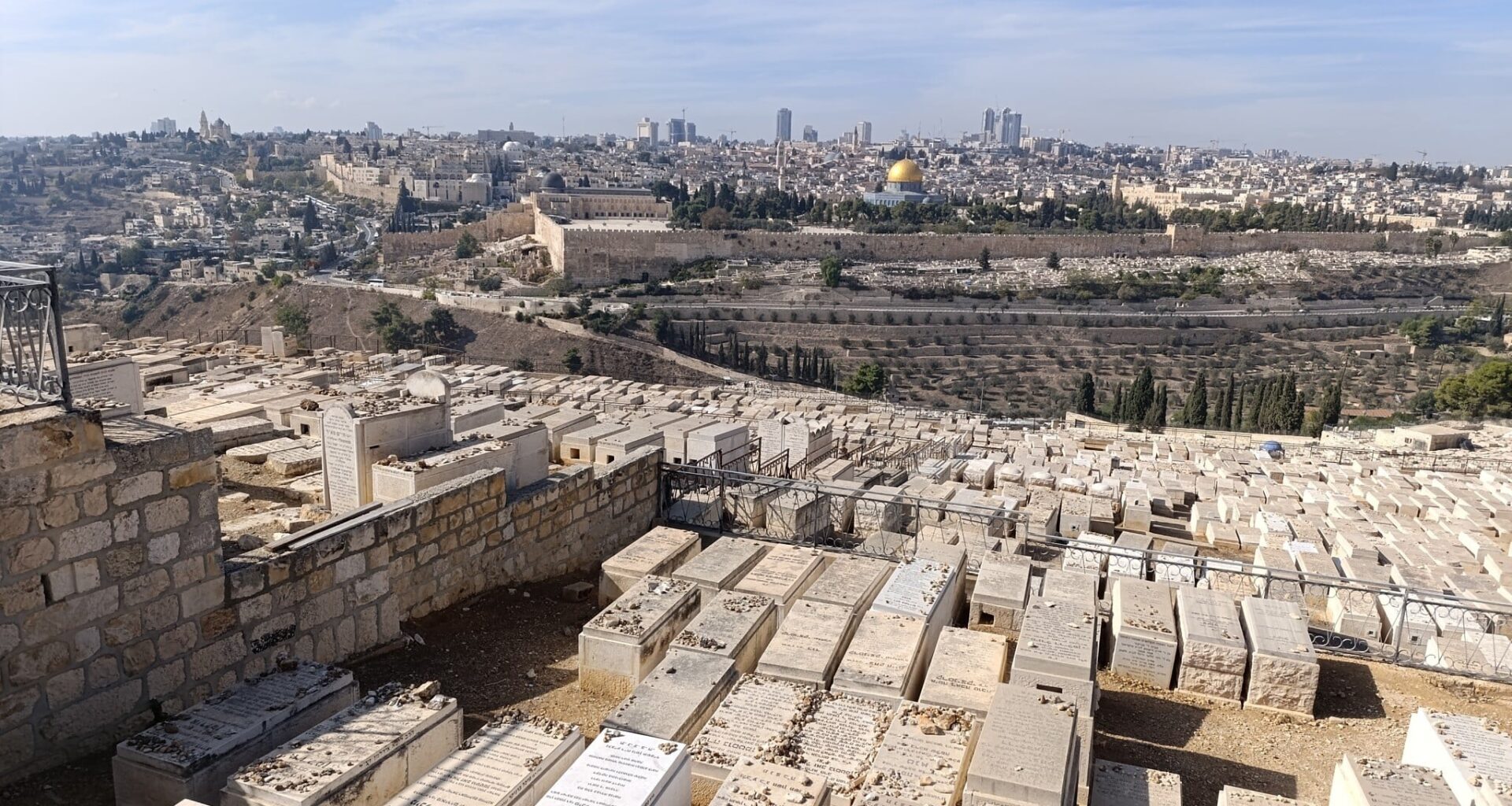
Israel’s policies regarding the burial of the dead are among the most generous in the world, with every citizen guaranteed a permanent state-funded grave near their place of residence.
This policy however may soon be unsustainable due to an expected surge in the elderly population in the coming decades, according to a new study by Prof. Alex Weinreb, chair of the Demography Area and Research Director at the Taub Center.
The report calls for the state to amend existing legislation covering burial rights and to rethink current burial practices. While acknowledging that cremation — the most widespread practice in much of the world — is not a viable option in Israel for cultural and religious reasons, a shift toward ancient Jewish “bone collecting” practices and modern “high-rise burial” techniques will help alleviate the problem, Weinreb suggested.
A spokesperson for the Religious Services Ministry did not reply to a request for comment.
Israel currently records approximately 45,000 to 50,000 deaths per year. But the country’s rapid population growth and the aging of the baby-boom generation suggest that the figure could rise by approximately 3.85% per year in the coming decades.
Get The Times of Israel’s Daily Edition
by email and never miss our top stories
By signing up, you agree to the terms
That would bring the annual total to more than 100,000 by the mid-2040s and 200,000 by the late 2070s, the report said.
At that rate, more people will die in the 26 years between 2024 and 2050 than died in the 75 years between the founding of the State and the end of 2023, Weinreb stated.
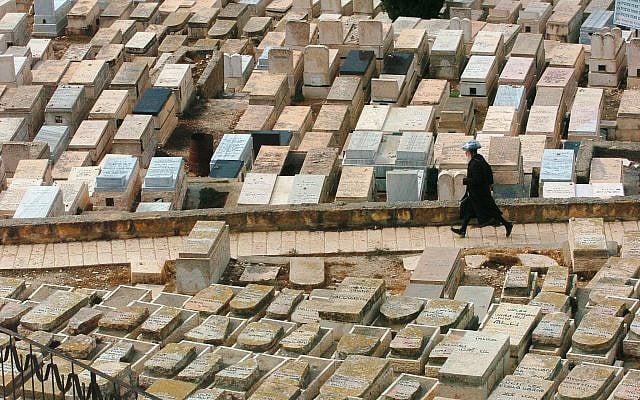
ILLUSTRATIVE — A man walks through a cemetery in Jerusalem (Nati Shohat /Flash90)
Major cemeteries in the densely populated Tel Aviv and Central districts, including those in Yarkon and Barkat (Ganey Ad) that were intended to serve as long-term solutions, are already expected to reach full capacity as early as 2035. That’s decades earlier than originally planned, the report said.
“The paradox… is that because of a cultural-religious outlook, we devote to the dead one of the country’s most valuable and scarce resources,” the report said. “If strategic planning is not advanced toward a comprehensive, system-wide solution, Israel will move toward a reality in which large parts of its territory become ‘cities of the dead.’”
A dying system
Israel’s burial policy is unlike any other country’s for three reasons, the report said. Almost everyone who dies in Israel —Jewish, Muslim and Christian — receives a state-sponsored burial in a grave. While cremation rates top 60% in most Western countries, only 10% of Israel’s Jewish secular population and none of its traditional and religious populations see cremation as an option.
Israel’s policy is far more generous than in most European countries, where the state only covers the cost of the simplest possible funeral in cases where families are too poor to cover the costs. Private burials can range from 2,000 to 13,000 euros (NIS 8,000 – 52,000) and more in some countries. (In some high-demand locations in Israel, such as Jerusalem’s Mount of Olives, private burials can also be quite expensive.)
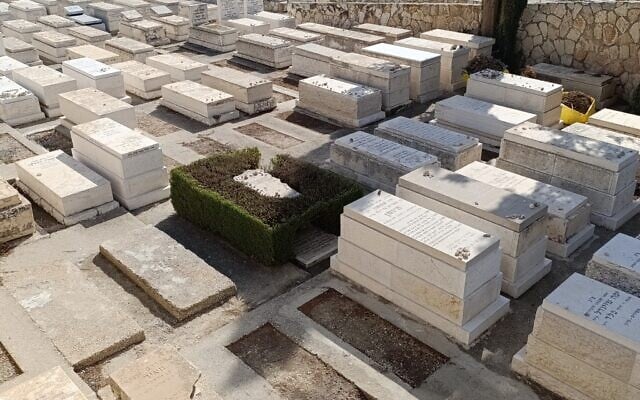
The cemetery at the Mount of Olives, November 17, 2025. The grave of Hadassah Women’s Organization founder Henrietta Szold is surrounded by rosemary plants (Zev Stub/Times of Israel)
Israelis expect burial sites to remain untouched forever, unlike in virtually every other country. The practice of exhuming graves from churchyards in the Middle Ages remains the standard practice across Europe, the report said.
Israel’s State Comptroller has repeatedly warned about a future shortage of burial land, including in a 2024 report. However, that report fails to fully account for Israel’s demographic changes, and underestimates the number of graves that will be required by the end of the century by about a third, Weinreb said.
The Religious Services Ministry, which is responsible for burial regulation and planning, has acknowledged that it does not maintain mortality forecasts or up-to-date nationwide data on available burial land, preventing it from developing long-term planning, he added.
According to Weinreb, if nothing changes, Israel will have to allocate an extra 3,327 dunams (approximately 822 acres) for cemeteries to accommodate all of the country’s deaths by 2050. Since the current law requires that a grave be provided near the deceased’s place of residence, most of that would have to be located in the center of the country, where such land reserves do not exist.
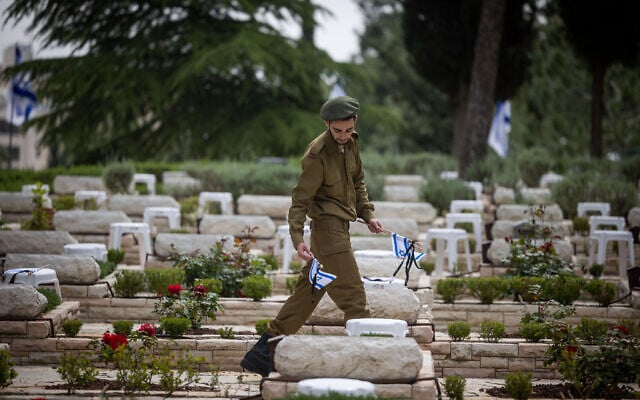
An Israeli soldier places flags, flowers and candles on graves of fallen soldiers at the Mount Herzl Military Cemetery in Jerusalem, April 23, 2023, ahead of Memorial Day. (Yonatan Sindel/Flash90)
Killing old patterns
The solution, Weinreb said, is to change the way burials are done.
For decades, the dominant burial method in Israel has been traditional “field burial,” in which each person is interred individually in the ground. Field burial is the least efficient method in terms of land use — about 300 graves per dunam — but it is also the least expensive in terms of infrastructure, costing roughly NIS 3,800 ($1,000) per grave.
As land has grown scarcer, the government has pushed burial societies to adopt denser methods, including multi-story burial structures and the so-called “Sanhedrin burial,” in which bodies are placed in niches carved into walls, one above the other. These approaches can accommodate up to 1,500 graves per dunam and are 4-5 times more land-efficient than field burial. However, they are also about five times more expensive than field burial, costing between NIS 18,000 and NIS 20,300 ($5,860 – $7,500) per grave.
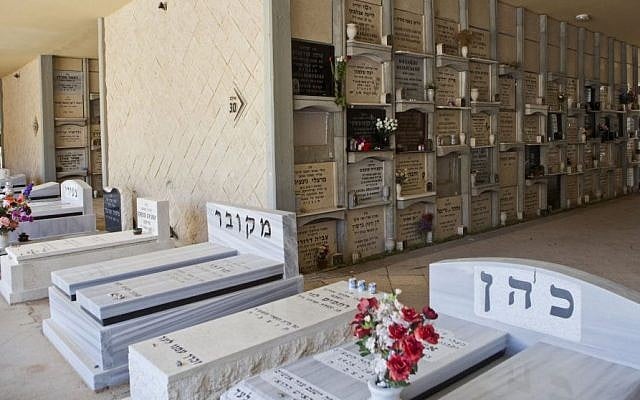
This Monday, Oct. 6, 2014, photo shows a new vertical part of the Yarkon cemetery outside of the city of Petah Tikva, Israel. After some initial hesitations and rabbinical rulings that made the practice kosher, Israel’s ultra-Orthodox burial societies have embraced the concept as the most effective Jewish practice in an era when most of the cemeteries in major population centers are packed full. (Photo: AP/Dan Balilty)
A better approach is an ancient Jewish burial practice known as “Land of Israel burial” — or bone collecting, Weinreb wrote.
Under this method, widely practiced from the First Temple period through the era of the Mishnah and Talmud, the deceased is initially buried in the ground. After about a year, once the body has decomposed, the bones are collected and placed in a small stone or clay ossuary, typically within a family compound.
The approach allows for burial densities of roughly 3,000 people per dunam — 10 times that of field burial and about twice that of today’s densest methods. That makes it the most efficient option available in terms of land conservation. The cost is hard to estimate due to the complexity of the process, but the study places it somewhere between NIS 5,300 and NIS 20,300 ($1,726 -$7,500) per grave.
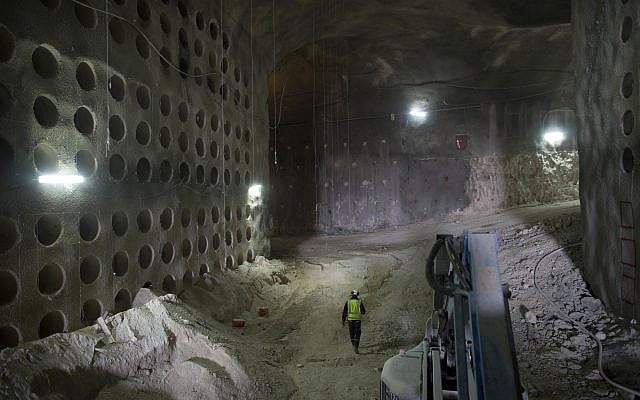
In this Tuesday, Nov. 14, 2017, photo, a worker walks at the construction site of a massive underground cemetery in Jerusalem. Tunnels running more than a kilometer under one of the holiest cities in the world have been carefully excavated over the past two years to allow a unique burial site for some 22,000 graves. (AP Photo/Oded Balilty)
Weinreb also suggested amending the law requiring burial near the place of residence, enabling the development of large-scale burial complexes in peripheral regions, particularly in southern Israel, where land is more abundant. Adjusting the economics of burial — for example, by allowing families to pay an additional cost for field burials — could also help.
“Israel faces a choice between adhering to existing burial patterns that are not sustainable, in which ‘the dead take from the living,’ and adopting burial solutions practiced in antiquity” like the Sanhedrin burial and bone collecting practice, Weinreb said. “It is important to understand that this issue has far-reaching social and economic implications, and that without a deep shift in outlook and long-term strategic planning, we will, before long, face a severe crisis whose consequences will affect not only us but also future generations.”