
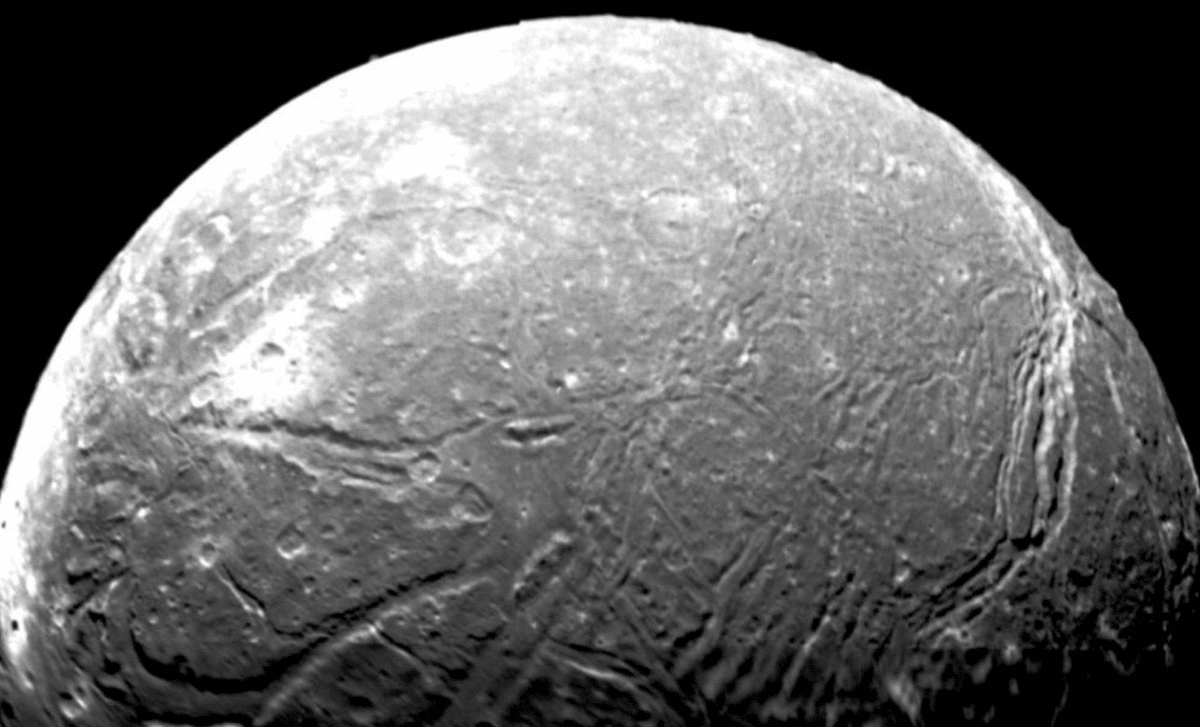
Miranda, one of the moons of Uranus, has always been considered a cold, lifeless world, far from the Sun and unlikely to support any form of life. However, recent research is turning that assumption on its head. A study published in The Planetary Science Journal suggests that beneath Miranda’s icy surface, there could be a hidden ocean. This ocean, which might still be liquid, could create conditions that are favorable for life. This surprising discovery challenges our understanding of the distant moon and opens up new possibilities for life in the far reaches of our solar system.
The Unexpected Discovery: An Ocean Beneath Miranda’s Surface
Miranda, a moon of Uranus, has long been a subject of intrigue, especially since the Voyager 2 spacecraft first captured detailed images of its strange and jagged surface in 1986. Known for its patchwork appearance, an amalgamation of deep grooves, towering cliffs, and bizarre trapezoid-shaped regions, Miranda has raised many questions about its origins. However, the latest study suggests that there’s more to this small moon than meets the eye. According to planetary scientist Tom Nordheim, who co-authored the study, “To find evidence of an ocean inside a small object like Miranda is incredibly surprising.” This revelation is groundbreaking because scientists had previously assumed that such small bodies, so far from the Sun, would be too cold and distant to host an ocean beneath their icy surface.
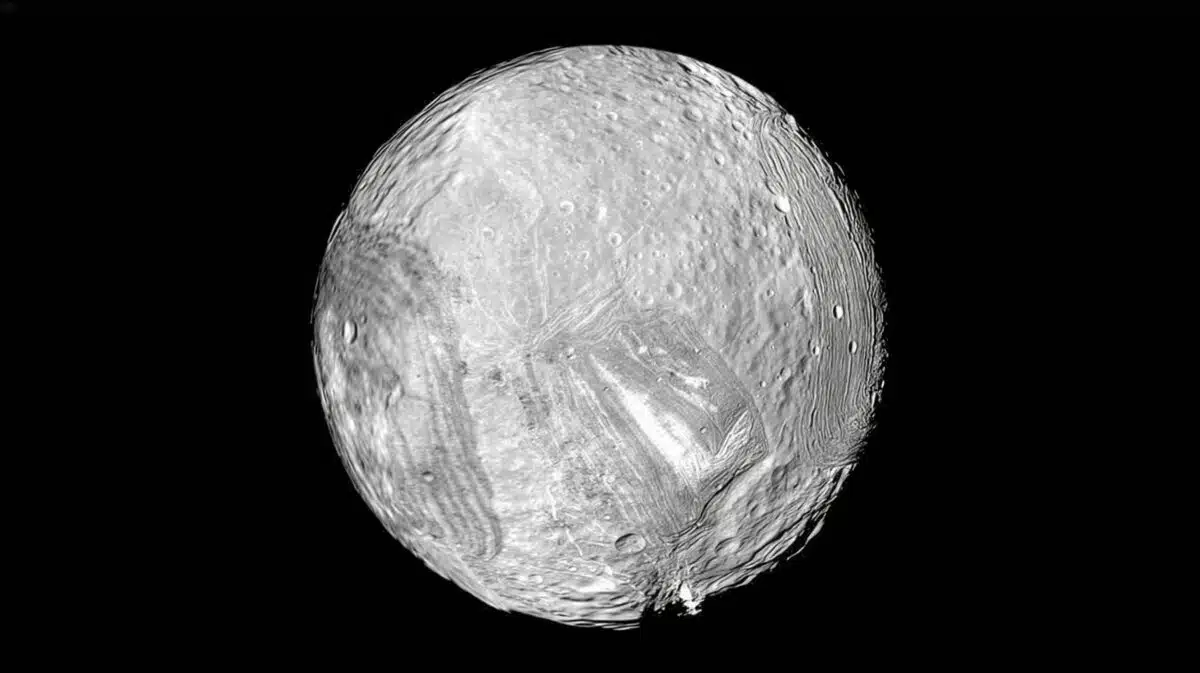 Uranus’ icy moon Miranda, captured by NASA’s Voyager 2 spacecraft on Jan. 24, 1986. Credit: NASA/Jet Propulsion Laboratory-Caltech.
Using modern computer modeling techniques, researchers revisited the old Voyager 2 images of Miranda, looking for clues that could indicate the presence of a subsurface ocean. They reconstructed different scenarios of the moon’s geological past, which led them to believe that Miranda may have harbored an ocean between 100 to 500 million years ago. This ocean could have been as deep as 62 miles and beneath a thin crust that is no more than 19 miles thick. Given that Miranda’s surface features suggested signs of geological activity, this new theory offers fresh insights into the moon’s history and its potential to support life.
The Forces Behind the Ocean: Gravitational Heating
What makes this discovery even more remarkable is the question of how such an ocean could remain liquid despite the moon’s incredible distance from the Sun. The key to this puzzle lies in the gravitational forces at play between Miranda and the other moons of Uranus. This interaction, known as orbital resonance, generates friction and heat within Miranda’s interior, potentially keeping the subsurface ocean warm enough to remain in a liquid state. This heating effect is a common phenomenon observed on other moons in the solar system, such as Enceladus, one of Saturn’s moons, which has also shown signs of subsurface oceans and water vapor geysers. The suggestion that such a small moon could support liquid water despite the cold, distant environment is what makes Miranda’s potential for life so intriguing.
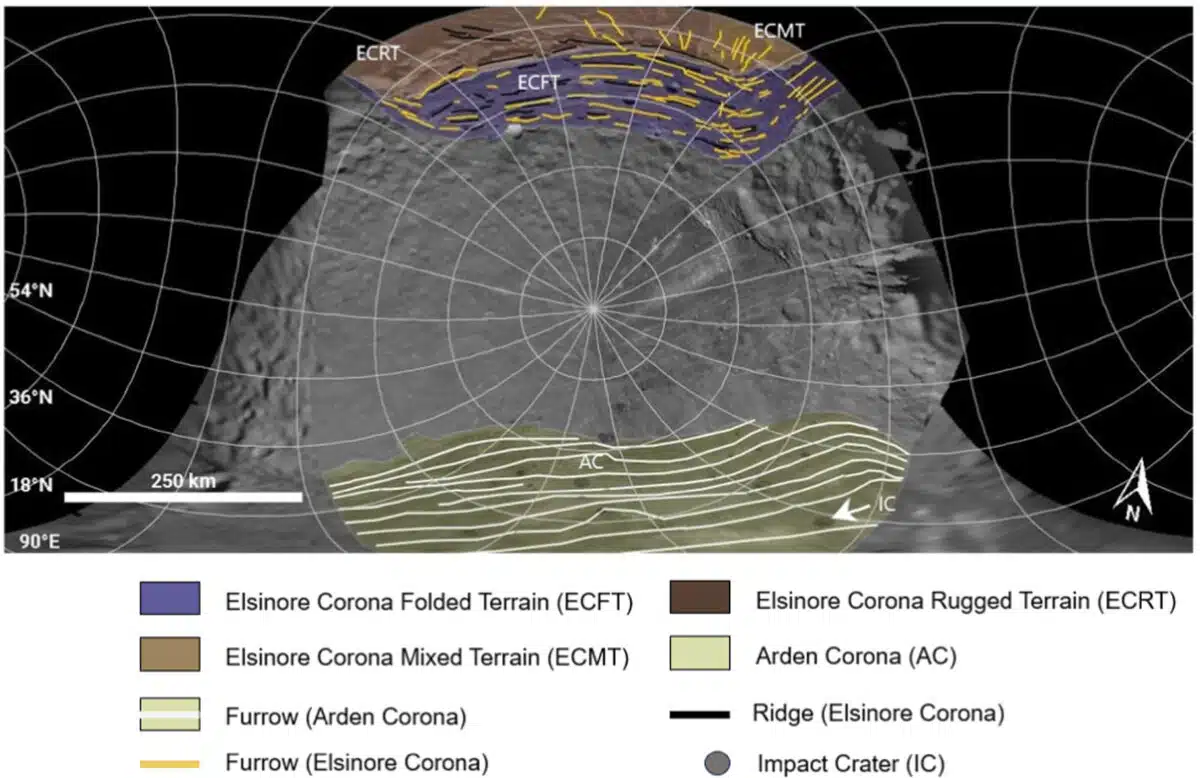 Map of Miranda’s southern hemisphere made using JMARS and a base map by P. M. Schenk (2013).
Credit: The Planetary Science Journal
Caleb Strom, a graduate student at the University of North Dakota and another key member of the research team, remarked, “That result was a big surprise to the team.” Scientists had not anticipated that Miranda, with its small size and location so far from the Sun, would be capable of sustaining such a large ocean. This revelation has led them to rethink what kinds of environments in the solar system may be hospitable to life, raising questions about the potential for other moons to harbor similar oceans.
The Ongoing Search for Life: Is Miranda Still Habitable?
While the team’s findings, published in The Planetary Science Journal, they have also raised more questions than answers. One of the major concerns is whether Miranda still contains a liquid ocean beneath its surface. Strom noted, “We believe that Miranda’s interior hasn’t entirely frozen over. If it had, we would see specific surface features that just aren’t there.” This suggests that the moon’s internal heating mechanisms may still be active, and its ocean, though possibly thinner than before, could still exist in some form. However, the presence of a liquid ocean and the potential for life on Miranda remains unproven, and further exploration is needed to confirm these theories.
In fact, scientists are still analyzing the data from Voyager 2, which continues to provide critical information about the moons of Uranus. As Nordheim aptly put it, “We’re squeezing the last bit of science we can from Voyager 2’s images.” This indicates that while the Voyager 2 mission has already provided a wealth of data, new missions are essential to unlock the full potential of these icy moons and determine whether Miranda could harbor extraterrestrial life.