
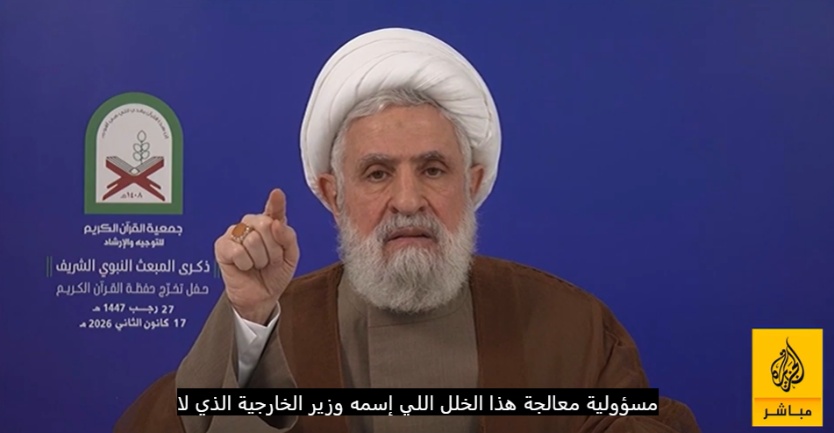
 Na’im Qassem speaks out against the Lebanese government (Al Jazeera Mubasher, January 17, 2026)
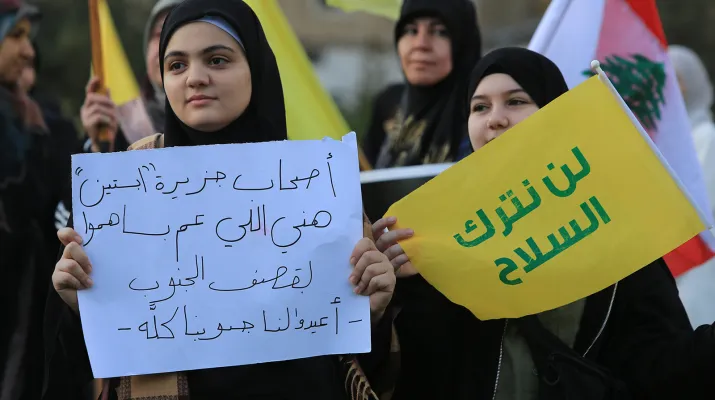
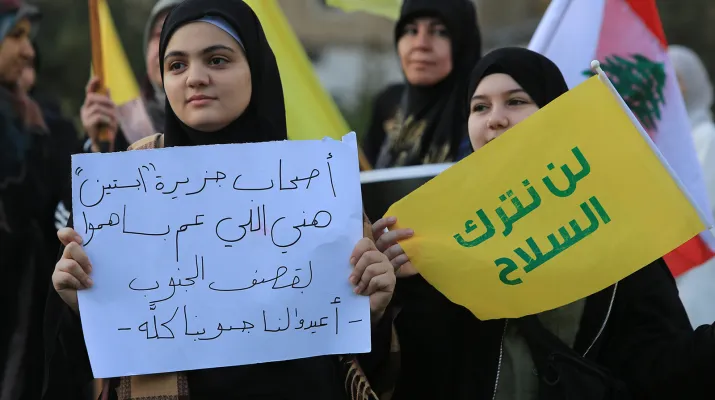 Hezbollah supporters at the rally in central Beirut. The sign at the right reads, “We will not abandon the weapons” (al-Madan, February 4, 2026)
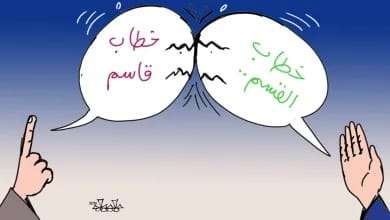 The oath clashes with Qassem’s speech and creates a political rift (al-Madan, January 28, 2026)
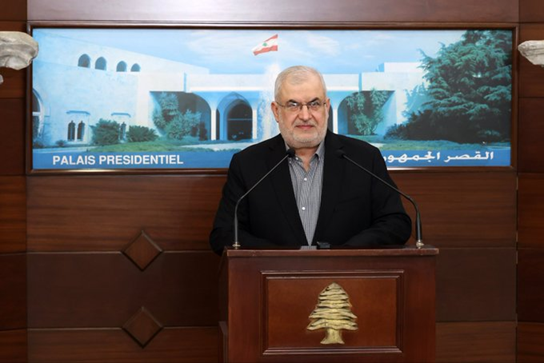 Raad after his meeting with Aoun (al-Jadeed, February 4, 2026)Overview[1]
Since the ceasefire agreement went into effect at the end of November 2024, Hezbollah has criticized Lebanese government institutions, claiming they are not doing enough to stop Israeli “aggression” and “violations” of the agreement.
In recent weeks, Hezbollah has become increasingly angry at the intention of the government and the army to continue disarmament north of the Litani River and because a civilian representative was appointed to the talks with Israel. Statements by President Aoun and other Lebanese officials regarding the end of the role of the “resistance” have also angered Hezbollah.
Hezbollah, led by secretary general Na’im Qassem, has escalated his rhetoric against the president and the government and accused state institutions of failing to safeguard Lebanon’s sovereignty and the Shi’ite community, while stating that the “resistance” will not surrender and is prepared for confrontation. Hezbollah-affiliated media outlets joined the campaign against the government and questioned the legitimacy of President Aoun, accusing him of acting in the interests of the United States and Israel.
Attempts were made to reduce tensions, including meetings between President Aoun and his aides and members of the Hezbollah faction in the Lebanese Parliament.
In ITIC assessment, Lebanon is in transition from managed political tension to an open and prolonged struggle. As long as no significant regional change occurs, especially regarding Iran, in all probably friction and tension will continue. The government will proceed cautiously in extending its authority north of the Litani River, and Hezbollah will block measures perceived as attacking the core of its power, without letting the situation deteriorate into a broad internal Lebanese crisis.
Why Tensions Are Rising
Since the ceasefire agreement went into effect at the end of November 2024, halting the fighting between Israel and Hezbollah which began on October 8, 2023, Hezbollah has shifted responsibility to Lebanese government institutions to ensure Israel stops its “aggression,” withdraws from the positions it holds in the south of the country and releases the Lebanese it still detains. Hezbollah is also dissatisfied with the government’s decision to implement a state monopoly over weapons, but claimed it was cooperating in the demilitarization of the area south of the Litani River.2 However, several developments at the end of 2025 and the beginning of 2026 increased the focus of Hezbollah’s criticism:
On January 8, 2026, the commander of the Lebanese army, Rodolph Haykal, reported to the government in Beirut that the objectives of the first phase the state’s monopoly over weapons had been completed, and the army declared “genuine, effective” control south of the Litani River, except in areas where there was an Israeli presence. The government praised the army’s achievements and instructed it to prepare a plan for the next phase, control north of the Litani River, ahead of a discussion in February 2026.3
The IDF continued attacking Hezbollah terrorist targets, operatives and field commanders in south Lebanon and other areas as part of enforcing the November 2024 ceasefire agreement and to prevent Hezbollah from renewing its military capabilities and rebuilding its arsenal.[4]
At the beginning of December 2025, the president of Lebanon, Joseph Aoun, announced the appointment of Simon Karam, former Lebanese ambassador to the United States, to head the civilian delegation to talks with Israel in the oversight committee for the ceasefire agreement. Karam participated in two meetings with Israeli civilian representatives, but no progress was made.[5] Reportedly, the United States and Israel were interested in dismantling the oversight committee and moving to direct or indirect talks between Israel and Lebanon to advance a security agreement and an agreement on border demarcation, as well as the possibility of normalization between the countries.[6]
Meanwhile, members of the Lebanese leadership made statements which increased tensions with Hezbollah:
In an interview marking a year in office, President Aoun said they continued implementing the plan for a state monopoly over weapons throughout Lebanon. He said the presence of weapons had become a burden and it was time to act “rationally,” referring to Hezbollah representatives (Telegram channel of the Lebanese presidency, January 11, 2026). At the annual meeting of members of the diplomatic corps stationed in Lebanon, Aoun said the decision for the monopoly over weapons was an achievement unlike any the country had seen in 40 years (Lebanese News Agency, January 20, 2026).
The Lebanese foreign minister, Youssef Rajji, accused Hezbollah of having agreed to keep south Lebanon out of a confrontation only to buy time, hoping for a regional or international change which would allow it to recover and resume control over the state. He said the confrontation with Israel served Hezbollah as a pretext for keeping its weapons, and its true aspiration was renewed control over government institutions (al-Nashra, December 23, 2025). Rajji also said Hezbollah’s weapons no longer protected the Shi’ite community or Lebanon, and had become a burden. He stated that the ceasefire agreement with Israel required the organization to disarm and the demand for a state monopoly over weapons came from the Lebanese people themselves, since the continued existence of Hezbollah’s weapons provided Israel with grounds for continued attacks and paralyzed the political-economic system (Sky News Arabic, January 12, 2026).
Hezbollah and Its Supporters Escalate Their Rhetoric
The combination of the commitment to also ensure a state monopoly over weapons north of the Litani River, the Israeli attacks and the possibility of political negotiations between Israel and Lebanon inflamed the tensions and caused Hezbollah to sharpen its rhetoric. Its senior figures argued that the ceasefire agreement and UN Security Council Resolution 1701 stipulated that disarmament would be carried out only south of the Litani River, and accused state institutions of weakness in the face of Israeli “violations” and of “surrender” to foreign demands, while emphasizing that the “resistance”[7] would not surrender and was prepared for confrontation, even within Lebanon:
Hezbollah secretary general Na’im Qassem gave a speech attacking Lebanese state institutions and claimed they were not fulfilling their duty and or acting to deter “aggression.” He claimed Lebanon had not had national sovereignty for more than 13 months because [Israeli] “aggression” continued against Lebanon and against the UN force, and said the state had the responsibility to restore sovereignty. He warned that “everything has limits, and such a situation cannot continue indefinitely.” He added that Hezbollah had helped elect the president and the government and had not violated the ceasefire agreement, and said he hoped Lebanon’s leaders would “act wisely,” like Hezbollah [sic]. He also accused Foreign Minister Rajji of inciting civil war and acting against Lebanese interests, and demanded that the Lebanese government deal with “this malfunction” (al-Manar, January 17, 2026).
Na’im Qassem speaks out against the Lebanese government
(Al Jazeera Mubasher, January 17, 2026)
Mahmoud Qamati, deputy head of Hezbollah’s political council, said that in any future confrontation the organization would take immediate defensive action without the need for consultations, and would defend Lebanon even if not deployed south of the Litani River. He claimed Hezbollah functioned as “ghosts” in the arena and would operate from wherever required. He rejected any demand for disarmament and claimed they did not sanctify the weapons themselves but their role in defending Lebanon, which he alleged faced “existential threats.” He called on the Arab states to support Hezbollah, claiming that the “resistance” was the first line of defense against Israel and its regional aspirations, and criticized American pressure to disarm while extensive military aid was being transferred to the Lebanese army (Lebanon On channel, December 18, 2025).
Hassan Fadlallah, a member of the Hezbollah faction in the Lebanese Parliament, represented the “resistance” as a force “rooted in the people and impossible to uproot.” He called the Lebanese regime “failing and helpless,” speaking of “dereliction of duty” and hinting at an internal “conspiracy,” reshaping the confrontation as not only a political dispute but a deep crisis of trust between the public and the state. Fadlallah challenged the concept of exclusive state control over weapons by claiming that during the period of the “resistance equations” Israel did not dare to attack, whereas when responsibility was transferred to the state “everything changed,” saying the government had failed in defense and was therefore unable to demand reduction of the “resistance’s” power (al-‘Ahed, February 3, 2026).
Ali Fayyad, a member of the Hezbollah faction in the Lebanese Parliament, accused the Lebanese regime of confusion, hesitation and concessions without compensation, and claimed that Israel exploited the discourse of the “second phase” of the disarmament plan to establish a presence south of the Litani River and expand its attacks. Fayyad called the oversight mechanism for the ceasefire a “circus, lacking credibility,” operated by Israel and the United States, and demanded the authorities adopt a firm line, according to which Lebanon had fulfilled its commitments, while Israel had not (al-‘Ahed, February 2, 2026).
During budget discussions, Fayyad expressed concern and anger over what he called the “internal strangulation” of Hezbollah’s environment, and claimed that the minister of justice, the foreign minister and the central bank governor were applying economic and institutional pressure on the organization, and warned of deterioration into internal confrontation and possible civil war. According to “political sources,” the remarks reflected a direct warning from Hezbollah to senior state officials, claiming the existence of a coordinated “internal war” which, according to them, was being conducted in cooperation with American elements (al-Diyar, January 30, 2026). “Sources close to Hezbollah” claimed that the organization had information about a “roadmap” to attack its economic infrastructure, to the point of closing its affiliated financial institutions at sensitive times. They claimed the measures were timed with regional developments, and Hezbollah regarded them as unacceptable (al-Diyar, December 30, 2025).
Hezbollah also claimed that the position of the state leadership was directed not only against Hezbollah and the “resistance” but against the entire Shi’ite community in Lebanon. Such remarks should be viewed in the context of the general elections scheduled to take place in the spring of 2026, when Hezbollah will fight to preserve its power within the community:
Ihab Hamadeh, a member of the Hezbollah faction in the Lebanese Parliament, rejected claims that the weapons of the “resistance” were a burden on the Shi’ite community, claiming that such a description attacked “a fundamental component of Lebanese society.” He noted the contribution of the Shi’ites and the “resistance” to preserving Lebanon’s standing in the political arena, claiming that certain “internal elements” defined their political identity through confrontation with it. He criticized statements which he said did not benefit the institution of the presidency, adding that the president was required to represent all Lebanese society (al-Nashra, January 15, 2026).
In a Friday sermon, Mufti Ahmed Qabalan accused the state of abandoning the south, the Beqa’a Valley and the Dahiyeh al-Janoubia, and claimed a “systematic process to weaken the Shi’ite community” was being backed or carried out by an indifferent establishment (Lebanese News Agency, January 23, 2026).
The anti-government campaign also reached the streets and social media, with warnings from Hezbollah that if the pressures and “provocations” continued, internal unrest could develop and the government would have to face broad public protest (al-Diyar, January 30, 2025):
A small demonstration took place in central Beirut, during which signs critical of President Joseph Aoun were held. The demonstrators linked the internal dispute to the security escalation with Israel with pictures of evacuation orders and Israeli threats (Lebanon Debate, January 21, 2026).
Hezbollah held a mass rally in central Beirut whose theme was “All the homeland is resistance.” Deputy head of Hezbollah’s political council, Mahmoud Qamati, claimed the diversity of the crowd reflected cross-sectoral support for the “resistance” and warned against any internal concession regarding its weapons (al-Madan and al-‘Ahed, February 4, 2026).
Hezbollah supporters at the rally in central Beirut. The sign at the right reads, “We will not abandon the weapons” (al-Madan, February 4, 2026)
Reportedly, Lebanese judicial authorities began proceedings against those who had insulted President Aoun, after Hezbollah supporters launched a campaign against the president on social media to criticize his support for a state monopoly over weapons and to protest Israeli attacks. “Sources” noted that the statements attacked the president and used offensive language and accusations which justified a legal investigation, even though the presidency itself did not file a complaint (Sawt Beirut International, January 23, 2026).
During a raid by the Lebanese army on wanted suspects in the border town of al-Qasr in the Hermel area, in the northern Beqa’a Valley near the border with Syria, a search was conducted at a center affiliated with Hezbollah and a military vehicle was confiscated. The raid was unprecedented, since for years Hezbollah compounds were considered outside the scope of direct state action. In response, voice messages were sent and “residents” blocked roads and prevented the army from taking the vehicle. The incident reflected a change in the pattern of confrontation: for the first time the civilian environment was positioned as a line of defense against the army, ignoring the organization’s responsibility and shifting the struggle into a framework of “community rights” rather than a direct clash between the state and Hezbollah. Thus, the tension is now also between the state and Hezbollah’s supporting environment, and not only with the organization itself (Nidaa’ al-Watan, February 2, 2026).
Hezbollah-affiliated media outlets enlisted in the campaign with critical statements and articles about dissatisfaction with the positions of state institutions toward the “resistance:”
Ali Shuaib, al-Manar correspondent in the south, attacked the wording of the Lebanese army’s statement regarding its having achieved the objectives of the first phase of the state monopoly over weapons and accused the army of attacking the “honor of the resistance” when it referred to it as “armed groups.” He called it “a dangerous distortion of the national discourse” which dishonored the memory of the shaheeds and prisoners and contradicted the principle of the “right to resist occupation” (Ali Shuaib Telegram channel – South News, January 8, 2026).
Hezbollah’s al-Manar channel claimed the gap between the official statements of the Lebanese state and the situation on the ground showed a lack of actual sovereignty. The channel said “the truth is what you see and not what you hear,” previously stated by former Hezbollah secretary general Hassan Nasrallah and recently adopted by President Aoun as well. The president’s using a saying identified with Hezbollah triggered criticism from the organization and its supporters, who interpreted it as a deviation from the “resistance” narrative and as retroactive approval of a policy perceived as trivializing the concept of sovereignty. It was further noted that if the state had indeed achieved a monopoly over weapons south of the Litani River, it had to exercise its responsibility and restore sovereignty and security by preventing Israeli attacks and violations, including by diplomacy (al-Manar, January 20, 2026).
Wissam al-Khalil, commentator for the Hezbollah’s daily al-Akhbar, published an article harshly critical of the Lebanese regime, and particularly of President Aoun. He noted that when Aoun was elected in January 2025, there had been quiet within the “resistance’s environment” but it had expected that the presidency would continue to reflect commitment to the legacy of struggle and the narrative of sacrifice, but that now the president was regarded as having violated an unwritten contract with his natural base of support. Al-Khalil said that throughout Aoun’s military service, until he headed the Lebanese army, he had expressed unequivocal positions in favor of the “resistance” and sovereignty, but the transition from uniform to the presidential seat was an “ideological betrayal,” since he used the discourse of the “resistance” as a means of personal advancement. Al-Khalil also accused Aoun of trying to dismantle the “resistance” and of promoting a policy which directly served Israeli and American interests, and therefore of being an active partner in an external effort to damage Lebanon. In his view, the state, which was supposed to protect its citizens, stood aside during “daily killing and destruction,” when the claim that “not a single shot was fired” from Lebanon since the ceasefire protected Israel, not Lebanon. Al-Khalil stated that the “resistance” would not “retreat,” even in the face of unified governmental and international forces, since its “struggle” was moral, popular and inevitable in the reality of a weak state (al-Akhbar, January 24, 2026).
The oath clashes with Qassem’s speech and creates a political rift
(al-Madan, January 28, 2026)
Ibrahim al-Amin, the editor of Hezbollah’s daily al-Akhbar, wrote that President Aoun’s rhetoric against the “resistance” had “escalated suddenly,” due to his call to dismantle the “resistance’s” weapons in all parts of Lebanon with the slogan, “There is no need for resistance!” According to al-Amin, Aoun did not believe in meaningful relations with Hezbollah even before he was elected president, and he acknowledged that his appointment was the implementation of an “American-Saudi decision based on the results of the last Israeli war against Lebanon.” According to al-Amin, Aoun believed that the blow suffered by the “resistance” in the last war was greater than anyone expected, and therefore his only objective in talks with the “resistance” was to demand that it hand over its advanced weaponry, since that was consistent with current international demands. He also attacked Aoun for acquiescing to the American demand to hold civilian talks within the framework of the ceasefire oversight mechanism without receiving any compensation for the “concession,” thereby causing Israel to interpret it as progress toward political negotiations (al-Akhbar, February 9, 2026).
Attempts to Defuse the Situation
Alongside the public disputes and the escalation of Hezbollah’s rhetoric, efforts were also reported to calm tensions through direct contacts between Hezbollah representatives and the presidential palace:
President Aoun’s senior advisor, Brigadier General André Rahal, met with Ahmed Mahana, assistant to Mohammad Raad, head of the Hezbollah faction in the Lebanese Parliament. The meeting was reportedly an initial attempt to curb the rhetorical escalation and open a channel for dialogue between the presidential palace and Hezbollah, but also exposed the substantive gaps between the sides: while the presidency sought to establish a monopoly over security, Hezbollah rejected any definition of its weapons as “illegal” and insisted on the legitimacy of the “resistance” (Nidaa’ al-Watan, January 27, 2026). According to reports, both sides felt they were paying a political price and were on the defensive, while the real gap revolved around fundamental questions of sovereignty and security authority, and therefore prolonged crisis management was taking shape within a framework of forced coexistence, rather than a close solution (al-Jumhuriya, January 27, 2026).
It was claimed that Hezbollah’s leadership had decided to freeze scenarios of internal confrontation with the Lebanese state. According to “Lebanese sources,” instructions were circulated to restrain interactions with the presidency, the prime minister’s office and the Lebanese army, as the price of friction at the present time would outweigh any possible gain. The decision was made after prolonged discussions within the organization and was explained as a cold cost calculation, not as an ideological change or political arrangement. According to the report, Hezbollah’s leadership identified a change in the position of state institutions, which now operated from internal and external momentum to establish state sovereignty and advance the issue of disarmament, in a way that narrowed the room for maneuver that existed in the past. It was further stated that the organization distinguished between the southern arena, where calculated rules of engagement were maintained, and the internal arena, perceived as the most sensitive, and that moderating the tone toward the presidency and the government reflected a tactical shift of “forced containment” in a new internal situation (Aram News, January 30, 2026).
At the presidential palace, there was dissatisfaction over the statements of Hezbollah secretary general Na’im Qassem regarding the organization’s readiness to fight alongside Iran in the event of an attack by the United States or Israel, and therefore a planned meeting between President Aoun and the chairman of the Hezbollah faction in the Lebanese Parliament, Mohammad Raad, was postponed (Nidaa’ al-Watan, January 29, 2026). After the meeting finally took place, Raad proposed internal unity and realism in view of the “sovereignty situation.” He noted Hezbollah’s readiness to reach understandings and cooperate with the state to achieve shared national goals, while emphasizing the state’s responsibility to defend sovereignty and provide it with assistance “when necessary.” Reportedly, the sides agreed to continue dialogue and consultations to formulate an agreed-upon methodology that would enable advancement of the goals in a short time and at a “minimal price,” while rejecting any form of foreign intervention or patronage (al-‘Ahed, February 4, 2026).
Raad after his meeting with Aoun (al-Jadeed, February 4, 2026)
[1] Click https://www.terrorism-info.org.il/en to subscribe and receive the ITIC’s daily updates as well as its other publications.
[2] See the May 2025 ITIC report, Challenges Faced by Hezbolla after the November 27, 2024 ceasfire, and the December 2025 report, Hezbollah: One Year After the Ceasefire.
[3] See the January 2026 ITIC report, The Completion of the First Phase of Hezbollah’s Disarmament
[4] See the weekly ITIC reports, “Spotlight on Terrorism: Hezbollah and Lebanon,” and the monthly reports on terrorism in the various arenas.
[5] See the December 1-8 2025 and December 15-22 weekly ITIC reports, “Spotlight on Terrorism: Hezbollah and Lebanon.”
[6] See the weekly ITIC report, “Spotlight on Terrorism: Hezbollah and Lebanon, January 20-26, 2026.”
[7] Hezbollah and the other terrorist organizations operating in Lebanon.
[8] The period before the outbreak of the Israel-Lebanon war on October 8, 2023.
Related Articles