
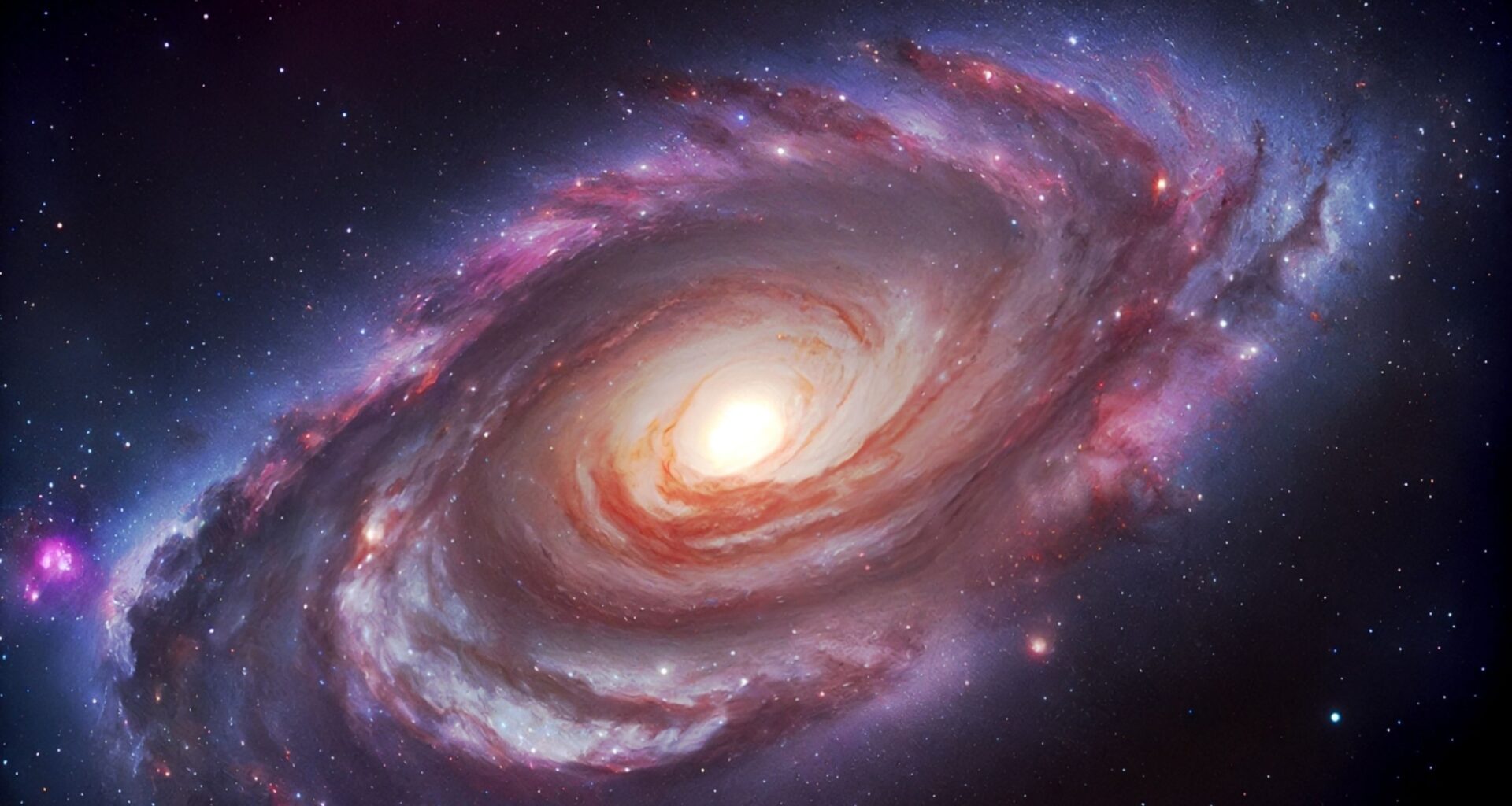
At the center of the Milky Way sits Sagittarius A*, long believed to be a supermassive black hole. But new research suggests the galaxy’s heart may instead contain an extremely dense core of dark matter.
Rather than treating the center and the surrounding dark matter halo as separate structures, the study proposes that they could be part of one continuous distribution of unseen matter. This material would be dense at the core and more diffuse toward the outskirts.

To test the idea, astronomers at the Institute of Astrophysics of La Plata in Argentina analyzed the tight, high-speed orbits of stars circling Sagittarius A*.
The team’s modeling shows that these stellar paths can be explained by a compact dark-matter core instead of a traditional black hole.
This raises the possibility that the Milky Way’s center may not be what scientists have long assumed.
Quantum particles shape core
The idea works if the Milky Way’s hidden matter behaves like particles that resist being squeezed together.
Physicists call these particles fermions – lightweight particles that cannot occupy the same state – and that simple rule naturally prevents the core from collapsing into a single point.
In Crespi’s model, those same fermions would form a dense central core while also spreading outward into a thinner halo that continues to add gravity across the galaxy.
Unlike a black hole, this kind of core would not have a point of no return, meaning matter could pass through it rather than being permanently trapped.
Dusty orbits reveal clues
Dust-covered objects also sweep around Sagittarius A*, and they carry clues because their light comes filtered through gas.
Astronomers call them G-sources – dusty bodies that move like stars – and their paths test the same central pull.
With only two percent of their long orbits measured, the team treated these tracks as softer evidence. Longer monitoring could turn these dim objects into tough tests between a black hole and a dark core.
Mapping the galaxy’s edge
Far from the center, the Milky Way’s rotation curve, a plot of speed versus distance, shows how gravity spreads outward.
Using Gaia’s third data release, a 2023 analysis found that the curve drops at large distances in a clean slowdown. Astronomers call that a Keplerian decline, a drop in speed as distance rises, and it hints at a tighter halo.
Compared with broad halos from older simulations, the fermionic model expects a shorter tail, so outer data become decisive.
Unified dark matter structure
In this scenario, the same invisible material would need to behave in two different ways – tightly packed at the galaxy’s center while spreading thinly across the outskirts.
That single distribution could generate the intense gravity near Sagittarius A* while also extending outward to help shape the Milky Way as a whole.
Under this view, Sagittarius A* may simply mark a dense knot within the same dark matter structure that surrounds the galaxy.
Even if a true black hole still lies at the very center, the unified model helps narrow what future observations need to confirm.
Core evidence still unclear
In 2022, the Event Horizon Telescope released its now-famous image of Sagittarius A*, showing a bright ring formed as glowing gas spirals around a compact object and gravity bends the light.
At first glance, the image seemed to support the black hole picture, but researchers note that a dense dark-matter core could produce a very similar appearance.
“The dense core can mimic the shadow because it bends light so strongly, creating a central darkness surrounded by a bright ring,” said study co-author Valentina Crespi, an astronomer at the Institute of Astrophysics of La Plata
Future observations may look for finer features known as photon rings – delicate loops of light predicted to differ between the two scenarios.
So far, however, both models still fit the data. The predicted star orbits differ by less than one percent. When researchers compared each model against the same stellar tracks, current measurement uncertainties allowed both explanations to remain viable.
Only sharper observations of stars orbiting even closer than S2 are expected to reveal the subtle gravitational differences that could finally distinguish a black hole from a compact dark-matter core.
Sharper views from Chile
In northern Chile, the Very Large Telescope hosts tools that track the Milky Way’s central stars with extreme precision. Back in 2020, the GRAVITY instrument measured a slow twist in S2’s orbit, matching relativity closely.
More years of that kind of data could show whether a dark core produces a slightly different twist over time.
As telescopes find stars closer in, their loops should amplify any difference between a black hole and a dark core.
Milky Way center mystery deepens
Particle physics plays a central role because the composition of dark matter – not just its location – determines the nature of the core.
A fermion-based halo would favor dark matter candidates that remain light and stable, rather than heavier particles that clump differently. Some theorists also suggest that an overgrown core could eventually collapse, transforming the same material into a true black hole.
Even if observations rule out that outcome, they would still tighten limits on how much additional mass can remain hidden around Sagittarius A*.
Seen as a single system, the Milky Way’s stellar orbits, outer rotational slowdown, and central ring may all trace one underlying dark structure.
With improved orbit tracking and sharper imaging now coming online, astronomers are gaining the tools needed to test the structure more precisely.
These observations will help determine whether it can fully account for the data or whether the traditional black hole explanation still prevails.
The study is published in Monthly Notices of the Royal Astronomical Society.
—–
Like what you read? Subscribe to our newsletter for engaging articles, exclusive content, and the latest updates.
Check us out on EarthSnap, a free app brought to you by Eric Ralls and Earth.com.
—–