
Updated on Thursday, Feb. 12, 2026 at 1 p.m. ET
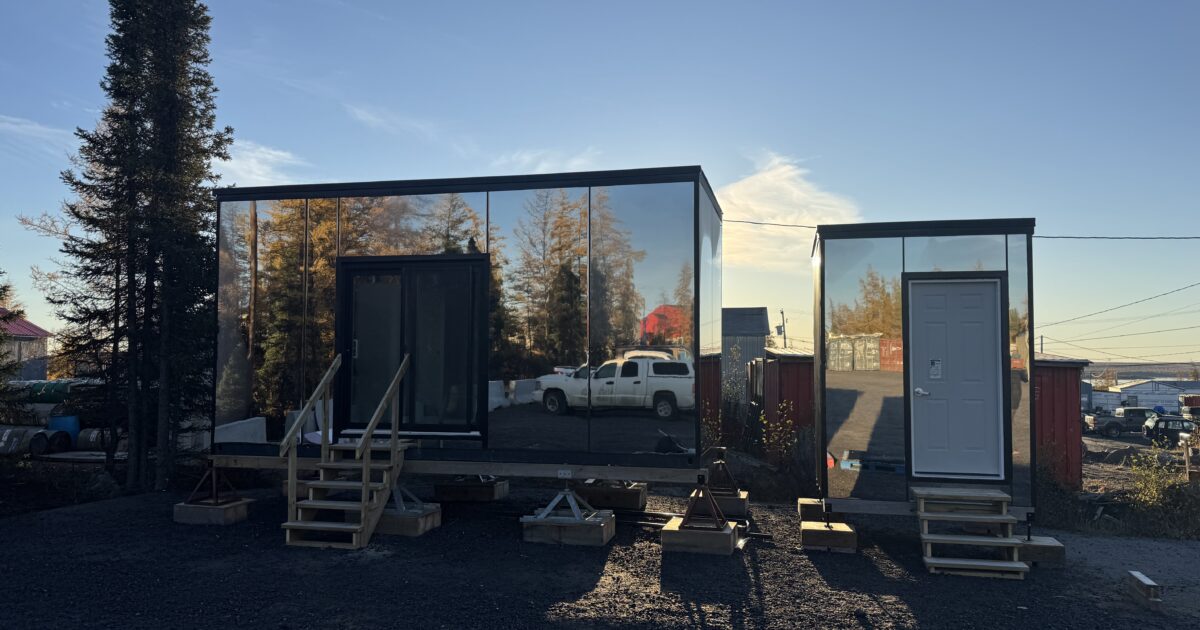
In just 10 days, a group of builders put together a home in Kuujjuaq in an effort to help tackle housing challenges in remote northern communities.
Tinybox Systems, a Canadian housing tech startup, began discussions with Kativik Regional Government in late 2024 regarding a pilot project to lower the cost and alleviate the difficulty of building in the Arctic, said co-founder Charlie Frise.
Building in northern Canada is expensive due to factors like the need to import skilled labour and limited construction seasons because of the harsh weather.
“What’s promising about our solution is everything comes as a kit,” Frise said. “It’s like Lego or Ikea furniture.”
The housing shortage in Nunavik is critical. A report released last year found the region falls short of its needs by 1,000 homes.
Nunavik’s population, which was 14,045 in 2021, is projected to grow by about one per cent a year until 2041. That will add stress to a housing market already in crisis.

Every two years, consulting firm Raymond Chabot Grant Thornton, in partnership with the Nunavik Housing Bureau, surveys Nunavik households to find out how many people live in them and how many bedrooms each unit has.
Of 3,738 households that completed last year’s survey, more than 25 per cent have at least five residents while most homes have three bedrooms or fewer.
Frise, who studied architecture and engineering, built homes the traditional way before joining forces with Oliver Zhang and Pooya Saberi in 2022 to launch Toronto-based Tinybox Systems.
“I wanted to find a way to make homes more affordable,” Frise said.
In Kuujjuaq, a two-person local crew assembled the unit between late September and early October, trained and supervised by Tinybox experts. This was the first time the company’s modular building system has been put together by an external team, Frise said.
The home is a studio space with a kitchenette, a bed built into a wall, and a bathroom. The mechanical room for the water, heating and electrical systems is in a separate unit next to the house.

The design uses special insulation to help the house handle extremely cold temperatures, down to -50 C.
The home is also built with a frame that can withstand heavy snow and has sensors to keep track of how the house is holding up in such harsh weather over time.
Frise said Tinybox will monitor the house to see how it performs in the North over the years.
The company was commissioned solely for the building and assembly, which cost approximately $90,000. Plumbing and electrical work will be done by KRG, Frise said.
He said he hopes Tinybox’s work in Nunavik isn’t done.

“We hope we’re actually just getting started, because this proves that we can build cheaper homes faster using local labour,” he said.
Correction: This article has been updated from its original version to correct how much Nunavik’s population will grow by 2041.