
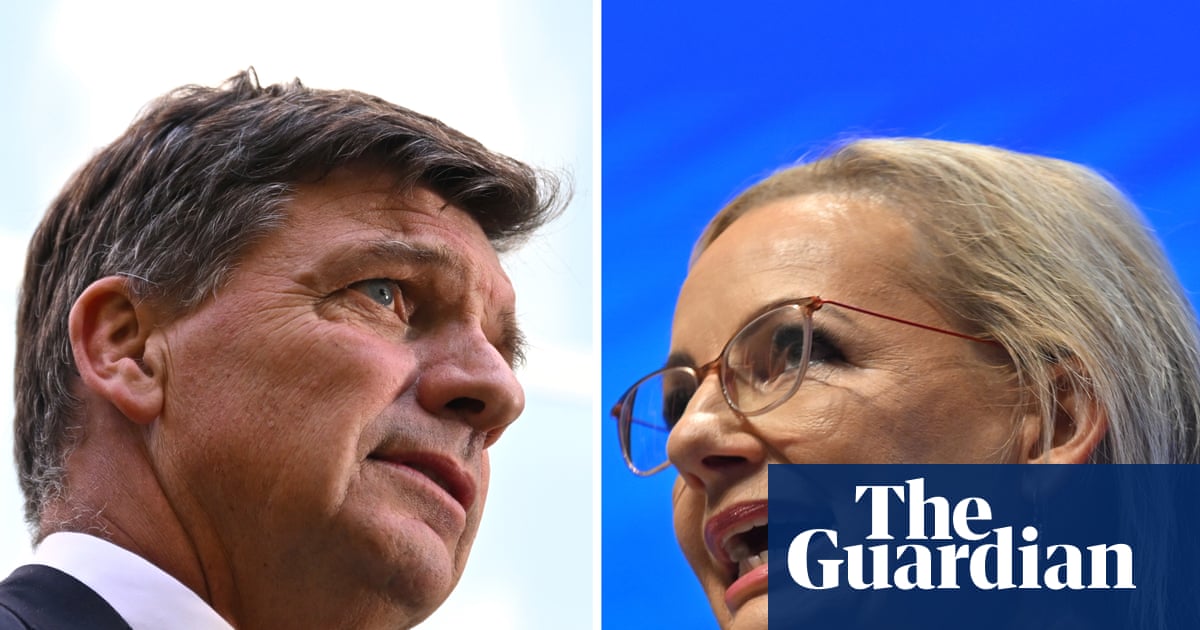
Angus Taylor has been elected the Liberal party’s new leader, ousting Sussan Ley in a partyroom ballot, 34 votes to 17.
The stronger than expected victory sees the conservative and former shadow defence minister become the party’s 17th leader, ending Ley’s nine-month tenure as Australia’s first female opposition leader.
Ley said she would quit parliament within weeks, in a bid to provide clear air for Taylor’s leadership, noting it was “something that’s not always afforded to leaders.”
A byelection in Ley’s seat of Farrer, in regional New South Wales, sets up an immediate challenge for Taylor, with the risk of a tough fight with One Nation and even the Nationals. Pauline Hanson’s party is strongly outperforming the Coalition in recent polls.
“I am not sure what comes next for me,” Ley said.
“I look forward to stepping away completely and comprehensively from public life, to spend time with family, to reconnect with my enduring passion, aviation, which taught me, if I had an ego, I’d be dead.”
Victorian senator and Taylor backer Jane Hume is the party’s new deputy leader, with Ley’s number two, Ted O’Brien, pushing to take a frontbench role after losing the ballot.
Hume won 30 votes to O’Brien’s 20. Frontbenchers Dan Tehan and Melissa Price were both eliminated in the early stages of the ballot for deputy.
Friday’s hotly contested ballot was the culmination of a months-long campaign from conservative forces inside the Liberal party to undermine Ley, who had been supported by the moderate faction to lead the party after Peter Dutton’s crushing election defeat in May 2025.
Ley’s leadership has been undermined by right faction opponents since she took the top job in May last year, and her position has been questioned by critics seeking a stronger conservative stance from the opposition.
Despite overseeing a partyroom process to dump the Liberals’ commitment to net zero by 2050 – a position agreed in 2021 when Taylor was energy minister, under prime minister Scott Morrison – and taking a position of full-throated support for Israel, Ley’s critics were unhappy she hadn’t been more forceful on migration and cultural issues, or moved more quickly to release policies on cost-of-living.
Ley’s leadership was also damaged by two separate splits from the National party, fuelled by bitter disagreements with the minor party’s leader, David Littleproud. After the second split in January, following Nationals breaking from shadow cabinet solidarity over the Coalition’s response to the Labor government’s legislative response to the Bondi terror attacks, Ley’s challengers again started circling.
Conservative MP Andrew Hastie had considered running against Ley, but opted not to contest the race over a lack of support. Taylor eventually challenged Ley on Thursday, with the Hume MP emerged as the right faction’s preferred candidate.
Minutes after the result was announced, Prime Minister Anthony Albanese’s office released new online attack ads, dubbing Taylor “just another Liberal.”
Tehan praised Ley’s dignified response to the loss on Friday.
“But, ultimately, in the end, [she] faced huge, huge challenges, because where we are on the right of politics, we’ve got to unify, and we’ve got to present a cohesive alternative to the government,” he said.
“I think we need a serious political manifesto which is true to our values, which clearly articulates where we want to take the nation.”
Former Liberal prime minister Tony Abbott told ABC TV the party should immediately unite under Taylor’s leadership.
“He’s the best person for the job,” Abbott said.
“Everyone should get behind him because we need to win and be a strong opposition. The Liberal party remains the best hope of better government in this country.
“The next election is winnable. It is winnable. Never forget that oppositions, in a sense, don’t win. Governments lose.”