
HELSINKI — Chinese launch firm iSpace has secured a record D++ funding round to accelerate its reusable rocket development efforts and expand its industrial footprint.
Beijing Interstellar Glory Space Technology Ltd., also known as iSpace, announced the D++ funding worth 5.037 billion yuan Feb. 12, following a D+ round of $98 million (700 million yuan) in September 2025. The round appears to be the largest disclosed funding round so far for a Chinese launch startup, eclipsing the previous rounds secured by Space Pioneer ($350 million) and Galactic Energy ($336 million) in 2025.
A press statement outlines a hybrid syndicate of numerous funding round participants, including government industrial funds, state-linked strategic ecosystem investors, municipal and provincial investment vehicles and private equity. This follows a trend of strong strategic investment in space companies in China over the past couple of years since the central government identified commercial space as a strategic emerging industry and key driver of high-tech development. Co-leads Tongchuang Weiye and existing shareholder Jingming Capital represent market-oriented investors focused on advanced manufacturing and aerospace, and were joined by repeat backing from private equity players such as CDH Baifu and Ganquan Capital.
The company says the funds will be used to further accelerate the development and commercialization of iSpace’s reusable methane-liquid oxygen launch vehicle models. It will also advance the approach of “land-based launch, sea-based recovery,” and expand final assembly and integrated testing production capacity. It will also expand and strengthen its industry footprint in Beijing, Shaanxi, Hainan, Sichuan and Guangdong. The scale of the round indicates the capital intensity of reusable launch development, spanning engine test infrastructure, production lines, maritime recovery systems and launch site integration.
iSpace has been working towards a first launch of its first liquid propellant rocket, the Hyperbola-3, previously aiming for a test launch in 2025. The company appears to have conducted a fit check at Hainan commercial space launch center in recent weeks, and also recently performed a cryogenic static test of the rocket’s second stage. The funding announcement did not include a timeline for the first launch of the Hyperbola-3. The company will however be attempting to recover and reuse the first stage in the future.
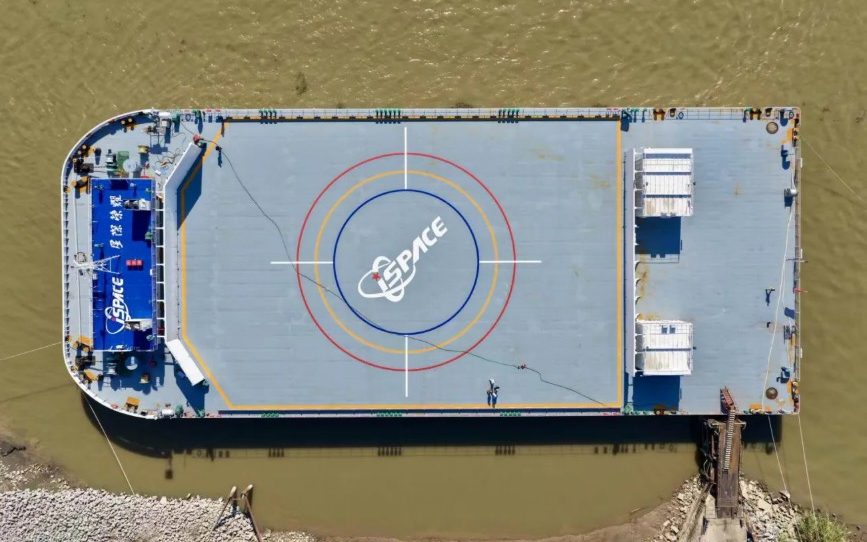
The company launched what it described as the country’s first rocket recovery ship in August 2025, with the vessel subsequently undergoing testing. “Interstellar Return” is 100 meters long and 42 meters wide and is designed to recover the first stage of the Hyperbola-3 rocket. While designed for the Hyperbola-3, it can also accommodate recovery of other medium- and large-scale reusable rockets. Earlier statements suggest the two-stage Hyperbola-3 is 69 meters long with a payload capacity of 8,500 kilograms to low Earth orbit in reusable mode and 13,400 kg to LEO in expendable mode.
iSpace has attracted the massive funding round despite strong competition from other launch startups. The company became the first Chinese commercial firm to reach orbit in July 2019 with the Hyperbola-1 solid rocket, yet the launcher has since flown just seven more times, including four failures.
Landspace, another of the earliest Chinese privately-backed launch companies, abandoned its solid rocket, Zhuque-1, after a failed first launch, and has since launched the methalox Zhuque-2 and Zhuque-3 rockets, with the latter’s debut flight making China’s first orbital booster recovery attempt in December 2025. Galactic Energy has established its Ceres-1 solid rocket and is preparing for first launches of its Pallas-1 and larger Pallas-2 kerosene-liquid oxygen potentially reusable rockets. Space Pioneer, Orienspace, Deep Blue Aerospace and newer entrants are also working towards debut flights of reusable launchers. These competitors are aiming to secure contracts to launch satellites for the country’s megaconstellation projects, notably Guowang and Qianfan.
A number of companies are also exploring or preparing for initial public offerings as the sector matures, including Landspace and Space Pioneer, both of which have also signaled efforts to develop full-flow staged combustion engines for new-generation rockets.
Related