
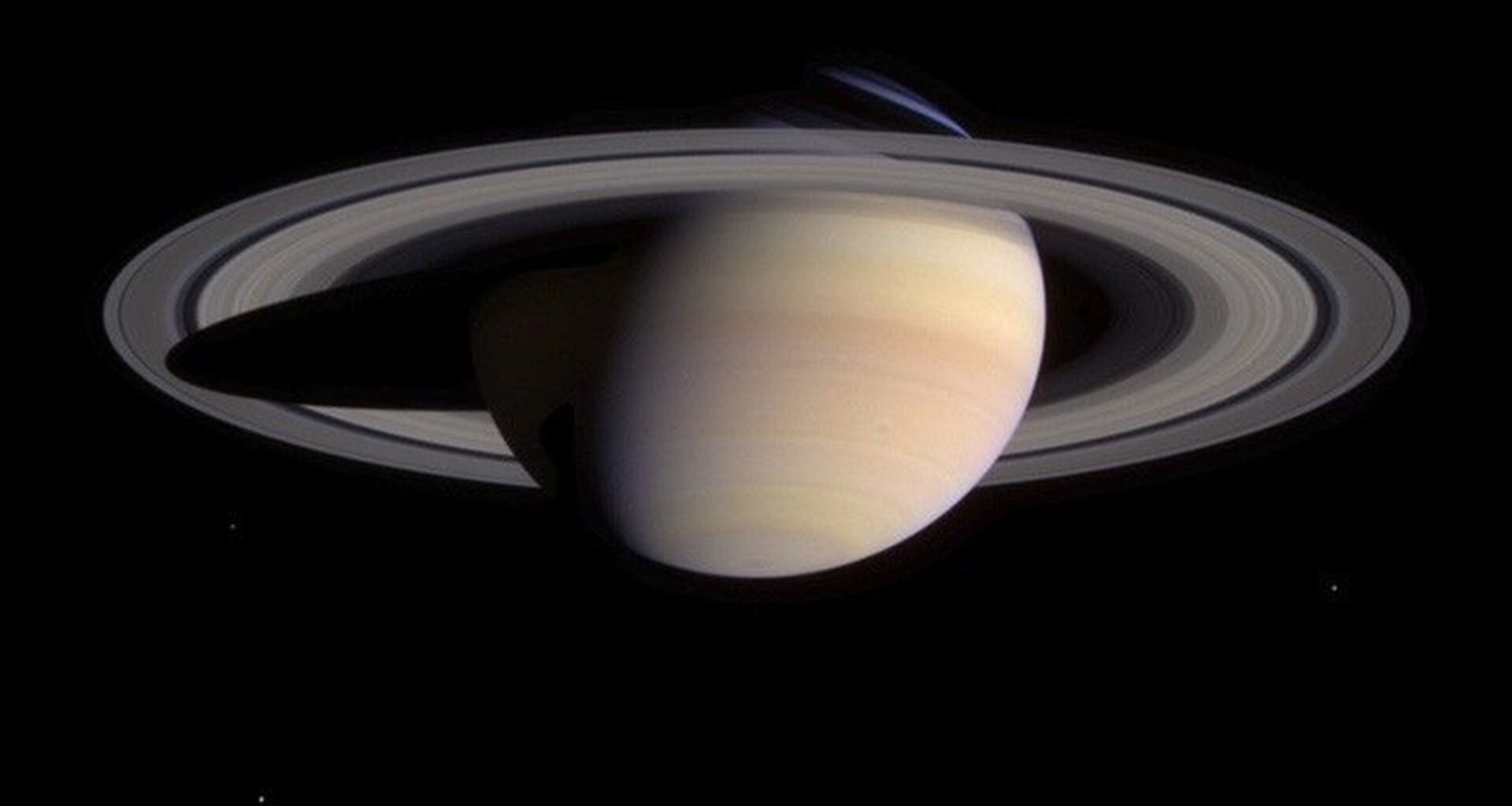
Saturn’s largest moon, Titan, may have formed in a collision with another moon, and the same chain of events may have later created the planet’s bright rings, according to new research led by the SETI Institute.
The study links several long-standing mysteries: the young age of Saturn’s rings, Titan’s unusual orbit, and the strange behavior of smaller moons such as Hyperion and Iapetus.
Using computer simulations, researchers argue that Titan is likely the product of a merger between two earlier moons.
The idea builds on data from NASA’s Cassini mission, which spent 13 years orbiting Saturn. Near the end of its mission, Cassini measured Saturn’s internal mass distribution.
That measurement showed the planet’s mass is more concentrated toward its center than scientists expected, changing the rate of its slow spin-axis wobble, known as precession.
For decades, scientists thought Saturn’s precession matched Neptune’s, allowing gravitational interactions between the two planets to gradually tilt Saturn and make its rings visible from Earth.
Cassini’s final data showed that the match no longer exists. To explain the discrepancy, earlier researchers proposed that Saturn once had an extra moon that was later ejected after interacting with Titan, eventually breaking apart to form the rings.
Clues from tumbling Hyperion
The new study tested whether such an extra moon could instead have collided with Titan. Simulations showed that a merger was more likely than a simple ejection.
Hyperion, a small, irregular moon that tumbles chaotically, turned out to be central to the case. It is locked in an orbital resonance with Titan.
“Hyperion, the smallest among Saturn’s major moons provided us the most important clue about the history of the system,” said Ćuk.
In many simulations, when the extra moon became unstable, Hyperion was lost. The team realized that the Titan-Hyperion orbital lock appears relatively young, only a few hundred million years old.
That timing overlaps with the disappearance of the proposed extra moon.
“If the extra moon merged with Titan, it would likely produce fragments near Titan’s orbit. That is exactly where Hyperion would have formed.”
The researchers propose that Titan formed from a merger between a nearly Titan-sized Proto-Titan and a smaller Proto-Hyperion.
The impact could explain Titan’s relatively smooth surface and limited number of impact craters. A major collision would have resurfaced the moon.
Titan’s slightly elongated orbit, which is now becoming more circular, also suggests a recent disturbance consistent with such a merger.
The study further suggests that before disappearing, Proto-Hyperion tilted the orbit of Iapetus, another distant moon, potentially solving another long-standing puzzle.
Rings from resonant chaos
The model also offers a path to forming Saturn’s rings. Previous work suggested that collisions among medium-sized inner moons could have produced debris, with some material spreading inward to form rings. The new research argues that Titan’s post-merger orbit could have destabilized smaller inner moons through orbital resonance.
When their orbital periods aligned in simple fractions with Titan’s, gravitational effects would have intensified, stretching their orbits and triggering collisions.
Most debris from those impacts would have reassembled into new moons. A smaller fraction would have remained in orbit as icy fragments, forming the rings.
The timing of this second disruption is uncertain, but it likely occurred after Titan’s merger and aligns with estimates that Saturn’s rings are about 100 million years old.
NASA’s Dragonfly mission, scheduled to arrive at Titan in 2034, could help test the hypothesis. The nuclear-powered rotorcraft will study Titan’s surface and chemistry and may uncover evidence of a massive moon-moon collision.
The study was accepted for publication in The Planetary Science Journal.
With over a decade-long career in journalism, Neetika Walter has worked with The Economic Times, ANI, and Hindustan Times, covering politics, business, technology, and the clean energy sector. Passionate about contemporary culture, books, poetry, and storytelling, she brings depth and insight to her writing. When she isn’t chasing stories, she’s likely lost in a book or enjoying the company of her dogs.