

The Board of Peace’s High Representative for Gaza Nickolay Mladenov said at the Munich Security Conference on Friday that the Palestinian technocratic committee tasked with governing Gaza in place of Hamas cannot enter the Strip if violations of the ceasefire continue.
“We need to make sure that what is happening now with the violations of the ceasefire stops,” said Mladenov, without placing blame on either Israel or Hamas. “If you put the committee tomorrow in Gaza and the violations of the ceasefire continue the way they are now. We’re only embarrassing the committee and ultimately making it ineffective.”
Under US President Donald Trump’s Gaza ceasefire plan, the National Committee for the Administration of Gaza (NCAG), a committee of Palestinian technocrats unaffiliated with Hamas or the Palestinian Authority, is supposed to oversee the reconstruction of the devastated Strip, with backing from the US-led Board of Peace. Mladenov, a former Bulgarian minister and UN envoy to the Mideast, took on his central role on the Board last month.
Mladenov’s comments came as IDF Chief of Staff Lt. Gen. Eyal Zamir said on Friday the military would “respond to any violation” and would not give up on the war objectives of demilitarizing the Strip and disarming Hamas. Zamir, who was visiting Gaza, confirmed that the army has such plans ready to go if the government orders it.
Israel has carried out daily strikes on what it says are terror operatives in Gaza. According to the Hamas-run Gaza health ministry, the death toll since the October ceasefire stands at nearly 600 and includes scores of women and children.
Get The Times of Israel’s Daily Edition
by email and never miss our top stories
By signing up, you agree to the terms
On Friday, the IDF said it had carried out an airstrike against two terror operatives who entered a building on the Israeli-controlled side of the ceasefire line in northern Gaza Thursday night. The air force struck the building “to remove the threat” after the operatives were identified by reservists of the Alexandroni Brigade,” the IDF said.
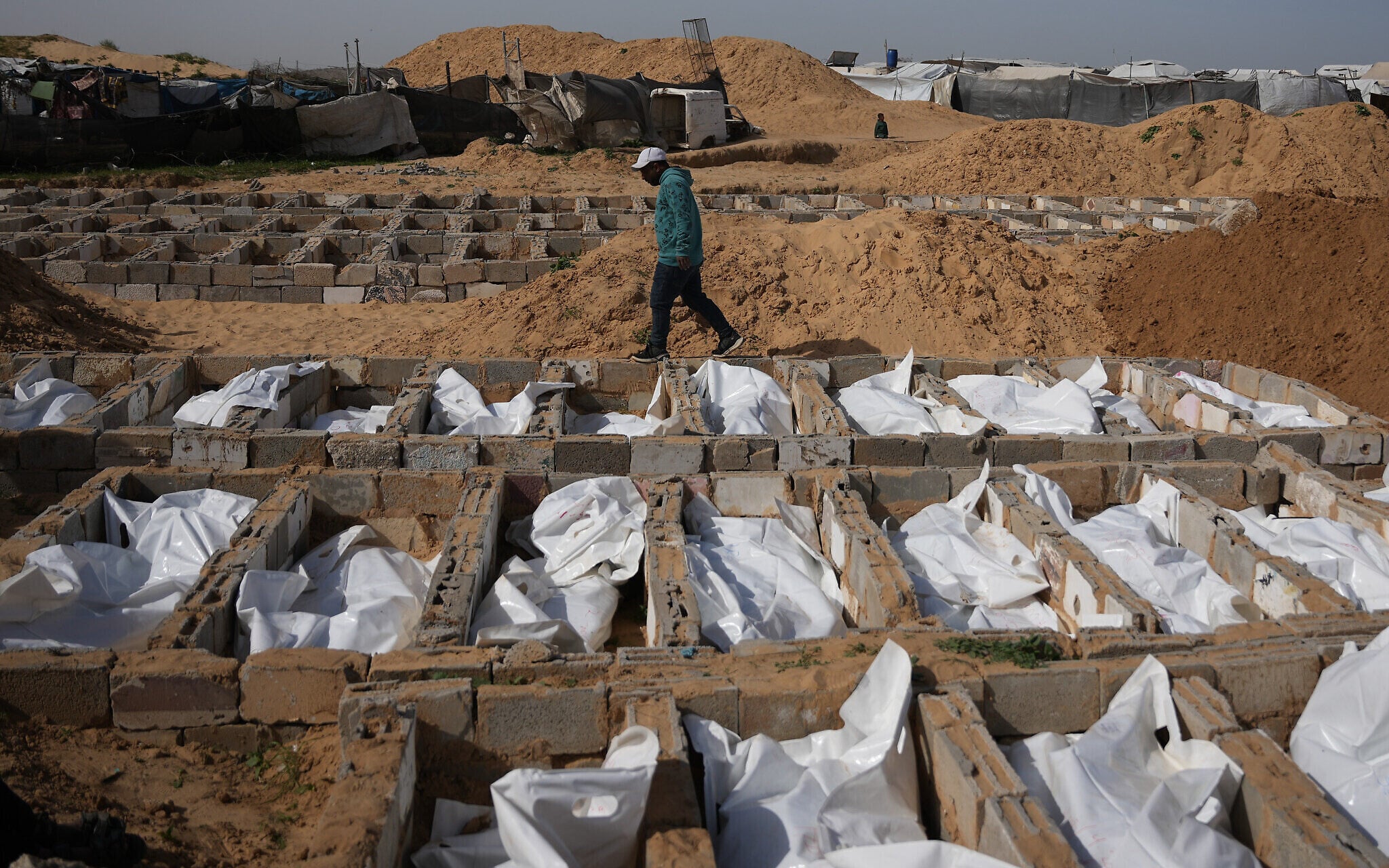
A man walks past graves containing the bodies of unidentified Palestinians returned from Israel as part of the Gaza ceasefire deal, during their burial in Deir al-Balah, in the central Gaza Strip, February 13, 2026. (AP Photo/Abdel Kareem Hana)
Also on Friday, a Hamas delegation headed by the terror group’s top negotiator Khalil al-Hayya arrived in Cairo for talks slated to focus on disarmament, an Arab diplomat told The Times of Israel.
Such talks have been taking place for months, but have been largely theoretical since the US has yet to put together a proposal on the decommissioning of weapons that can be formally presented to Hamas.
A US official told The Times of Israel earlier this week that Washington is expected to present its disarmament plan in the coming weeks, but no exact date has been set. In the meantime, Mideast mediating countries Egypt, Qatar and Turkey have been holding talks with Hamas officials to get an understanding of what the group would be willing to accept.
In the absence of an alternative governing body, Hamas has managed to bolster its control on its side of the Yellow Line, to which Israel retreated under the October 9 Gaza ceasefire agreement.
The US took until January to unveil the members of the NCAG, after Israel dragged its feet on approving the names of potential participants, said the Arab diplomat who spoke with The Times of Israel.
Hamas must cede control and disarm, says Mladenov
In the rare public comments since he took on his role, Mladenov, speaking on a panel at the Munich conference, warned against “cementing” the status quo in which the Strip is divided between Israeli- and Hamas-controlled sides.
The way to prevent this was to let the NCAG enter Gaza and take the reins from Hamas, said Mladenov, adding that five conditions had to be met for that to happen.
The first condition, he said, was that Hamas must transfer control over civilian institutions to the NCAG. While the terror group has said it is in the process of doing this, Mladenov stressed that the process is complicated and “requires a little bit more careful planning and verification” — a possible nod to concerns that Hamas would quietly keep controlling government offices behind the scenes.
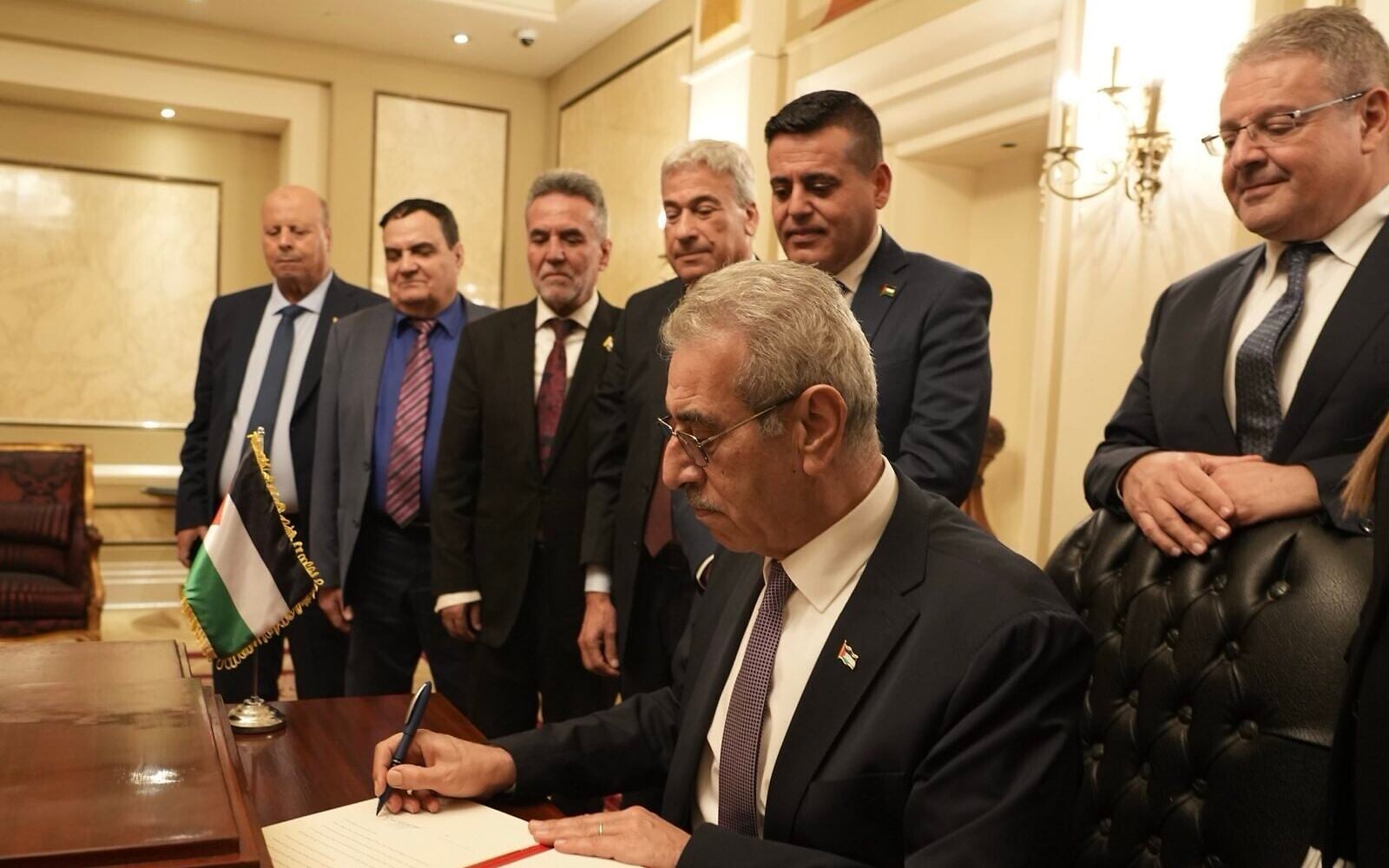
Ali Shaath, the top official of the National Committee for the Administration of Gaza, signs the committee’s mission statement in a photo posted to his X account on January 17, 2026. (Ali Shaath/X)
The second condition for the NCAG to be able to govern in Gaza is that ceasefire violations in Gaza must end, said Mladenov.
The third condition, he said, was that there be “a radical increase in the aid going into Gaza — materials that have been long needed: temporary housing, tents, caravans, medicine, food — everything that is required… so people can quickly see some basic change in their lives.”
Israel maintains a strict ban on dual-use items that it deems capable of being turned into weapons, even as humanitarian organizations have warned that the ban covers life-saving items such as viable shelters from the wind and rain for hundreds of thousands of displaced Palestinians.
The fourth condition cited by Mladenov for NCAG governance is that adequate resources must be procured for the committee. The Board of Peace is slated to host a fundraising meeting in Washington on Thursday, where the US plans to announce several billion dollars in donations, largely from the Gulf countries of the United Arab Emirates, Kuwait and Qatar, Arab diplomats told The Times of Israel this week.
The fifth and final condition is that “we need to make sure that we have an agreed framework in place on the decommissioning of weapons in Gaza,” said Mladenov. Hamas has publicly rejected calls to disarm, but Arab diplomats say the group has privately expressed more flexibility.
New Gaza police expected to play greater role
Mladenov indicated that the new Palestinian police force set to be deployed in Gaza will play a greater role in the decommissioning process than will the still-unestablished International Stabilization Force that is also meant to deploy in Gaza, under Trump’s plan.
The police force “should be able to secure the ground, with the assistance of the ISF. Because if we are relying on international troops — no matter where they come from — to police Gaza, we have a very wrong approach,” Mladenov said.
Earlier this week, two Arab diplomats told The Times of Israel that after initial plans for the NCAG to enter Gaza in late January and early February, those involved now recognize that a specific timeline for the entry cannot be given because the technocratic body doesn’t yet have the tools necessary to govern the enclave.
Asked about the financial priorities of the Board of Peace once it secures its funding, Mladenov said the first aim will be to expand humanitarian aid, the second will be emergency recovery and the third will be security.
“For Gaza to be reconstructed in a way that is sustainable — one, we need to have the [NCAG] inside effectively governing; two, we need to have the process of decommissioning of weapons; and three, we need Israeli withdrawal,” Mladenov said.
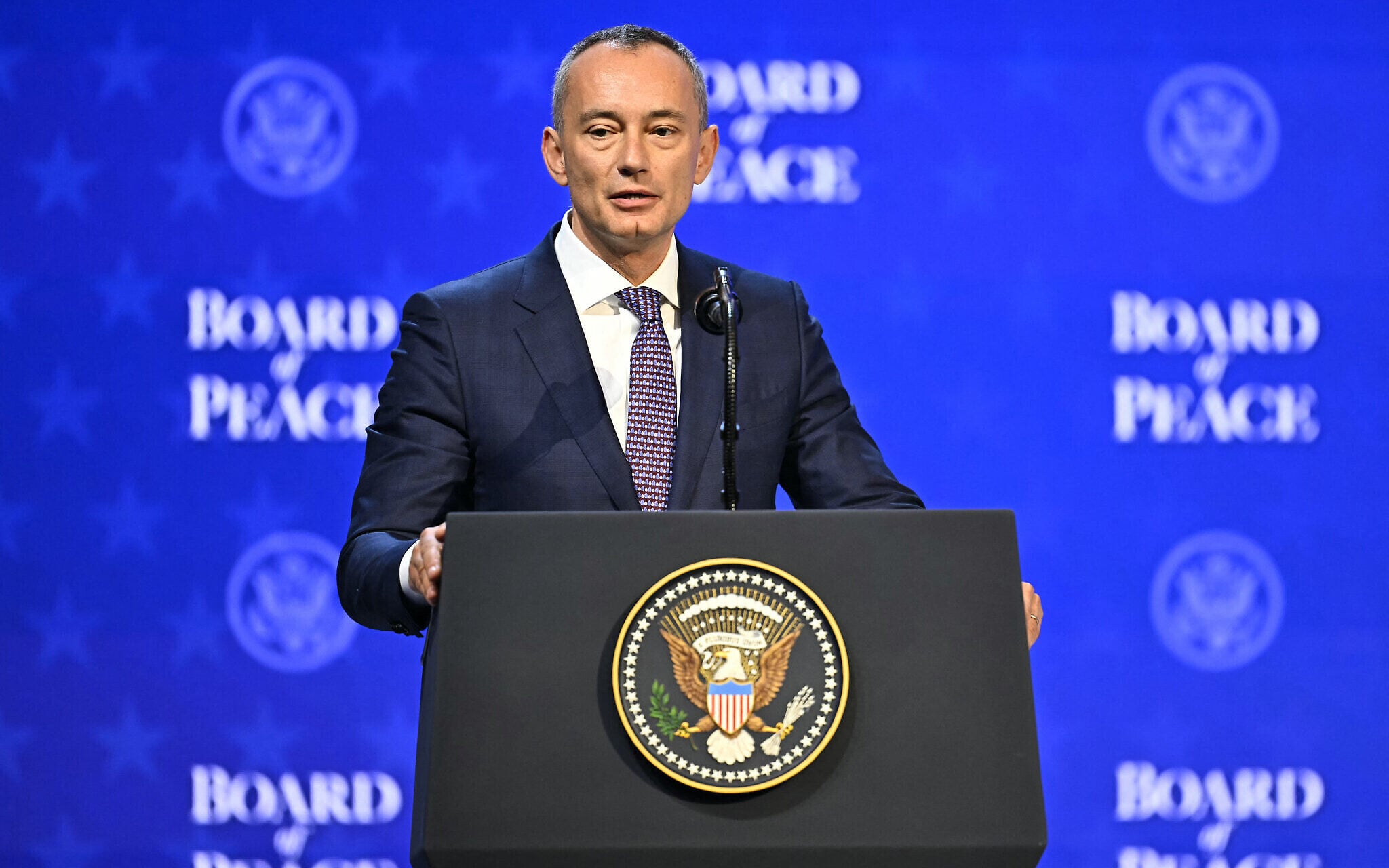
Nickolay Mladenov, high representative for the Board of Peace, speaks at the board’s meeting during the World Economic Forum (WEF) annual meeting in Davos, Switzerland, on January 22, 2026. (Fabrice COFFRINI / AFP)
Trump’s Gaza peace plan envisions Israel withdrawing from the Yellow Line in tandem with Hamas’s disarmament. However, Prime Minister Benjamin Netanyahu has insisted that Israel will maintain overarching security control of the Strip, and Defense Minister Israel Katz has claimed the IDF will also maintain a physical presence in the enclave.
Pressed on where he sees Gaza one year from now, Mladenov said he hopes the NCAG will govern the Strip in cooperation with the Palestinian Authority.
“I hope that we will be significantly advanced on deploying a new security force of Palestinians inside Gaza and Hamas would have given up a significant part of its weapons so that… Israel can withdraw from the Yellow Line,” he said — suggesting Hamas will not have given up all its weapons by then.
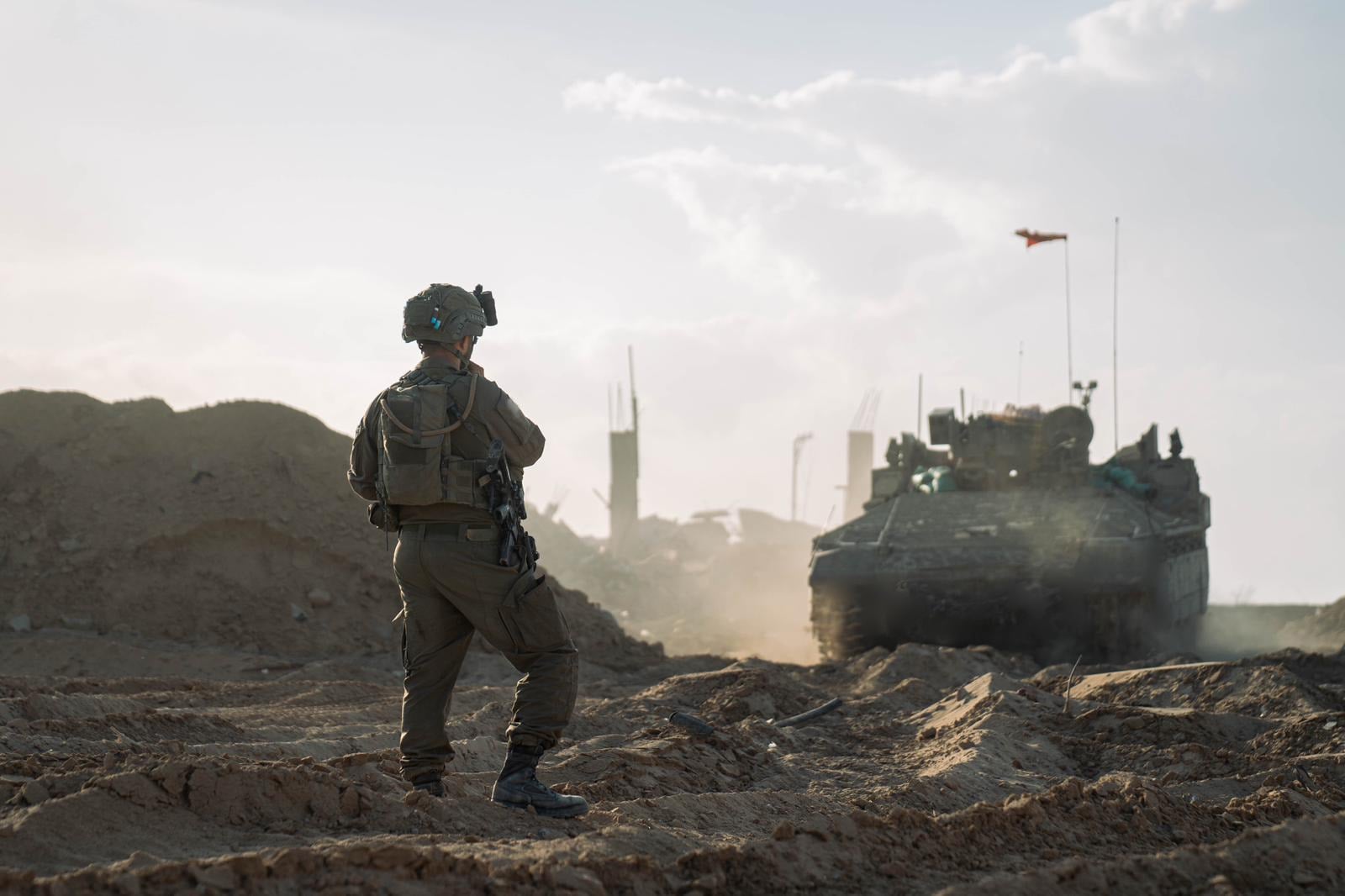
Troops with the IDF’s Golani Brigade seen operating in Rafah near the Yellow Line in Gaza in this handout photo cleared for publication on December 15, 2025. (IDF)
Two sources familiar with discussions about the US decommissioning plan for Hamas told The Times of Israel earlier this week that its fundamental principle will be stripping Hamas of weapons that can be used to threaten Israel.
The plan envisions Hamas handing over heavy weaponry and destroying manufacturing sites in addition to incentivizing the handover of lighter weapons by offering funds, jobs and amnesty to those who cooperate, the sources said.
The proposal will focus on one section of Gaza at a time, rather than the entire Strip at once. Accordingly, it will take months to finish, the sources added.
While this may not lead to the recovery of every single weapon belonging to terror groups in the Strip, the US thinks enough pressure from mediators Egypt, Qatar and Turkey can prevent Hamas from holding on to power, keeping its weapons and carrying out attacks.
Focus on immediate aid to Gazans
NCAG’s governance in Gaza, Hamas disarmament and Israel’s withdrawal “are critical if we are ever to return back to the political resolution of the Palestinian question,” said Mladenov. “Because the political resolution of the Palestinian question requires negotiation. It requires one Palestinian leadership over the entire occupied territory, and it requires a dialogue that is facilitated by the United States, Europe and others.”
Mladenov also noted that the November UN Security Council resolution mandating the Board of Peace to oversee Gaza includes a requirement for the PA to undergo significant reforms so that it can replace the NCAG in Gaza “at the end of the transition period.”
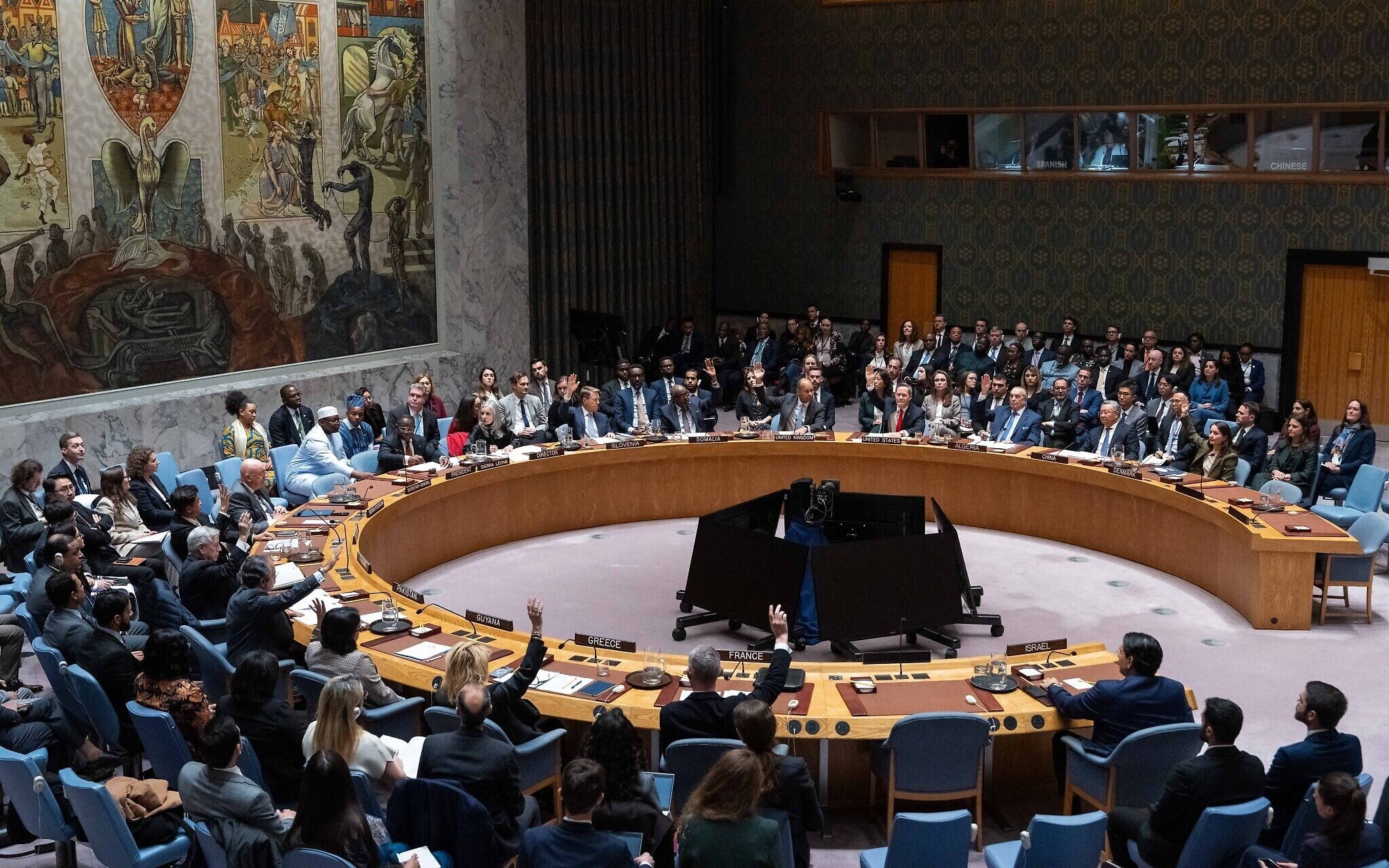
Members of the UN Security Council raise their hands to vote in favor of a draft resolution to authorize an International Stabilization Force in Gaza, on November 17, 2025 at UN headquarters in New York City. (Adam Gray/Getty Images/AFP)
Meanwhile, he pushed back on the notion that the Board of Peace and its executive boards will be overseeing the NCAG, arguing that those bodies will instead provide “support, guidance and assistance” to the technocratic committee.
Mladenov said he is focused on getting immediate relief to Gazans.
“Our focus needs to be on making sure that the people of Gaza receive the aid that they require right now, that we put in transparent institutions of governance in Gaza that they have not had for 20 years, and that we make sure that there are no weapons beyond the control of the transitional authority in Gaza.”
He argued that solving the broader Israeli-Palestinian conflict cannot be done if the more immediate issues in Gaza are not addressed.
“Under the current conditions, with Hamas still in Gaza and Gaza divided into two, we’re setting ourselves up for complete and utter failure if we don’t address that. And the price of that daily failure will be paid both by Palestinians and Israelis down the line,” Mladenov said.
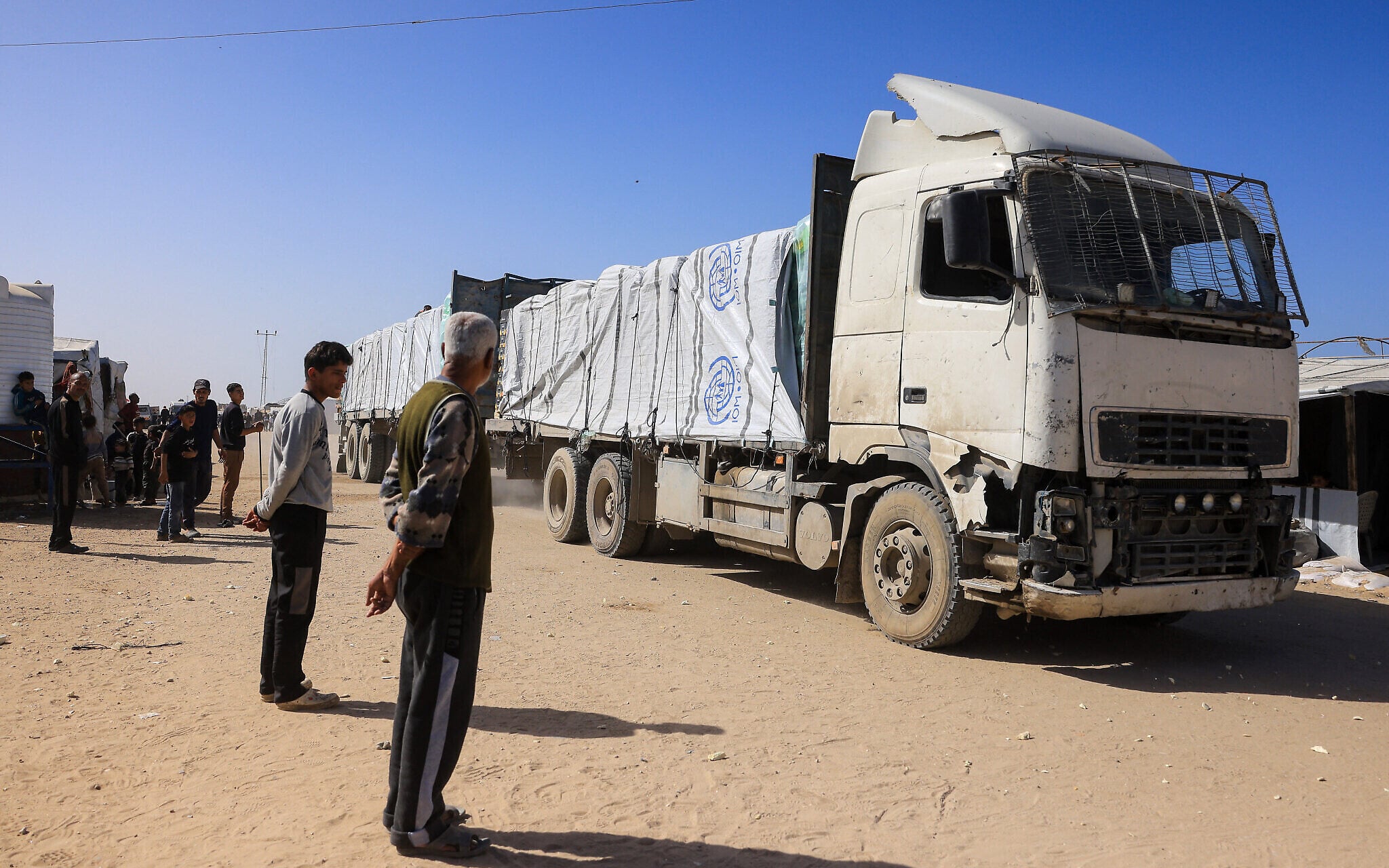
Palestinians look on as trucks carrying humanitarian aid arrive in Khan Younis in the southern Gaza Strip on February 1, 2026. (Bashar Taleb / AFP)
Also participating in the panel was senior Emirati official Anwar Gargash, who laid out the framework of Abu Dhabi’s involvement in Gaza.
While the UAE will not contribute troops to the ISF, it will continue leading the humanitarian efforts and leveraging its ties with Israel so that Jerusalem can “see the other perspective,” Gargash said.
He argued that while the immediate focus in Gaza must be on surging humanitarian aid into Gaza, advancing such a response would be futile without a political horizon for Palestinians.
Asked about the absence of a Palestinian representative on the Board of Peace, Gargash said that this should be changed.
“A more equal situation will be for the Palestinians to have their voice — not only on the Board of Peace, but everywhere. Because they are one of the principles, as much as the Israelis are,” he said.
PA President Mahmoud Abbas was not invited by the US to attend the inaugural Board of Peace meeting in Gaza. An Arab diplomat told The Times of Israel that the PA has sought to recruit its allies to convince the US to offer it a spot on the Board of Peace, but Washington has held off on including Abbas. Instead of Abbas, the US has invited NCAG chief commissioner Ali Shaath to attend the Washington event.
Emanuel Fabian contributed to this report.