

Listen to this article
Estimated 4 minutes
The audio version of this article is generated by AI-based technology. Mispronunciations can occur. We are working with our partners to continually review and improve the results.
Canada has raised the quota for lucrative commercial fishery for juvenile eels by 22 per cent for the coming season, and will allow 12,180 kilograms to be fished along Nova Scotia and New Brunswick rivers in 2026.
This marks the first change to the elver quota by the Department of Fisheries and Oceans in 20 years. The previous total allowable catch had remained at 9,960 kilograms since 2005.
DFO communicated the decision to licence holders earlier this month.
“The increase is supported by the best available science, which shows increased trends of elver returns observed on the index river used to evaluate population size,” DFO said in an email to CBC this week.
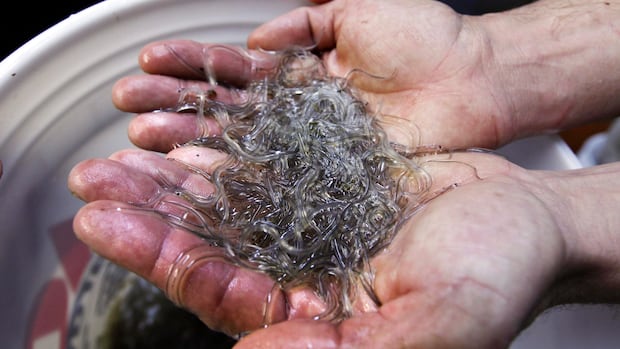
The juvenile American eels, called elvers, are fished during the spring in Nova Scotia and New Brunswick, and then shipped live to Asia where they are raised in aquaculture facilities for food.
DFO said future decisions on the total allowable catch “may allow for increases with the goal of a 50/50 balance of quota between commercial and communal commercial licence holders.”
Consultations regarding the allocation for the 2026 total allowable catch are still ongoing. The quota includes 180 kilograms to “allow for more science on the elver stock.”
Support and skepticism
The decision to increase the overall quota is being met with support from some commercial fishermen and skepticism from some conservationists.
Mitchell Feigenbaum, the president of licence-holder South Shore Trading, said in a phone interview this week that the decision is “a long overdue.”
He said stakeholders have been suggesting DFO increase the total allowable catch as there are more people entering the fishery and the species stock is strong and healthy.
“This is good news. More to go around means people don’t have to fight over the quota as much,” Feigenbaum said. “It’s always good when the pie increases. If the government has to slice the pie up, we want the pie to be of a reasonable size.”
Feigenbaum said the industry hopes the quota increase will also help tackle the illegal fishing.
“We hope this will take pressure away from illegal fishing,” he said. “That’s not a good thing for the species or the public and people’s confidence in law enforcement.”
Demand from the Asian market has meant elvers in some years fetched a price of $5,000 per kilogram internationally, but the fishery has caused chaos along the rivers.
Between 2020 and 2024, DFO shut down the elver fishery three times citing “significant quantities of elvers being fished illegally” and “harassment, threats and violence between harvesters and toward fishery officers.”
Last year, DFO redistributed 50 per cent of the fishery access and total allowable catch to First Nations communities, and decided not to list the American eel as a species at risk.
Limited science
In a statement, the marine conservation group Oceans North expressed its disappointment in DFO’s decision to increase the quota and questioned the science behind it.
“The stock is not increasing, there is uncertainty around the science, and illegal, unreported and unregulated fishing remains an issue. In light of this, we question whether an increase of this size can be justified or sustained,” said the statement.
John Couture, a senior fisheries advisor with Oceans North, said in an interview the index DFO uses for observing elver population has been “scientifically in jeopardy for a number of years.”
He said the research efforts for elvers are under-resourced and often incomplete due to disruptions from illegal fishing and fishery closures.
“With so many unknowns and insufficient science to make a decision, increasing the quota by 22 per cent is almost looking for a disaster to happen,” Couture said.
“It’s a sorry state for eels. I mean that they’re losers in this.”
MORE TOP STORIES