
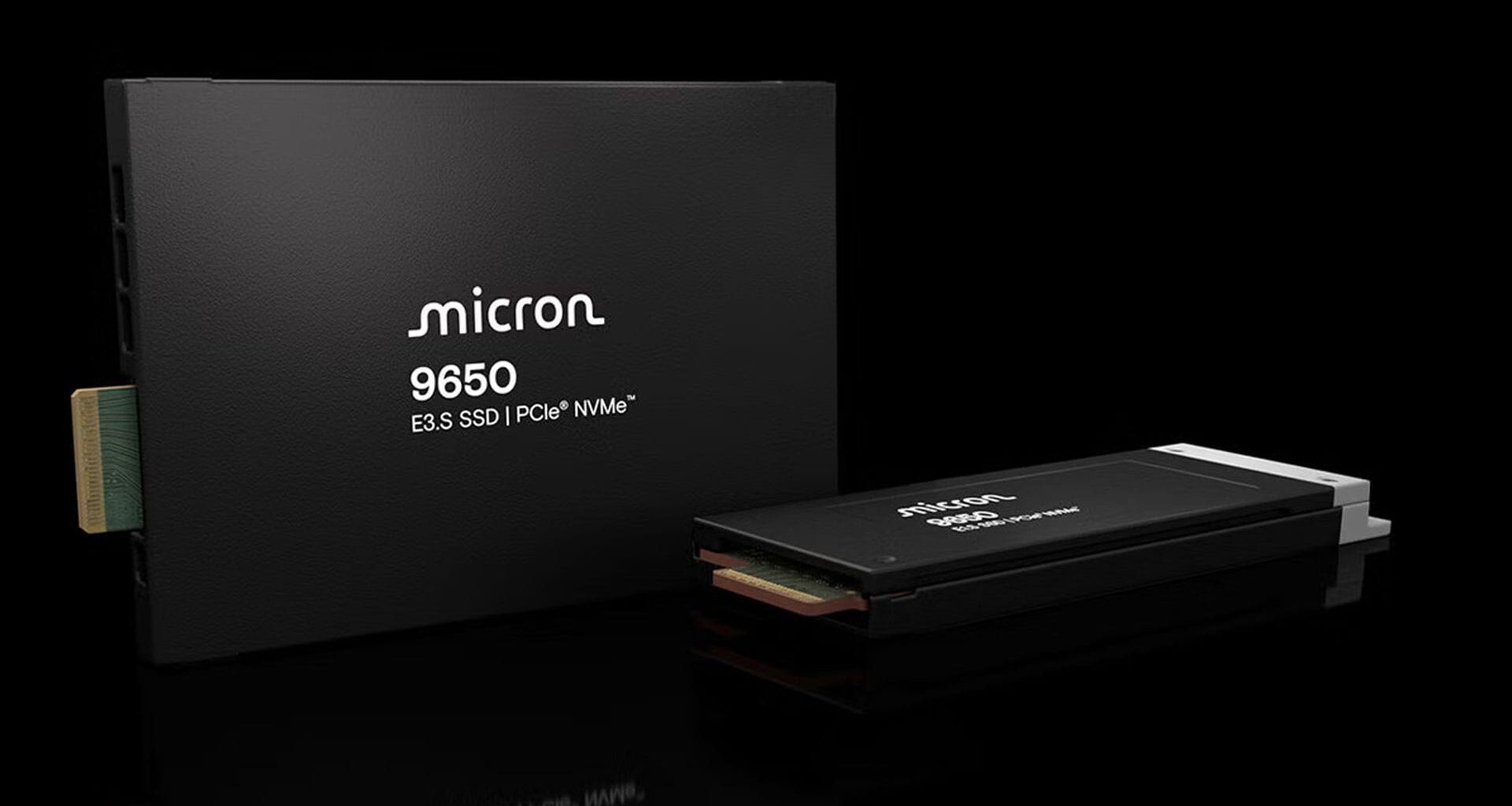

Micron recently announced mass production of its 9650 NVMe SSD supporting PCIe Gen6. Following its decision to exit the consumer memory market in December 2025, this launch shapes up as an interesting turn of events. First, the company is claiming significant improvements in the drive’s read and write speeds; second, liquid cooling is incorporated; and last but not least, there are various size configurations across E3.S and E1.S form factors. Here’s everything you need to know.
Read more: Microsoft is reportedly working to bring back taskbar location customizations in Windows 11
Micron 9650 SSD specifications and performance
9650 featured image (Image via Micron)
The company claims the 9650 SSD delivers sequential read speeds of up to 28 GB/s and sequential write speeds of up to 14 GB/s. For context, this throughput is twice the bandwidth of PCIe Gen5 drives. For random operations, the drive delivers 5.5 million IOPS for reads and 900,000 IOPS for writes, representing 67% and 22% improvements over Gen5 SSDs, respectively.
In terms of storage, the drive is available in multiple capacity ranges, starting at 7.68TB up to 30.72TB, and is offered in both E3.S and E1.S form factors with air-cooled and liquid-cooled configurations.
As for operating temperatures, the company states the drives can be used in environments from 0°C to 70°C. Regarding power consumption, it draws up to 18W during sequential reads and up to 16W during sequential writes. Below is a table detailing the claimed specifications.
SpecificationMicron 9650 NVMe SSDInterfacePCIe Gen6 x4Form FactorsE3.S, E1.SCooling OptionsAir-cooled, Liquid-cooledCapacities7.68TB, 15.36TB, 30.72TBSequential Read SpeedUp to 28 GB/sSequential Write SpeedUp to 14 GB/sRandom Read IOPSUp to 5.5 millionRandom Write IOPSUp to 900,000Power Consumption (Read)Up to 18WPower Consumption (Write)Up to 16WOperating Temperature0°C to 70°CGen5 Improvement (Read)67% higher IOPSGen5 Improvement (Write)22% higher IOPS
Read more: Dell Inspiron 14 5445 vs ASUS Vivobook 14 (2025): Which is the better laptop?
Efficiency and market position
Thanks to such lower power consumption figures at incredibly high read-write speeds, Micron claims the 9650 delivers 2x better efficiency than the older Gen5 drives. In simple terms, for every watt of electricity used, the drives do twice the work compared to older ones.
This is significant for data centers because power is often the primary limiting factor when operating on the grid. By maintaining the same 25-watt power limits as older drives while doubling speed, Micron enables companies to upgrade their systems without overhauling the electrical components in their data centers.
With that being said, Micron positions this drive specifically for AI use cases, as it is heavily tuned for AI-related workloads. The drive targets complex tasks such as “Retrieval-Augmented Generation” (RAG), which is the process the AI model uses to quickly retrieve new information to answer your questions accurately.
We can now understand why the company has decided to exit the consumer memory market, as it is shifting its entire focus to building the foundation on which AI continues to run.
Why did you not like this content?
Cancel
Submit
Was this article helpful?

Thank You for feedback
Edited by Mainak Kumar Dey