
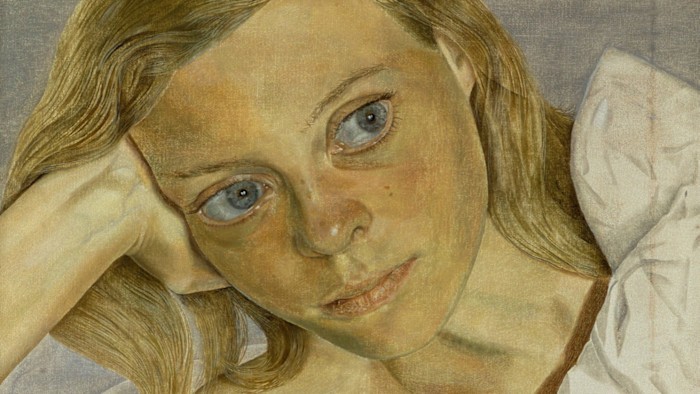
As a young man, Lucian Freud disliked praise for his devastatingly candid, unsparing, forensic draughtsmanship: “The idea of doing painting where you’re conscious of the drawing and not the paint just irritated me.”
But later, confidently the virtuoso of monumental, meaty paint-as-flesh figures, he changed his stance: “Being able to draw well is the hardest thing, far harder than painting, as one can easily see from the fact that there are so few great draughtsmen compared to the number of great painters — Ingres, Degas, Van Gogh, Rembrandt, just a few.”
The marvellous, insightful Lucian Freud: Drawing into Painting at London’s National Portrait Gallery shows that he ranks alongside those rare masters, and created some of the 20th century’s most distinctive portraits on paper.
Across half a century and a diversity of media, his instinct for the essential, the indelicate and the confrontational give the exhibition riveting consistency
“Francis Bacon” (1951), shirt and trousers undone, flexes his hips, sexually aggressive in crayon and chalk. Dishevelled, craggy “Lord Goodman in his Yellow Pyjamas” (1987) is “unshaved and unwashed” in a flamboyant etching dashed with buttercup yellow. Picasso’s biographer “John Richardson” (1998), in charcoal and paint, said he was “confronted with the real me — apprehensive, not to say fearful — which I usually try to conceal under a mask of confidence and geniality.”
Richardson’s small-scale depiction was a preparation for Freud’s condensed “Queen Elizabeth II” (2000-01) — and here she is, tight-lipped, stoical: a weary old lady transformed into an extraordinary presence by her steely look and the weight of her glinting impasto-heavy diadem.
Freud generally portrayed the young with prophetic ruthlessness — both his tearful lover Celia Paul, 22, in “Head of a Girl”, and Deborah, Duchess of Devonshire, painted in her late thirties for “Woman in a White Shirt”, look decades older. But he was also an outstanding, heartbreaking chronicler of actual old age, especially his widowed, depressed mother. In a sculptural charcoal drawing, with white highlights for wavy hair and broad brow, in an etching in knotty lines, frontal with a direct gaze, and in the defiantly absorbed “The Painter’s Mother Reading” (1975), she compels as a beleaguered woman clinging to her fierce intelligence and inner life.
 An incomplete etching titled ‘Bella in her Pluto T-Shirt’ (1995)
  ‘Bella in her Pluto T-Shirt’ (1995) © Lucian Freud Archive
Across half a century and lively diversity of media — ink, chalk, pastel, crayon, etchings, plus three dozen carefully selected oils — Freud’s instinct for the essential, the indelicate, the confrontational, his intensification of the real, give the exhibition riveting consistency and integrity. Meanwhile, a number of unfinished pieces and etchings in several states, such as “Bella in her Pluto T-shirt”, bear witness to how, as his daughter Bella Freud recalls in the catalogue, when “things would go wrong . . . he never gave up, he never stopped”.
The show is original and full of rare things. Its impetus was 48 sketchbooks that the NPG received from Freud’s estate in 2015-24, a stash beginning with charming childhood illustrated letters in the Sütterlin script taught in 1920s German schools — “gothic writing with so many loops that I could fill in with colour”, Freud remembered. Of greatest interest are works on paper relating to major paintings, illuminating his thought process and the evolving role of drawing.
In wartime Britain, the refugee from Berlin initially brought a mournful, crystalline exactitude redolent of the Neue Sachlichkeit movement — the wide-eyed “Boy with a Pigeon”, “Young Man” in crayon and conté/chalk (both 1944) — and the idiosyncratic detail of German graphic tradition, as in the figure towering over little streets and rooftops “Man and Town” (1941).
 ‘Portrait of a Young Man’ (1944) © Lucian Freud Archive
“The Ingres of existentialism,” declared art critic Herbert Read when virtuosity shot Freud to fame in the late 1940s. Everyone in his early portraits looks terrified — from his first wife, Kitty Garman, buttoned into a bus conductor’s uniform in “Girl in a Dark Jacket (1947)”, strands of hair standing up as if electrified, to the toy monkey spreadeagled, grinning miserably, who shares a cradle with a plump-cheeked baby in the conté sketch “Juliet Moore Asleep” (19443). Plants compete with people to destabilise near-surreal dramas: “Self-portrait with Hyacinth (1948)”, “Girl with a Fig Leaf (1947)”.
Pivotal to the story of Freud’s development, a luminous early room contrasts portraits of his second wife, Guinness heiress Caroline Blackwood — inspiration for his beautiful “Girl in Bed” (1952) and its queasy successor “Hotel Bedroom” (1954), where the couple seem disconnected and Freud himself is a menacing shadowy column — with “Woman Smiling” (1958-59), his first, larger-than-life-size, painterly portrait of his girlfriend, Suzy Boyt.
The Caroline pictures are tightly linear, freckles and bitten fingernails picked out with a fine sable brush, similar to silverpoint drawing. Yet the enlarged shining blue eyes disconcertingly exceed realism: Freud’s close-up concentration sometimes led, he said, to “involuntary magnification”. In childlike round handwriting encircling a sketch of the pair embracing, he addresses “my dearest Caroline, I am feeling heavy with sadness this morning I can hardly move. I miss you so much. I have quite forgotten what you are like.” Presence, you sense, is everything.
 Freud’s 2002 portrait of David Hockney © Lucian Freud Archive
For “Woman Smiling”, Freud switched from sable brushes to coarser hog’s hair bristles, abandoning smooth flatness for full contours and gestural marks. Detail remains strong — mottled complexion, folding, puckering skin — while thick impasto gives a fleshy feel and new plasticity. Watercolour experiments around 1960, such as “Ama in Venice”, Freud’s daughter Annabel with flowing hair in warm orange-brown washes, filling a page in a Venetian sketchbook, further loosened his handling.
Although from then onwards he drew less, a revelation is the numerous studies for his 1983 painting “Large Interior W11”, featuring Boyt, her son Kai, Paul, and Bella in an outlandish reprise of Watteau’s group “Pierrot Content”, borrowed here from Madrid. Turpentine and charcoal portraits — Boyt holding a leaflike fan in “Woman with Geranium”, Bella in scratchy brocade dress, strumming a mandolin — blur lines between painting and drawing; Freud at that time began canvases with direct charcoal strokes pulled with turpentine-soaked rags.
The show’s largest painting, the majestic “Sleeping by the Lion Carpet” (1996), displayed alongside huge drawings of model Sue Tilley, inaugurates the extravaganza of late Freud. The grandeur of Tilley’s undulating flesh is matched by the predatory big cat on the hanging rug: a complicity between human, animal, textile. “Lucian observes the individuality of every inanimate and animate object with the same level of concentration,” says David Dawson, director of the Lucian Freud Archive.
Recommended

Displayed alongside the great portrait “David Hockney” (2002), gazing intently over his glasses, returning Freud’s scrutiny — it took “120 hours and you see the layers”, Hockney recalled, and crucially, “he let me smoke” — are the monumental etched heads, the key late graphic works, which have tremendous gravitas: Dawson himself, dealer William Acquavella (“The New Yorker”), performer Leigh Bowery, the scratched copper plate for restaurateur Jeremy King, charismatic yet meditative. There is also “Eli” (2002), the whippet Freud gave Dawson, dozing, glossy cross-hatched pelt, tail tucked into sinewy legs, apparently “the perfect temperament” for a model. Next to her, flipping back to 1944, “Rabbit on a Chair” receives, in pencil and crayon, the same attention to its fur.
Linear precision has become textured expressiveness, but the two works share an unbroken connection in what Frank Auerbach called Freud’s “attention to his subject. If his concentrated interest were to falter, he would come off the tightrope; he has no safety net of manner.” That tightrope act is thrilling to watch.
February 12-May 4, npg.ork.uk; then Louisiana Museum of Modern Art, Denmark, June 10-September 27, louisiana.dk
Find out about our latest stories first — follow FT Weekend on Instagram, Bluesky and X, and sign up to receive the FT Weekend newsletter every Saturday morning