
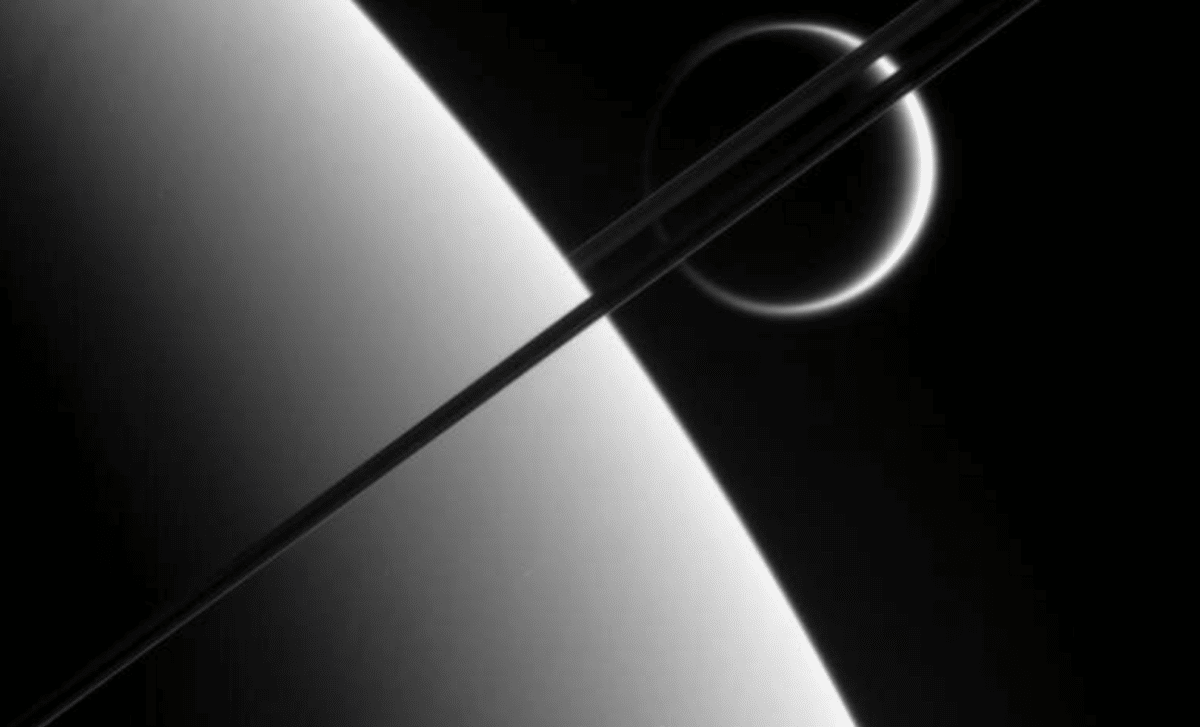
A new study, led by SETI Institute scientist Matija Ćuk, proposes an intriguing explanation for the formation of Saturn’s largest moon, Titan. According to the research, Titan may have originated from the collision and merger of two ancient moons in Saturn’s system. The study, available on the arXiv preprint server, sheds light on the violent and complex history of Titan’s formation and its role in shaping Saturn’s moons and rings. With insights drawn from simulations and data from NASA’s Cassini mission, the study revises our understanding of the moon’s evolution, suggesting that Titan’s current characteristics were forged through intense cosmic events.
Understanding Titan’s Mysterious Formation
Titan, Saturn’s largest moon, has long been a subject of fascination for scientists and astronomers. With a dense atmosphere, vast lakes of liquid methane, and a relatively young surface, Titan stands out as one of the most intriguing moons in our solar system. However, the origins of this moon, particularly how it came to be the way it is today, have remained shrouded in mystery. The new study led by Matija Ćuk offers an explanation that involves a violent past, one that sees Titan as the product of a merger between two earlier moons.
The study, published on the arXiv preprint server, uses computer simulations to suggest that Titan may have formed when two ancient moons collided and merged. According to Ćuk,
“Hyperion, the smallest among Saturn’s major moons provided us the most important clue about the history of the system.”
These simulations showed that an extra moon in the Saturn system could have interacted gravitationally with Titan, resulting in a catastrophic collision that likely formed Titan’s current structure. This collision would have produced debris that eventually formed the moon we see today.
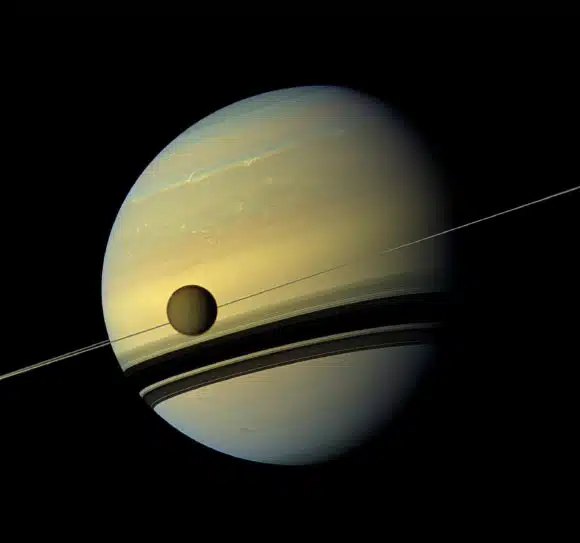 This mosaic of Saturn and its largest moon Titan combines six images — two each of red, green and blue spectral filters — to create this natural color view. The images were obtained with Cassini’s wide-angle camera on May 6, 2012, at a distance of approximately 778,000 km (483,000 miles) from Titan. Image credit: NASA / JPL-Caltech / Space Science Institute.
The Role of Hyperion in Titan’s Formation
One of the key pieces of evidence for this theory lies in the strange behavior of Saturn’s moon Hyperion. Hyperion is unlike other moons in the Saturnian system; it has an irregular shape and a tumbling orbit. Hyperion’s unique behavior has long puzzled scientists, but recent simulations conducted by Ćuk and his team have provided an answer.
“In simulations where the extra moon became unstable, Hyperion was often lost and survived only in rare cases,” Ćuk explains. “We recognized that the Titan-Hyperion lock is relatively young, only a few hundred million years old. This dates to about the same period when the extra moon disappeared.”
The simulations point to the possibility that Hyperion did not survive the upheaval caused by the extra moon’s demise, but rather, it formed as a result of that collision. If the extra moon merged with Titan, the debris produced would have been scattered around Titan’s orbit, where Hyperion would have formed. This provides compelling evidence that Titan and Hyperion have a shared, violent past, shaped by catastrophic events that took place hundreds of millions of years ago.
The Significance of Saturn’s Rings in This Theory
The theory of Titan’s origin through a moon merger is closely tied to the broader history of Saturn’s rings. The study proposes that the rings themselves could have formed as a result of collisions between medium-sized moons that once orbited closer to Saturn. These collisions would have scattered debris inward, leading to the formation of the rings we observe today. Previous theories suggested that the rings were created by the sun’s influence on these moons, but the new research points to Titan’s expanding orbit as a critical factor in this process.
Titan’s orbit, which is gradually becoming more circular, is thought to have played a key role in destabilizing the orbits of nearby moons. When Titan’s orbit expands, it can create an orbital resonance with smaller moons, which may lead to catastrophic collisions. This gravitational influence could have been the trigger for the creation of Saturn’s iconic rings, with debris from these collisions contributing to their formation. As Ćuk’s study, available on the arXiv preprint, suggests, this chain of events may have been set into motion by Titan’s merger with the extra moon.
Implications for Saturn’s Moon System
The proposed moon merger theory not only reshapes our understanding of Titan’s formation but also offers insights into the broader dynamics of Saturn’s moon system. By proposing that Titan formed from a collision, the study challenges previous assumptions about the origins of the moon and its relationship with other moons in the system. It also provides a potential explanation for some of the unique features observed in Saturn’s other moons, such as Hyperion’s erratic orbit and the tilt of Iapetus’ orbit, which may have been influenced by the upheaval caused by the moon merger.
This model of moon formation emphasizes the violent, dynamic nature of Saturn’s moon system, suggesting that many of the features we observe today are the result of cosmic collisions and gravitational interactions over millions of years. The study’s findings also open the door for further research into the past interactions of Saturn’s moons, as scientists continue to unravel the history of the planet and its satellites.