
The post Elusive Invader: Guam’s Brown Tree Snake Problem appeared first on A-Z Animals.
Quick Take
Brown tree snakes are invasive in Guam, depressing populations of native wildlife by eating lizards, birds, and small mammals.
Introduced from ship cargos in the 1950s, these venomous snakes face no natural predators in Guam.
A lasso climbing adaptation allows brown tree snakes to climb fences and electric poles, causing blackouts from electrical damage.
Eradication programs aim to remove brown tree snakes from Guam, habitat by habitat, but are limited by the snakes’ elusive habits.
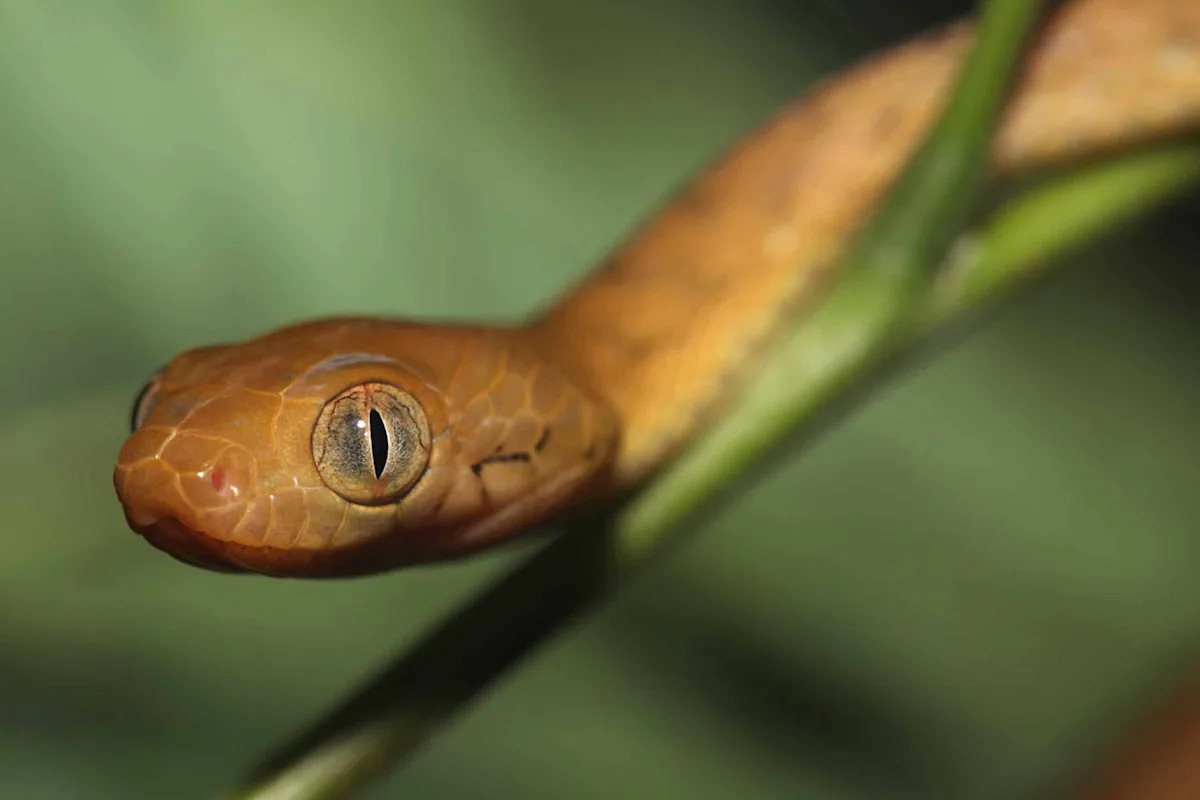
The island of Guam has a snake problem. Though innocuous enough in appearance – slender with brownish or greenish coloration and large eyes – brown tree snakes (Boiga irregularis) have single-handedly (or rather, no-handedly) managed to eat several native bird species to extinction:
The Guam flycatcher (Myiagra freycineti) was declared extinct in 1983.
The Guam rail (Hypotaenidia owstoni) went extinct on Guam in 1987.
The Guam kingfisher (Todiramphus cinnamominus) went extinct in the wild in 1988 and now survives only in captivity.
The Guam Reed-warbler (Acrocephalus luscinius) was declared extinct in 1992.
Of the three bat species native to Guam, brown tree snake predation has been implicated in the extinction of two. Brown tree snakes have also contributed to the extinction of several species of Guam lizards.
Brown tree snakes are native to Australia, Indonesia, and Papua New Guinea. They were first introduced to Guam in the 1950s, likely as stowaways in cargo ships, according to a U.S. Department of Agriculture study. Because they face no natural predators in Guam, these snakes have flourished and spread rapidly. Their venom, although relatively mild, helps them subdue prey. It’s typically not dangerous to adult humans, but it can be dangerous to infants under six months old.
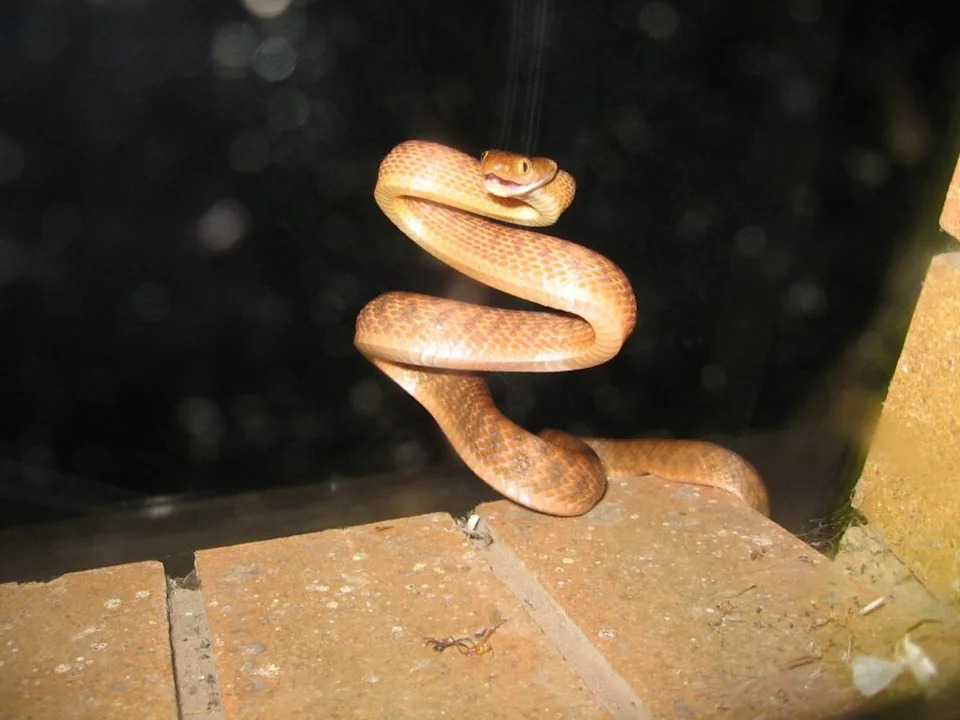
Brown tree snakes are venomous.
©Soulgany101/public domain – Original / License
(Soulgany101/public domain)
As youngsters, brown tree snakes eat small lizards. Once they reach adult sizes of up to three meters long, they also go after larger rodents, birds, and bats. Their appetites extend to the eggs, young, and adults of any animal they can fit into their mouths. Because they are adept at climbing trees and fitting through small openings, brown tree snakes are effective nest predators. Their large eyes with vertical pupils provide superior night vision, according to a U.S. Fish and Wildlife Service report, allowing them to hunt nocturnally. Brown tree snakes also hunt on the ground, then take refuge during the day in palm trees, hollow logs, rock crevices, or caves. Unfortunately, brown tree snakes may also take refuge in thatched roofs.
A study published in Ecology and Evolution found that brown tree snakes increase their impact on Guam’s fauna by frequently biting off more than they can chew. The researchers found that brown tree snakes can consume prey weighing up to 80 percent of their own body weight. Nearly half the time, when they attack relatively large prey, they fail to consume it. The prey, which includes fledgling birds, may die from the attack, even if the snake does not eat it.
Another study in Current Biology discovered that brown tree snakes have a unique ability to climb vertically up smooth surfaces by forming their bodies into lassos. As one part of its body loops over itself to grip a pole, the rest of the snake inches upward, using its many vertebrae like a ratchet. This unusual ability may be an adaptation for climbing smooth-barked trees in their native habitats, such as eucalyptus trees in Australia.
It’s clear that as long as brown tree snakes inhabit Guam, the continued existence of native bird species hangs in the balance.
“There are several attributes that make invasive snakes as a whole difficult to eradicate,” said Melia Nafus, Research Ecologist at the Pacific Island Ecosystems Research Center, in an email interview. “Their slower metabolic requirements mean they require infrequent meals to survive, which means that food-based removal tools, commonly used for mammals, tend to be less effective.”
Also, ironically, as brown tree snake populations decrease due to eradication programs, the available food supply per individual increases. “For B. Irregularis, this is combined with a size-based (ontogenetic) change in diet preference from lizards at small sizes to birds and small mammals at larger sizes,” such that a new range of foods becomes available to them as they grow, added Nafus.
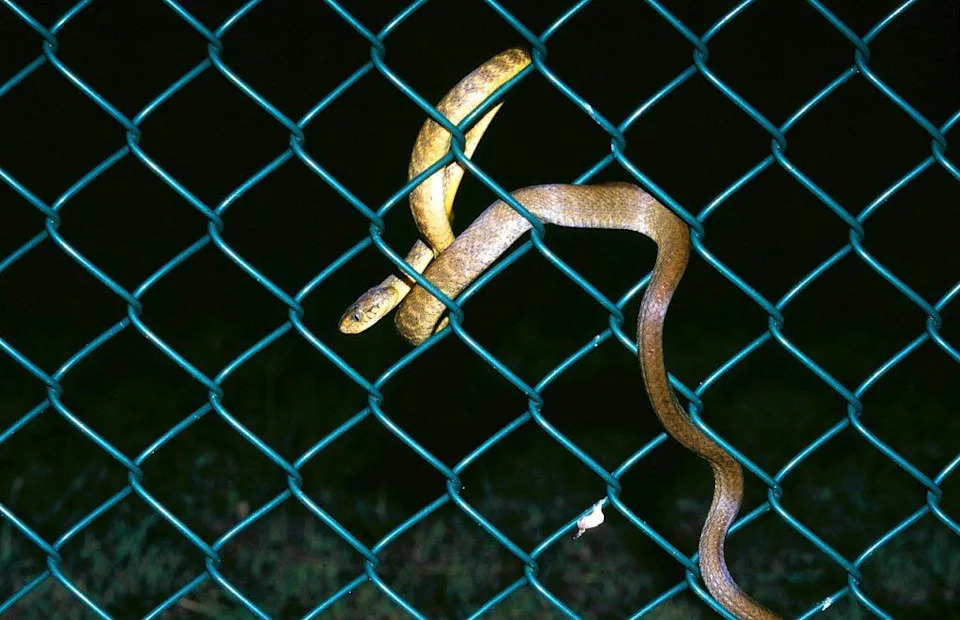
Because brown treesnakes are excellent climbers, they are often found on fences and power lines.
©USDA/APHIS/CC-BY-2.0 – Original / License
(USDA/APHIS/CC-BY-2.0)
Their slower metabolic requirements mean they require infrequent meals to survive, which means that food-based removal tools, commonly used for mammals, tend to be less effective.
Melia Nafus, Research Ecologist at the Pacific Island Ecosystems Research Center
Aside from preying on birds and lizards, brown tree snakes regularly climb electrical wires, causing power outages and, in some cases, electrical damage. Brown tree snakes have caused hundreds of power outages annually in Guam, though these are typically localized rather than island wide. The direct and indirect costs of the damage they cause to power systems have been estimated at up to 4.5 million dollars per year, including lost productivity, according to a study published in International Biodeterioration & Degradation.
“Snakes caused the extirpation of most of the native forest vertebrate species; thousands of power outages affecting private, commercial, and military activities; widespread loss of domestic birds and pets; and considerable emotional trauma to residents and visitors alike when snakes invaded human habitats with the potential for severe envenomation of small children,” wrote Thomas Fritts and Dawn Leasman-Tanner in a USFWS report.
Natural resource professionals in Guam have joined forces to try to eradicate the invasive brown tree snakes. The National Park Service, U.S. Geological Survey, and U.S. Fish and Wildlife Service have partnered to find and remove snakes.
Because food-based approaches to luring brown tree snakes are generally ineffective, they rely on alternative methods. “As of now, we really only have two of those: human searching and detector dogs,” said Nafus. “Detector dogs have not been demonstrated to be effective at locating the precise location of snakes in the forest, although they can detect their presence … Humans are effective, but this snake is nocturnal, cryptic, and very difficult to detect. It requires extremely intensive labor hours to detect snakes, especially at the level required for eradication.”
The partner group is testing removal methods in Asan Beach Park on the west coast of Guam, which is naturally isolated by the ocean and a large road. As of September 2025, a total of 153 brown tree snakes has been removed from Asan Beach Park. But “there are likely hundreds more snakes that need to be trapped before wildlife restoration projects can begin,” reported the USGS in a news story.
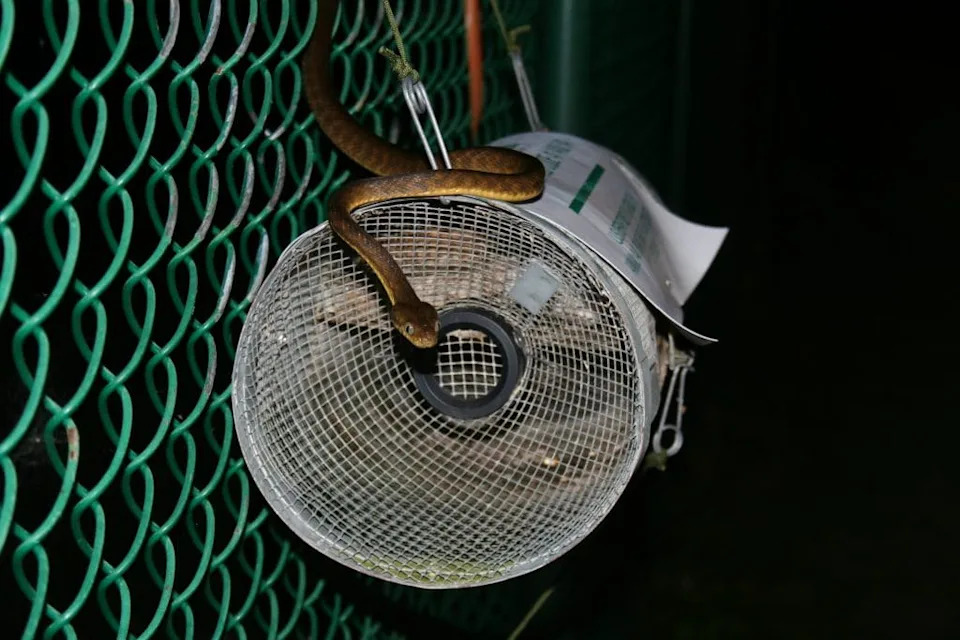
Using specially designed traps, hand capture, and oral toxicants, field personnel remove an average of 7,000 brown treesnakes annually from Guam.
©U.S. Department of Agrictulture/CC-BY-2.0 – Original / License
(U.S. Department of Agrictulture/CC-BY-2.0)
Two broader projects have tested the feasibility of techniques to eradicate brown tree snakes. At one site, at a 55-hectare conservation area in northern Guam now bounded by a snake-proof fence, 30 snakes were fitted with radio transmitters and monitored. After toxic baits with a dead mouse attractant were applied aerially by helicopter, scientists checked the signals weekly over six weeks to determine if the snakes were still alive. The study, published in The Journal of Wildlife Management, found that 11 radio-tagged snakes died during the treatment period, compared to zero during a non-treatment period, showing that aerial baiting can reduce brown tree snake abundance.
Because hand control of brown tree snakes is intensive, the other project has recruited citizens—as “citizen scientists”—to participate in the effort on Cocos Island, a smaller island off the south coast of Guam. In both cases, suppression of the snake populations is logistically achievable, but full eradication is difficult to assess. But, explained Nafus, “We have not verified eradication at either location. Verifying absence of a species with extremely low capture probabilities is quite challenging, especially when traditional wildlife monitoring tools are known not to be that effective when applied to snakes.”
Ultimately, relocating birds imperiled by brown tree snake predation to safer habitats may be the best solution. Brown tree snakes, through their impacts on other species, have changed the ecology of Guam’s natural areas, making them less suitable for native species. In a cascade of effects, as native pollinators are eliminated, the plants that rely on them also disappear. The Guam rail (Hypotaenidia owstoni), after going extinct in Guam in 1987, has been reintroduced to the islands of Rota and Cocos, and has been downlisted from Critically Endangered to Endangered.
As a citizen volunteer on Cocos Island (also known as Dåno’) said in a news story, “When we remove one snake, and then another, or plant one tree, then another, and another, we make a difference. Start small, start now!”
The post Elusive Invader: Guam’s Brown Tree Snake Problem appeared first on A-Z Animals.