
After four decades adrift, the world’s largest iceberg has entered an active breakup phase, with satellite observations confirming structural failure across its surface.
The change signals the imminent end of a long-lived Antarctic giant whose collapse will erase one of the most closely tracked ice features on record.
Water triggers instability

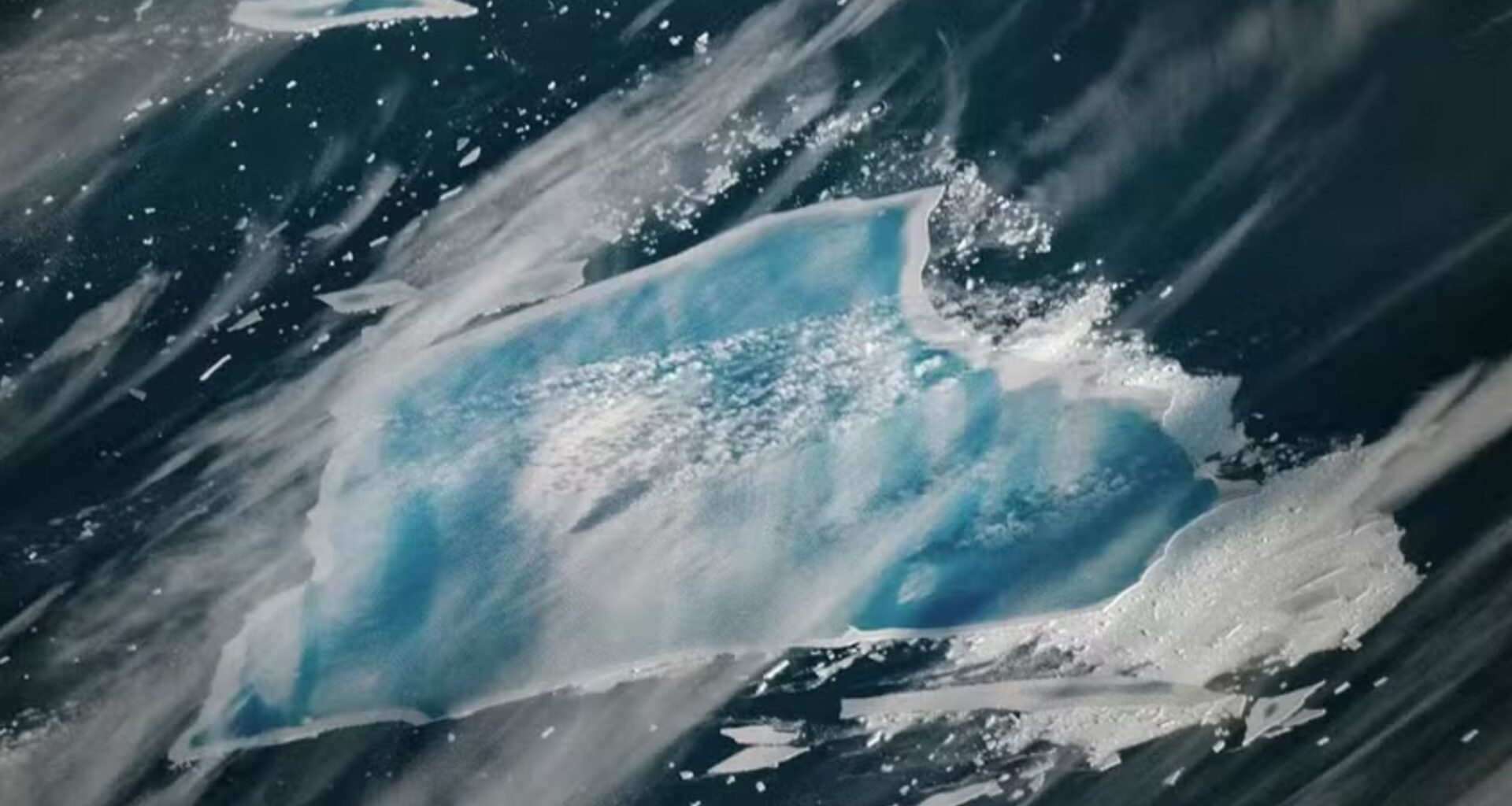
A high-resolution satellite image captured in late December shows water spread across the iceberg’s surface, concentrated in broad pools and fresh fractures along its edges.
By examining that evidence, Chris Shuman at the University of Maryland, Baltimore County (UMBC) linked the surface flooding to structural stress that forced the outer margins to give way.
The pattern marked a decisive turn after years of relative stability, revealing that the iceberg had crossed from slow erosion into rapid internal failure.
Once surface water reached this extent, the remaining lifespan narrowed sharply, setting up the accelerated fragmentation described in the sections that follow.
A long record
Since 1986, scientists have followed A-23A from its first break off Antarctica to its current, shrinking path north.
Back then, the slab covered about 1,544 square miles (3,999 square kilometers), and it ranked among the biggest icebergs ever tracked.
By early January 2026, its area had fallen to 456 square miles (1,181 square kilometers) after several large pieces broke away in 2025.
“I certainly don’t expect A-23A to last through the austral summer,” said Shuman.
Grounded for decades
For more than 30 years, A-23A sat stuck in the Weddell Sea, a cold bay east of the Antarctic Peninsula.
Shallow ridges on the seafloor pinned the iceberg in place, limiting wave attack and slowing the loss of its edges.
Without that anchor, warmer currents likely would have carried it north sooner, triggering earlier surface melting.
Breaking free in 2020 ended the long pause, and the iceberg entered a busier corridor of currents and storms.
Spinning in place
Soon after it broke free, the iceberg got caught in a Taylor column – a spinning water column tied to seafloor bumps.
Instead of drifting north, A-23A looped in place for months, and the same sides met waves again and again.
That delay helped keep the berg intact longer, yet it also left a tall rim that could trap surface water.
Once it escaped the vortex, currents pushed it toward the South Atlantic, where warmer air and water sped up breakage.
Brush with land
Northward drift carried it toward South Georgia Island, a rugged British territory east of South America with rich seabird colonies.
Near the coast, the berg almost collided with the island, then lodged in shallow water for months before moving again.
Shallow grounding can grind ice against the bottom, shedding pieces that spread into nearby fishing routes and wildlife feeding areas.
Escaping into open water later in 2025 removed the last slowdown, and cracks began racing across the main slab.
Cracks fed by water
Surface pools increase pressure, and a 2019 study identified hydrofracture as the process where water drives cracks deeper and wider through ice.
On A-23A, that process likely punched through at the edge, letting meltwater spill down in a sudden rush.
In the satellite view, a pale patch beside the berg marked leaked water mixing with loose ice fragments near it.
After that kind of drain, the remaining block can fracture quickly, and scientists said it could be days or weeks from vanishing.
When giants fragment
Fragments spread fast once a big berg starts shedding, and each piece meets warmer water on more sides.
Smaller chunks also drift into shipping lanes, and crews can miss them in bad weather or long polar darkness.
A 2006 paper estimated that giant Antarctic icebergs deliver a major share of freshwater to the Southern Ocean.
That fresher surface layer can change mixing nearby, which affects how heat and nutrients move around the fragments.
Eyes in orbit
From space, satellites have watched A-23A through cloud gaps and winter darkness, logging its size changes without ships nearby.
Repeated passes let analysts match one date to the next, revealing where the surface flooded and where cracks opened.
“I’m incredibly grateful that we’ve had the satellite resources in place that have allowed us to track it and document its evolution so closely,” said Shuman.
At UMBC, Shuman and others can keep using those archives after the berg vanishes, because the record stays online.
Models need real tracks
Forecast models struggle when a berg stalls for years, so real tracks matter as much as physics rules.
A 2025 study stitched A-23A’s 2024 positions together, giving modelers a clean path to test.
With that baseline, teams can spot when odd currents or shallow seafloor spots hold an iceberg back longer than expected.
Still, a breakup can start from a single weak point, and no model can watch every crack form.
Watching the finish
As A-23A breaks apart, surface water, ocean currents, and decades of satellite tracking come together in one clear ending.
Future alerts will depend on spotting flooded tops early, while agencies keep monitoring the next giant icebergs that leave Antarctica.
Photo credit: NASA Earth Observatory.
—–
Like what you read? Subscribe to our newsletter for engaging articles, exclusive content, and the latest updates.
Check us out on EarthSnap, a free app brought to you by Eric Ralls and Earth.com.
—–