
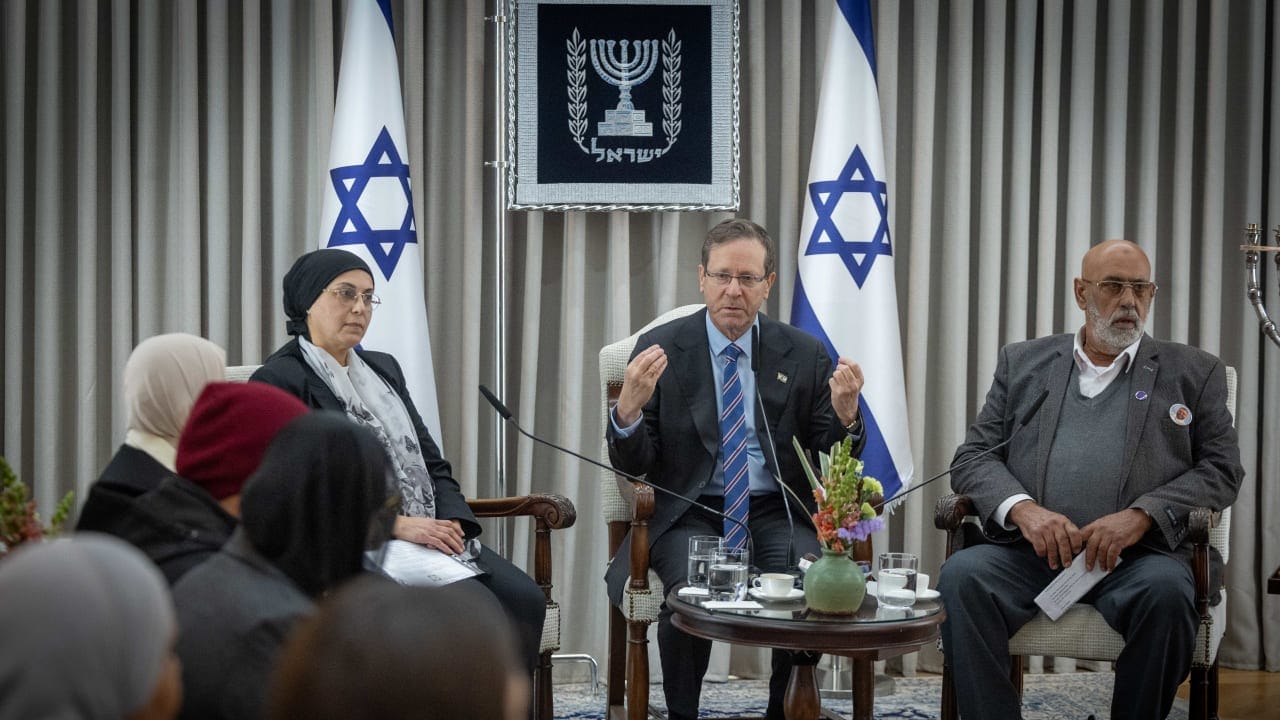
President Isaac Herzog announced on Sunday that he will press for anti-gun legislation.
Contrary to National Security Minister Itamar Ben-Gvir, who advocates that security can be better assured if more civilians have gun permits, Herzog believes that the more guns there are in civilian hands, the greater the security risk.
The president made this point repeatedly on Sunday, when addressing a delegation of bereaved Arab parents, grandparents, siblings, and other relatives whose loved ones were murdered over the past two to three years.
Herzog said that every local authority should make the banning of guns and violence of any kind a top priority. It is a terrible thing, he said, when one human being shoots another for the purpose of killing them.
The delegation, comprising mostly women, included three men and was led by Qasem Awad, a former mayor of Tamra whose son, Dr. Abdullah Awad, was brutally murdered while treating patients at a health clinic in Kfar Yasif.

Awad previously met with Herzog when the president, alarmed by the escalation of violence in Arab society, visited Sakhnin on January 29.
“We Arabs love you because you tell the truth and we need people to listen to you and to listen to us,” Awad told Herzog when they met again on Sunday.
‘We are all law-abiding citizens – help us’
Awad reiterated what other prominent Arab citizens have said: they cannot fight this battle alone.
“We need the help of the Jewish people,” the former mayor said, adding that many Jews are already supporting the struggle against violence in the Arab sector.
Speaking primarily of his own family, but also in reference to the families of the delegation, Awad said, “We are all law-abiding citizens. Help us. Tell us what to do.” The meeting as such was extremely emotional as each member of the delegation told the story of a close relative whose needless death had created an extreme void within the family.
One of the most touching of these stories was of a woman whose abusive husband kept telling her that he was going to throw her out. The woman reported him to the police, who took no action. Two days later, she was dead, leaving behind three children aged 15, seven, and nine months. This was one of the rare cases in which the police later apprehended the perpetrator, said the dead woman’s sister, “But now there are three orphans without a mother or a father.”
Herzog was visibly upset by this information, instructing his staff to obtain full details so the story could be widely published.
One of the delegates told Herzog that in Arab society, when a woman is killed, it is usually because she is perceived as having besmirched the family’s honor. Nevertheless, none of the murdered females related to members of that specific delegation were victims of honor killings; none had done anything that could have invited malice or embarrassed their families.
Herzog was asked throughout the morning to help do away with violence. Members of the delegation refused to accept that his position is merely ceremonial and not executive, telling him he has the influence to effect change.
Almost every speaker reported police inaction, saying law enforcement showed little if any interest in any case involving Arab victims, and failed to provide information.
Due to the frequency of violent killings, children panic in fear whenever they hear gunfire, said one of the delegates.
There was also an inference to racism. More than one delegate noted that “Arab blood is no less important than Jewish blood.”
Herzog said that the violence and killing in Arab society are a stain on both the government and the nation. The president pledged to do his utmost to make legislators aware that what has evolved is not just an Arab problem, but a national issue that affects all sectors of Israeli society.