
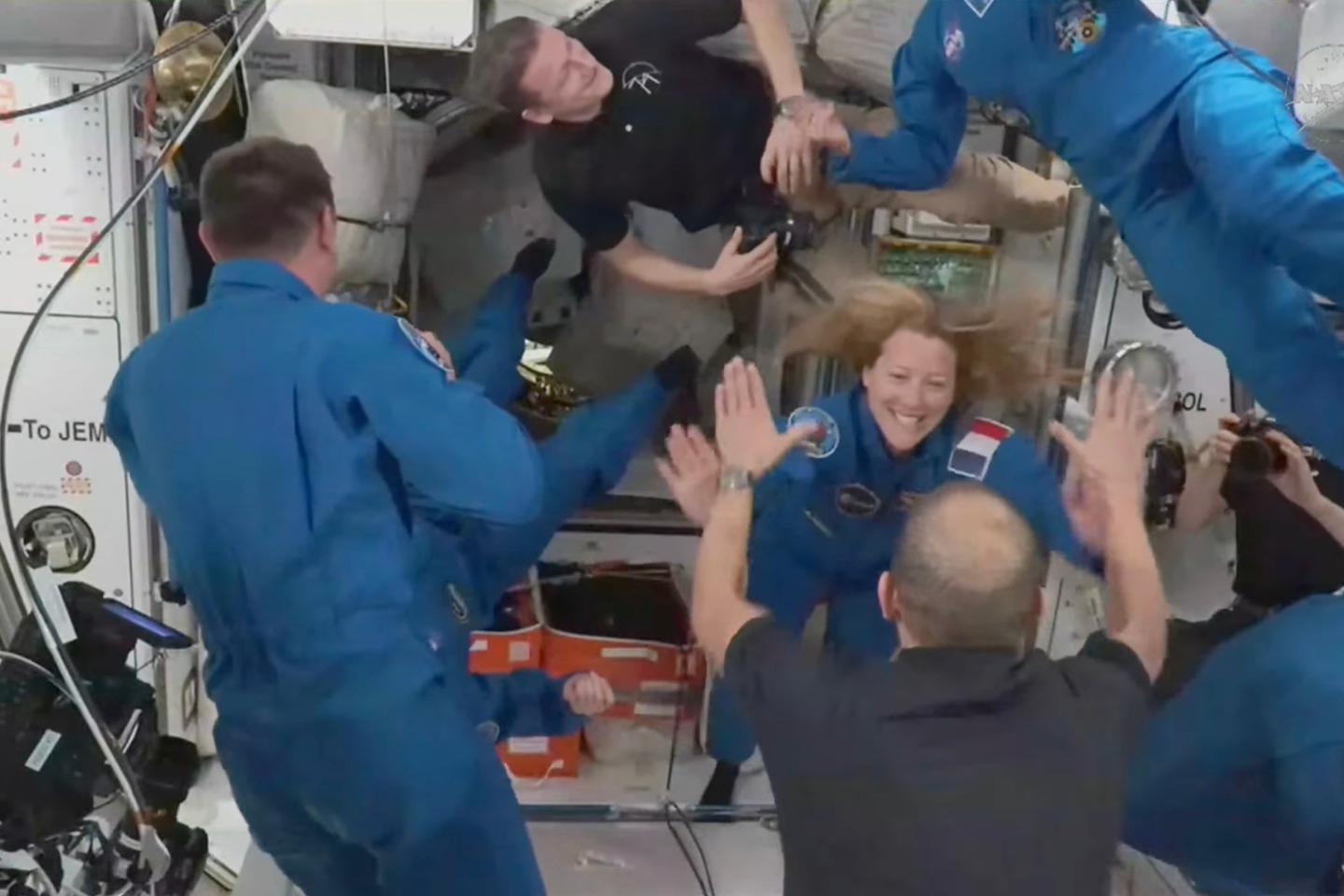
 In this image from video provided by NASA, France’s Sophie Adenot, Russia’s Andrei Fedyaev and Americans Jessica Meir and Jack Hathaway greet colleagues as they enter the International Space Station after arriving on a SpaceX Dragon capsule on Saturday, February 14, 2026. AP
Four astronauts docked at the International Space Station on Saturday, February 14, for a months-long research mission, replacing a crew forced to return to Earth early over a medical issue.
The US space agency’s Crew-12 arrived at the orbiting laboratory after a journey of about 34 hours that started with blastoff from Cape Canaveral, Florida aboard a SpaceX Falcon 9 rocket.
“We have bridged the legacy of humankind’s continuous presence in space spanning more than 25 years at this very site,” American astronaut Jessica Meir said after docking at the ISS. “As we look back at Earth from these windows, we are reminded that cooperation is not just possible, it is essential. Up here, there are no borders and hope is universal.”
Other members of Crew-12 are American Jack Hathaway, Russian cosmonaut Andrey Fedyaev and French astronaut Sophie Adenot, the second French woman to fly to space. She follows in the footsteps of Claudie Haignere, who spent time on the Mir space station.
Read more Subscribers only Astronaut Sophie Adenot prepares for her first takeoff
Among other research, she will test a system that uses artificial intelligence and augmented reality to allow astronauts to carry out their own medical ultrasounds. “I am proud to bring France and Europe along on this incredible adventure that transcends borders,” Adenot said. “Count on me to share every step with you and bring a sparkle to the eyes of the French people.”
During their eight months on the outpost, the astronauts will conduct many experiments, including research into the effects of microgravity on their bodies.
One of the last crews abord the ISS
The foursome are replacing Crew-11, which returned to Earth in January a month earlier than planned in the first medical evacuation in the space station’s history. The ISS, which orbits 400 kilometers above Earth, has since been staffed by a skeleton crew of three. NASA declined to disclose any details about the health issue that cut the previous mission short.
Crew-12 will be one of the last crews to live aboard the football field-sized space station. Continuously inhabited for the last quarter-century, the aging ISS is scheduled to be pushed into Earth’s orbit before crashing into an isolated spot in the Pacific Ocean in 2030.
Read more Subscribers only ‘Space has become a potential battlefield, and we need to be ready for it’