
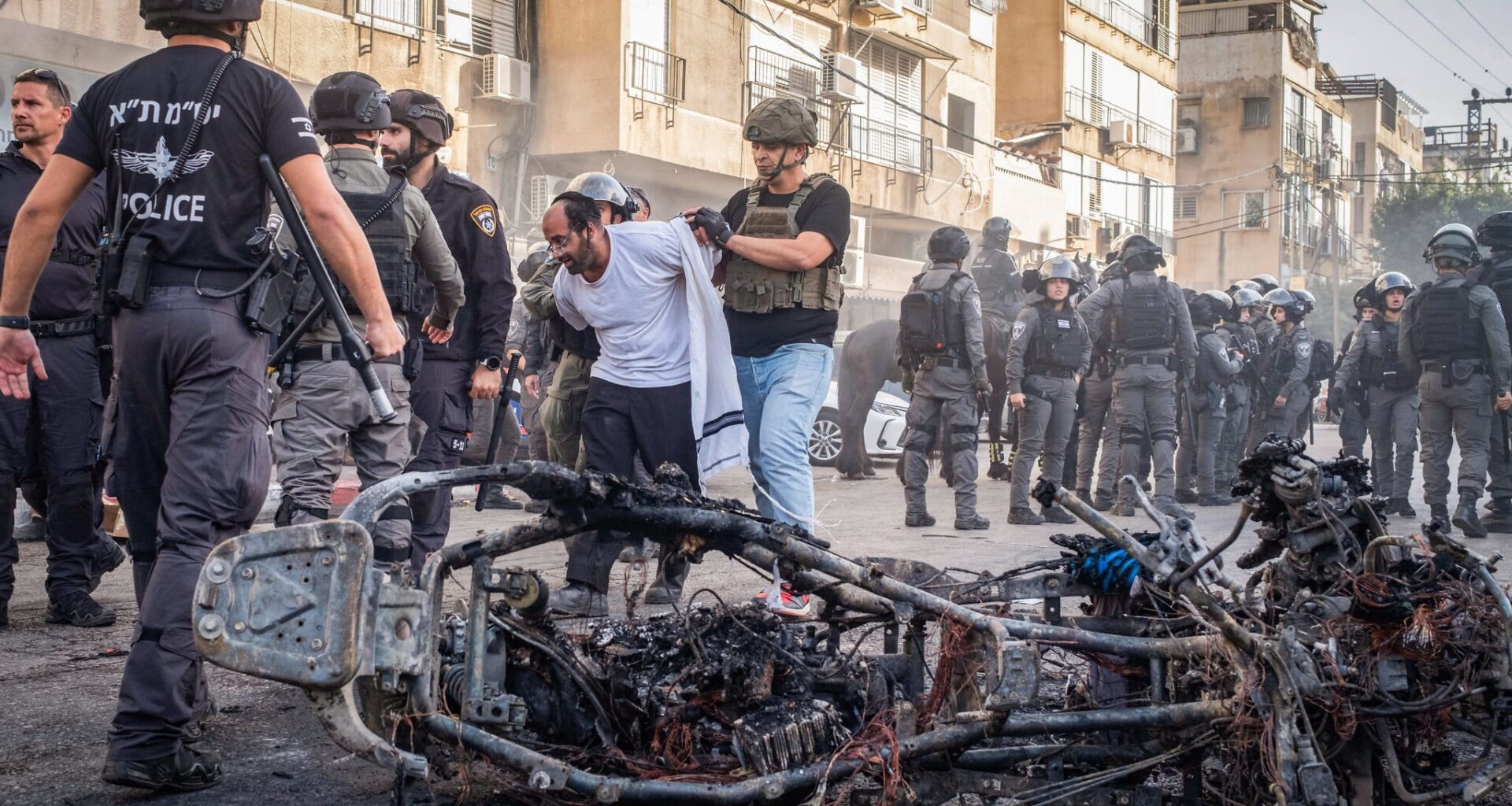
Sunday afternoon’s mob attack in the ultra-Orthodox city of Bnei Brak, in which hundreds of men thronged two female Israel Defense Forces soldiers, is the latest in a string of violent incidents and follows leading rabbis engaging in increasingly harsh rhetoric against the military, while simultaneously raising up draft evaders as community heroes.
The incident, which saw rioters overturn a patrol car and set fire to a police motorcycle, occurred after a resident apparently called a telephone hotline run by the Jerusalem Faction to wrongly claim that the soldiers were attempting to deliver conscription orders.
The servicewomen, squad commanders at the Education and Youth Corps, had in fact been on an official home visit to one of the soldiers in their unit when they were confronted by the mob. They were not affiliated with the Military Police.
“During the morning hours, several reports were received by our system regarding soldiers arriving to deliver enlistment orders to yeshiva students,” an email sent out by the hardline Haredi group stated.
“At 1 p.m., upon the conclusion of the study session in yeshivas and kollels, the ‘Color Black’ system issued an update and warning to the public. Simultaneously, a large crowd gathered to protest the persecution of the Torah world,” the Jerusalem Faction said.
Get The Times of Israel’s Daily Edition
by email and never miss our top stories
By signing up, you agree to the terms
But, speaking with The Times of Israel, a spokesman for the group denied any responsibility for the incident, stating that the riots were “not something organized.” He also maintained that the members of the mob were “all from the mainstream” of the Haredi community, contradicting coalition politicians who insisted that those involved in the violence represented a violent fringe.
Uniformed female soldiers fleeing in the Haredi neighbourhood of Bnei Brak pic.twitter.com/IS9G3obaL2
— Amit Segal (@AmitSegal) February 15, 2026
An extremist ultra-Orthodox group numbering some 60,000 members, the Jerusalem Faction regularly demonstrates raucously against the military enlistment of yeshiva students. It runs a telephone hotline to mobilize the community when the IDF engages in enforcement activities and has helped distribute tens of thousands of shekels to yeshiva students arrested for draft evasion.
While the involvement of the Jerusalem Faction would initially appear to support claims by ultra-Orthodox MKs that the rioters do not represent their community, the size of recent demonstrations, as well as the increasing virulence of “mainstream” Haredi leaders’ anti-conscription rhetoric, seem to indicate that the violence is not confined merely to an extremist fringe.
“The rhetoric of the Haredi leadership is very sharp, making it difficult to control the intensity of the situation regarding the youth, who are naturally more hot-headed than their spiritual leaders,” said Dr. Gilad Malach, a researcher at the Israel Democracy Institute.
“As we saw in the Jerusalem riots, it’s not just the ‘Jerusalem Faction’ youth participating, but also at-risk youth and those just looking for ‘action,’” he said. “Since the atmosphere on the Haredi street is so hostile toward the army and police, they all feel perfectly comfortable using violence.”
Malach was referring to last month’s massive anti-draft demonstration in Jerusalem, during which large crowds of Haredi teenagers set fires, blocked roads, and attacked a passenger bus — whose driver then ran over several protesters, killing 14-year-old Yosef Eisenthal.
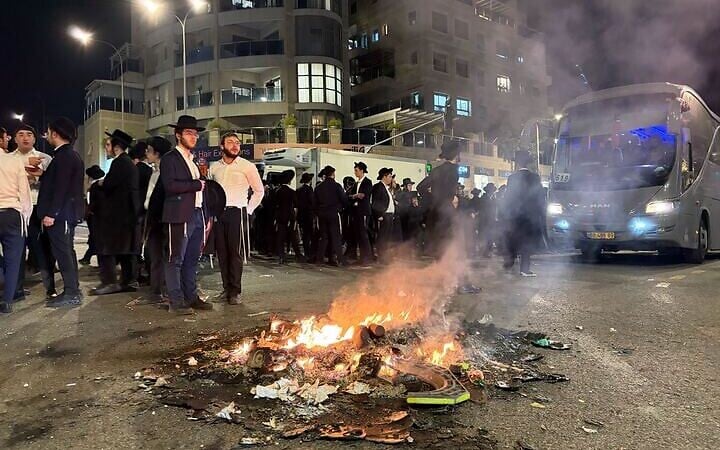
Haredim protesting against military conscription stand by a bonfire on a street in Jerusalem, January 6, 2026. (Sam Sokol/Times of Israel)
That demonstration was one of a series of protests against efforts to enforce conscription on the Haredi community in the wake of the High Court of Justice’s 2024 ruling that decades-long blanket exemptions from army duty informally afforded to full-time yeshiva students were illegal.
Some 80,000 ultra-Orthodox men aged between 18 and 24 are currently eligible for military service, but have not enlisted. The IDF has said it urgently needs 12,000 recruits due to the strain on standing and reserve forces caused by the war in Gaza.
Protesters have blocked highways, attacked senior IDF officers, and even targeted ultra-Orthodox lawmakers perceived to be insufficiently opposed to conscription. In January, a mob broke into an IDF conference held in Bnei Brak for members of the military’s ultra-Orthodox Hasmonean Brigade, attacking soldiers and commanders.
That violence led Rabbi Dov Lando, the spiritual leader of the Degel HaTorah political faction, and one of the Haredi community’s most prominent leaders, to call on his followers not to attend demonstrations.
Yet Lando and other senior rabbis representing the so-called Haredi “mainstream” have refrained from moderating their own rhetoric or repudiating the use of such popular slogans as, “We will die and not enlist.”
Addressing a gathering in Bnei Brak last Monday, Lando — who has explicitly called on yeshiva students to ignore conscription orders — declared that anyone complicit in the “terrible crime” of arresting draft dodgers should be aware that they could face divine judgment.
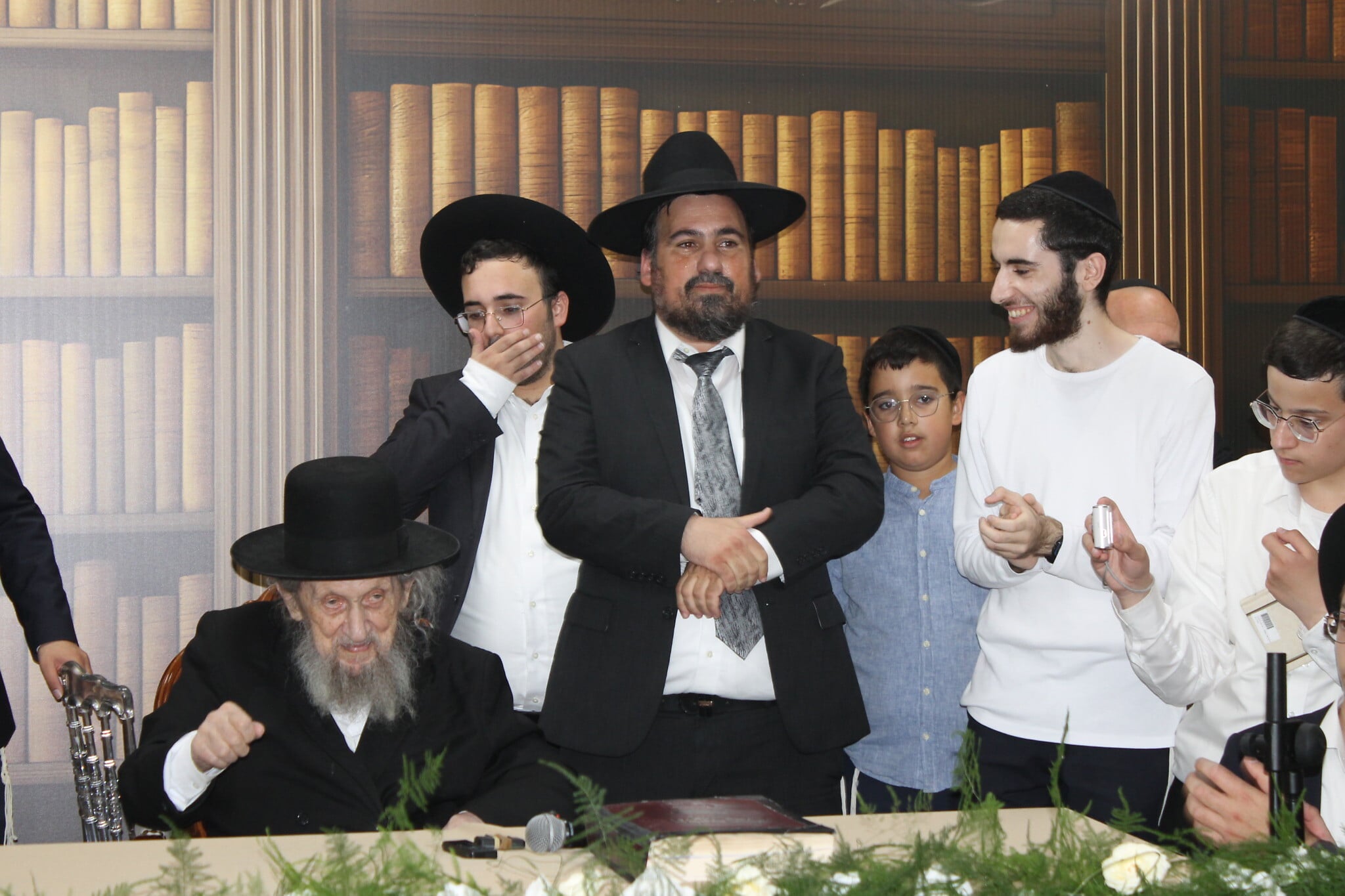
Rabbi Dov Lando (seated) celebrated the release of draft evader Tomer Sapayev, following his release from military prison, August 21, 2025. (Sam Sokol/Times of Israel)
Similarly, Rabbi Moshe Maya, a member of the Shas party’s ruling Council of Torah Sages, told Haredi radio station Kol Barama that anybody who arrests an evader “has no portion in the world to come” and deserves to be excommunicated.
Both rabbis’ comments came a day after police clashed with rioters in the southern town of Ofakim over the arrest of a Haredi draft dodger.
Asked if he believed there was any link between Maya’s comments and Sunday’s violence in Bnei Brak, a Shas insider told The Times of Israel there was “absolutely no connection” and argued that mainstream Haredim were “capable of distinguishing between rhetoric within the framework of accepted discourse and avoiding physical violence.”
“The fact is, we aren’t talking about followers of the Sephardic rabbis here,” he said.
However, critics like MK Moshe Tur-Paz (Yesh Atid) disagreed. “Even if the rioters are radical fringe youth, the statements of leaders have a direct connection to [their] actions,” said Tur-Paz, a member of the Knesset Foreign Affairs and Defense Committee, quoting the Talmudic dictum, “Sages, be careful with your words.”
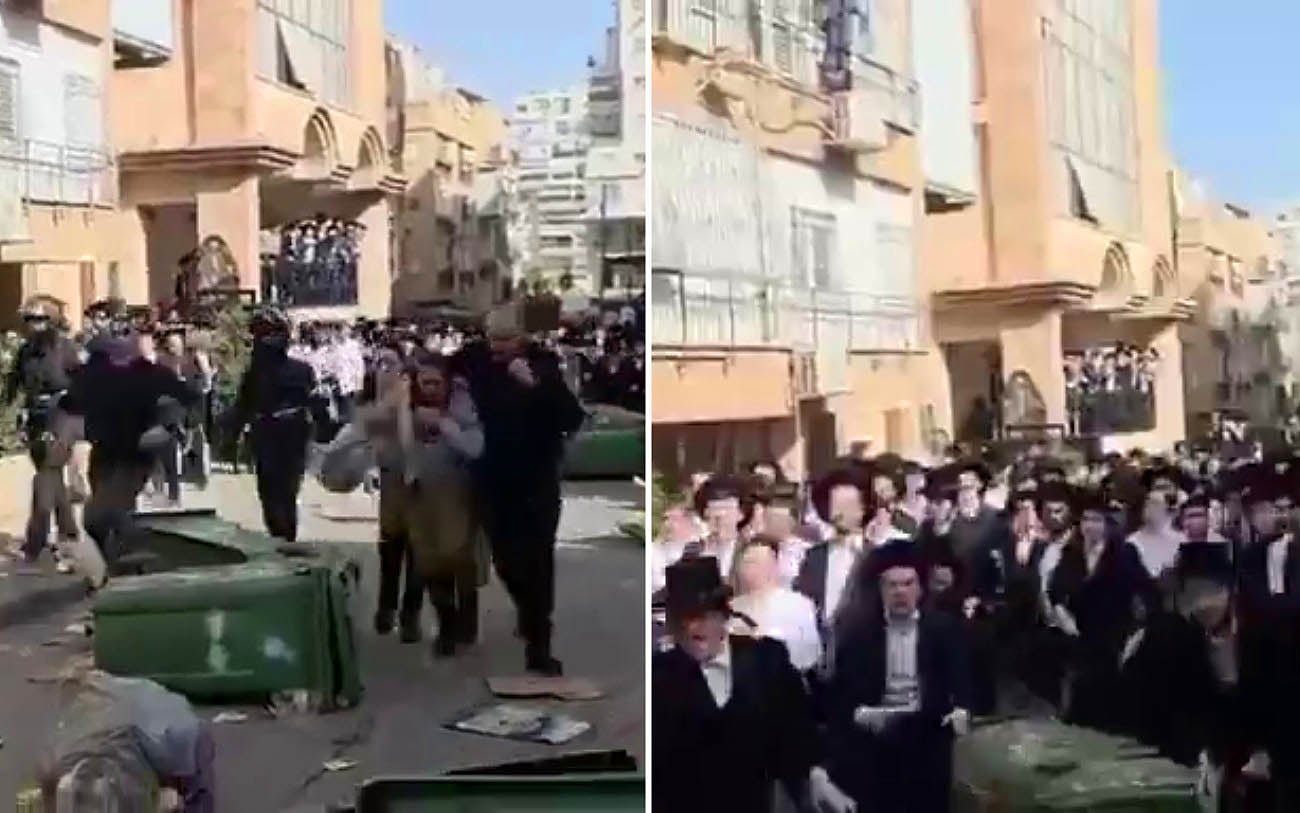
Two female IDF soldiers are rescued by police after being chased by a mob in the ultra-Orthodox city of Bnei Brak on February 15, 2026. (Screenshots/David Keshet/X)
While he cautioned against generalizing about the entire Haredi community, former senior Israel Police superintendent Amnon Alkalai agreed, telling The Times of Israel that “the rhetoric of leading rabbis who shape Haredi public opinion against IDF enlistment — as well as the tacit approval, whether through action or omission, of expressions such as ‘We will die rather than enlist’ and other statements and actions — is linked to mass rioting directed at both female and male soldiers, as well as police officers.”
“Given the rabbinical power, where many of their followers are loyal and view their words as a divine dictate and a call to action, this is how rabbinical responsibility is established and defined,” he said, arguing that while the rabbis may not be criminally liable, “public responsibility most certainly exists.”
Among those who condemned the violence after years of harsh rhetoric was former chief Sephardic rabbi Yitzhak Yosef, who said in a statement that “rioters who desecrate the Name of Heaven” should be “denounced and cast out from the community.”
Yosef had previously called on yeshiva students to tear up and flush conscription orders down the toilet and warned that if the government arrests yeshiva students for dodging the draft, then the ultra-Orthodox community would be forced to leave Israel. Last August, he also stated during a Torah lecture that “if the military police come, stand up to them,” the Ynet news site reported.
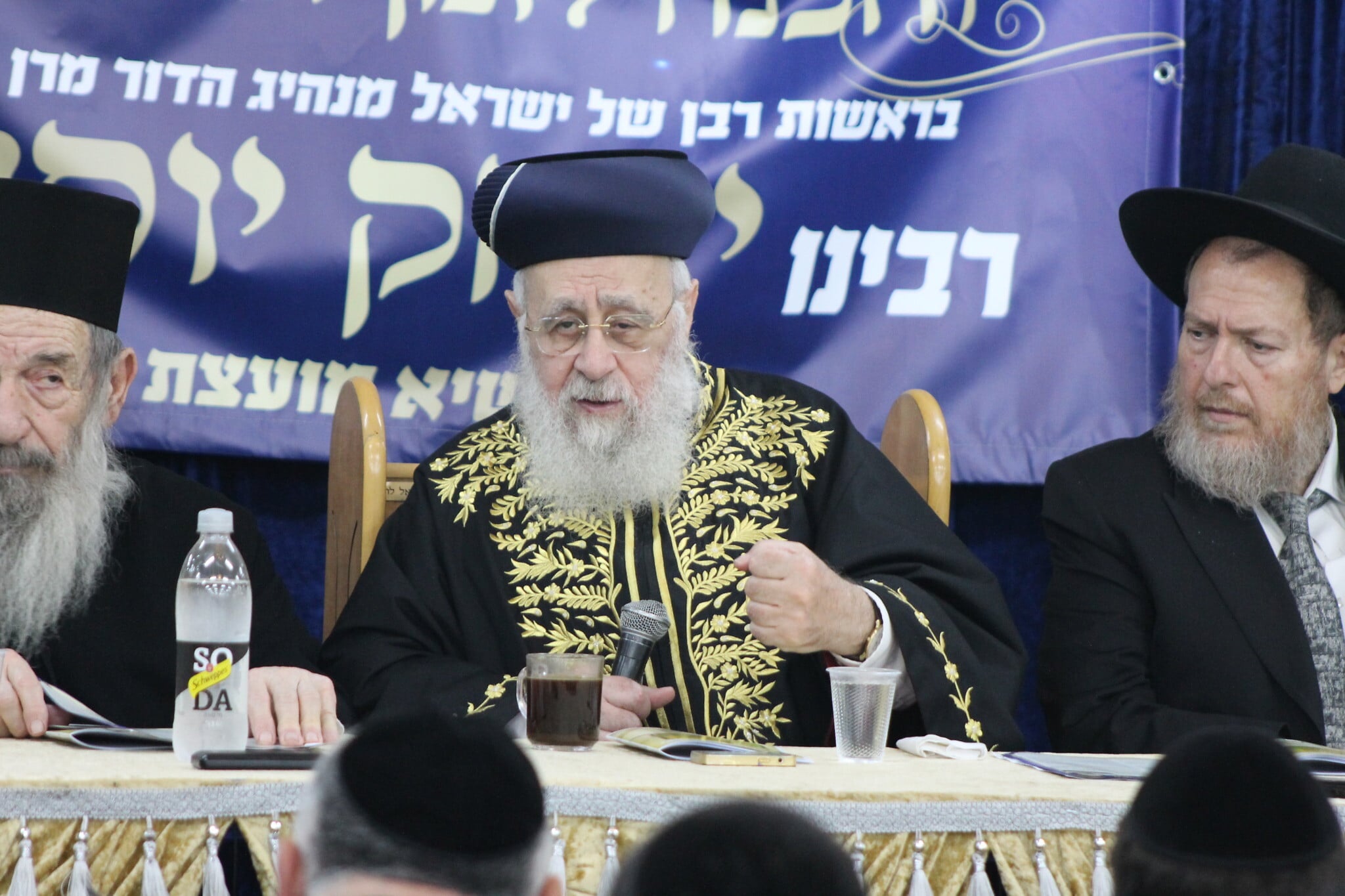
Former chief Sephardic rabbi and current Shas party spiritual leader Yitzhak Yosef addresses a gathering in Bnei Brak, August 21, 2025. (Sam Sokol/The Times of Israel)
Pushing back against criticism of the Haredi community on Sunday evening, Deputy Minister Yisrael Eichler (United Torah Judaism) appeared to blame the authorities for the violence.
In a statement, the Haredi politician warned against what he described as “indiscriminate governmental violence that harms the innocent.”
“This ‘revenge campaign’ in the city of Bnei Brak endangers the lives of innocent bystanders, including infants, the elderly, and small children,” he said in an apparent reference to IDF enforcement efforts against draft evaders. “We call upon the national security minister, police commissioner, and [police] commanders not to carry out illegal orders from politicians and jurists who incite constantly.”