
Few attending this year’s Munich Security Conference will have known the history of two parallel streets near their venue, snaking through the Bavarian capital’s old town.
In the Hitler era, anyone heading down the Residenzstrasse were obliged to give the Nazi salute as they passed the Feldherrnhalle, then a well-guarded memorial to fascist “martyrs” killed in the failed putsch of 1923.
Those who resented this forced show of ideological submission ducked instead down the back of the Feldherrnhalle and continued along the parallel Theatinerstrasse.
For anyone who knows this history, on top of Munich’s reputation since 1938 as the capital of Hitler appeasement, the parallels to this year’s Munich Security Conference were uncomfortably prescient.
Which path should Europe take now? Continue down the current path of co-operation and compromise, based on lessons learned the hard way in the second World War, or follow the Donald Trump path to prioritise the national interest in politics, economics, migration and climate policy.
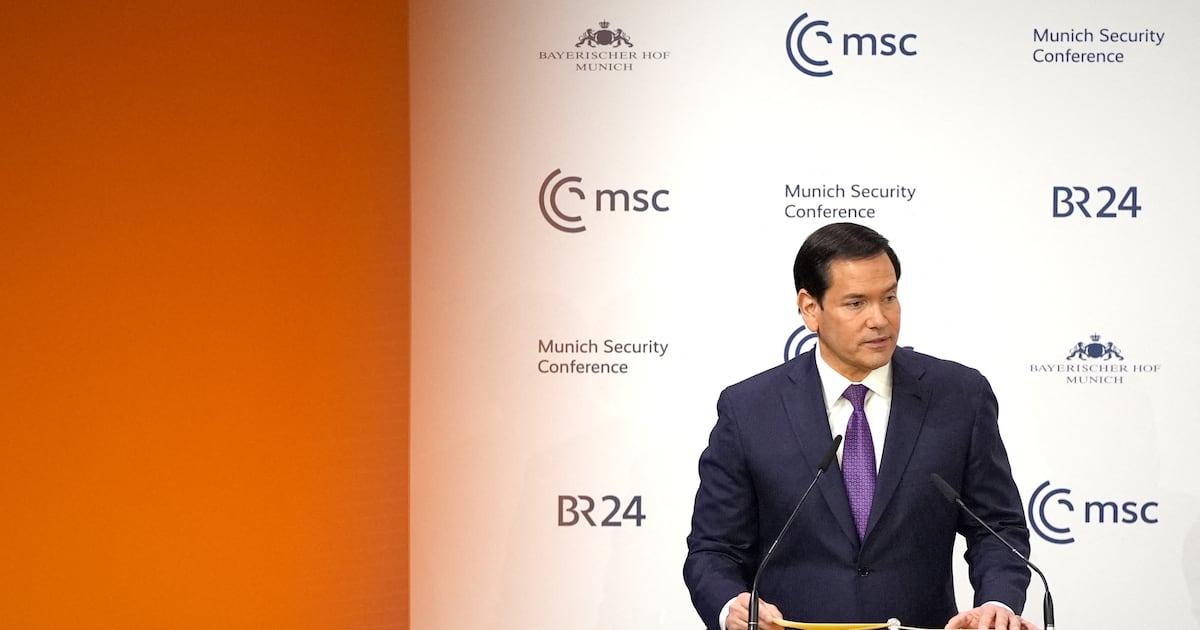
Rubio’s speech
Trump’s chief diplomat Marco Rubio made a play for the latter, in a speech that mixed sentiment and sneers.
The United States was a “child of Europe” but its rules-based order was a “delusion” while the “dogmatic idea of free and unfettered trade” had, in the Trump world view, expedited the West’s decline, deindustrialisation, supply-chain dependencies and a “malaise of hopelessness and complacency”.
His conciliatory message: “We made these mistakes together and now, together, we owe it to our people to face those facts and move forward.”
[ Marco Rubio says US destiny ‘intertwined’ with Europe, but with caveatsOpens in new window ]
“We in America have no interest in being polite and orderly caretakers of the West’s managed decline,” he said. “We do not seek to separate but to revitalise an old friendship and renew the greatest civilisation in human history.”
European leaders in the hall listened carefully and applauded politely at the end. Later, some expressed relief that Rubio had spared the transatlantic relationship a Valentine’s Day massacre. But others noted that the Trump administration’s interest in a “strong Europe” rests on a Trumpian definition of strength.
Kallas and Lagarde
It fell to political Europe’s leading ladies to offer the most polite but firm pushback. Some could not resist a snarky response to the contested claim, repeated by Rubio, that Europe’s liberal laws and migration policies have put the Continent on a slippery slope to “civilisational erasure”.
“Contrary to what some say,” said Kaja Kallas, the European Union’s foreign policy chief, “woke decadent Europe is not facing civilisational erasure.”
European Central Bank president Christine Lagarde was in fiery form when she said renewed European investment in defence, as well as migration policy corrections, were the correct response to “the kick in the butt that we all received as a result of president Trump’s change of attitude towards Europe”.
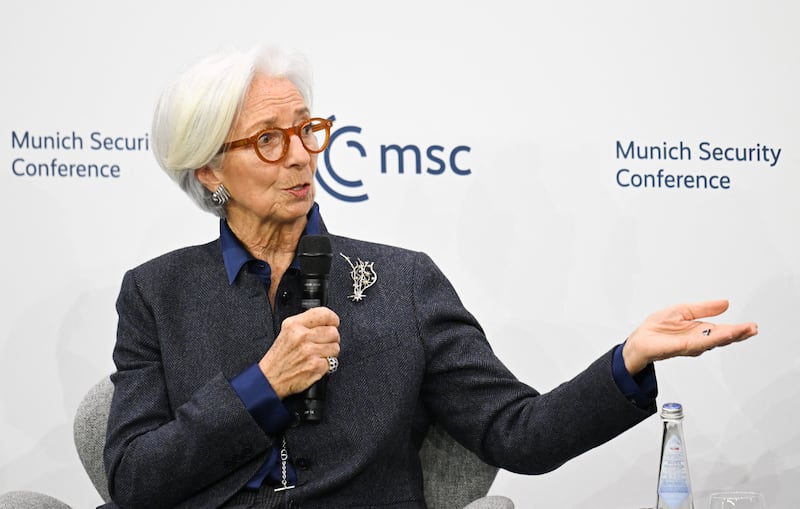 European Central Bank president Christine Lagarde. Photograph: Thomas Kienzle/AFP via Getty Images
But she said US officials would do well to read the founding fathers of the European integration project, Jean Monnet and Robert Schuman.
“They all say the same thing,” she said. “Europe is stronger, and gets better together, in times of crisis”.
Ireland’s delegation
Minister for Foreign Affairs Helen McEntee, leading the Irish delegation, saw some signs of hope in how, rather than denigrate the United Nations like other Trump officials, Rubio said a reformed UN “still has tremendous potential to be a tool for good in the world”.
“The UN has served us extremely well,” said McEntee, “but we all agree that there is change and reform needed to reform it from within to reflect the world we live in now.”
A delegation of vocal and visible Democrats in Munich took issue with the world according to Donald Trump, in particular Rubio’s implication that the White House holds a monopoly on the national interest.
Gavin Newsom
“Trump is an invasive species who has taken over the Republican Party … our republic is being destroyed in real time,” said Gavin Newsom, Democratic governor of California. In his second appearance on Sunday, echoing the diagnosis of Christine Lagarde, he noted how “today Europe feels more united than in a long time”.
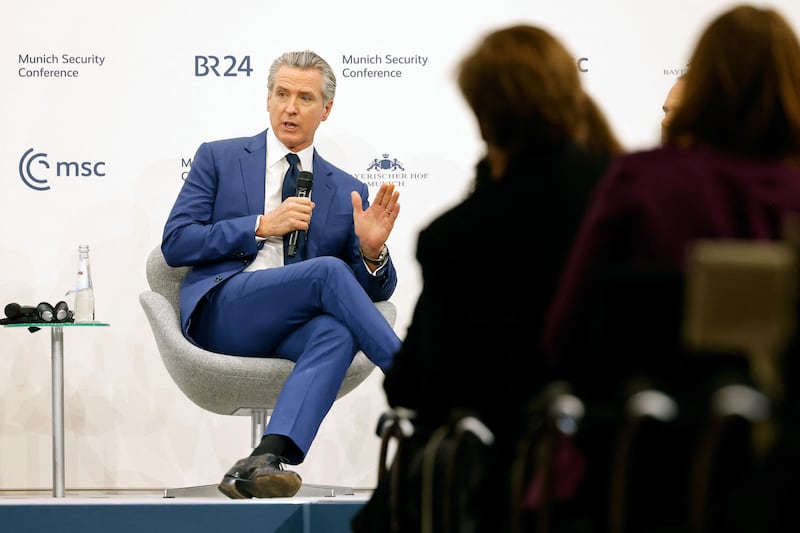 California governor Gavin Newsom. Photograph: Alexandra Beier/AFP via Getty Images The German perspective
The Lagarde-Kallas interventions on Sunday book-ended a united EU response that began with the opening address of German chancellor Friedrich Merz on Friday afternoon.
“Hegemonic fantasies? No,” he said. “We’re building our strength, our sovereignty and our capacity for mutual solidarity in Europe – and we do it with principled realism.”
Embracing principled realism meant acknowledging, Merz noted, that the postwar international order based on rights and rules “no longer exists”. That was in part because of Russia’s war of aggression against Ukraine and, in part, due to a new and muscular struggle between “great powers”.
On Saturday, German officials were frank in their reviews of the Rubio address as a zero-sum game to authoritarian disaster. One summarised its Trumpian logic using the ironic German expression: “If everyone thinks of themselves, then everyone is thought of.”
Greenland as sideshow
Amid European debate over the world’s direction of travel, US Republican delegates offered a sideshow by fighting in public over Greenland, part of the kingdom of Denmark, which Trump has vowed to annex – by force if necessary.
A month on from those threats, South Carolina Republican Lindsey Graham insisted in Munich that Greenland “is behind us”.
“Who gives a shit who owns Greenland?” he asked. “I don’t.”
Fellow Republican senator Thom Tillis of North Carolina, also in Munich, hit back: “The 55,000 indigenous people of Greenland give a shit about who owns Greenland. And at the end of the day, we need to show them respect.”
In a sign of continual Republican divisions over Trump’s Arctic gambit, still the subject of discreet talks in Washington with Denmark and Greenland, Tillis added: “Our nation was founded on rejecting bullies.”
It was a timely remark as Marco Rubio departed for pro-Russian EU member states Slovakia and Hungary, where the main election rival to Viktor Orban accused the Hungarian prime minister of bullying him with a threatened sex tape.
Iran’s demand
Demanding an intervention from the White House on Saturday were 250,000 exiled Iranians who came from all over Europe to demand an end to the Islamic regime in Tehran.
They braved wind and rain, waved green-white-red flags with lion and sun emblems of the Pahlavi dynasty and chanted “Change! Change! Change!” and “Javid shah” (long live the shah).
Exiled crown prince Reza Pahlavi said the continuing survival of the Iranian government – even after last month’s civilian massacre – sent “a clear signal to every bully: kill enough people and you stay in power”.
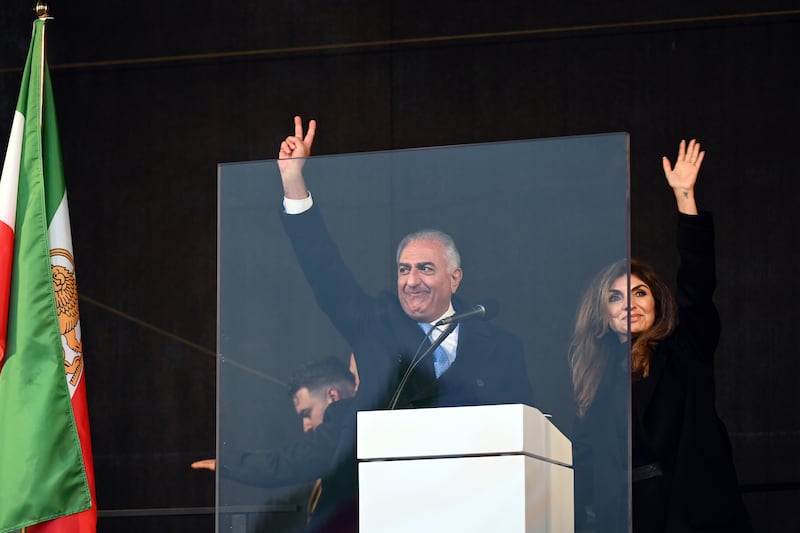 Reza Pahlavi and his wife Yasmine during a rally in Munich to denounce the Iranian government’s crackdown on recent protests. Photograph: Fariha Farooqui/EPA
“To president Trump … the Iranian people heard you say ‘help is on the way’, and they have faith in you. Help them,” he said.
The China choice
Amid Europe’s ongoing standoff with the US, Rubio was followed by China’s foreign minister and Politburo member Wang Yi.
He framed “growing turbulence” as a sign that “humanity has come to a new crossroads” where certain unnamed bully countries “seek to magnify differences and disagreements” and “revive a Cold War mentality”.
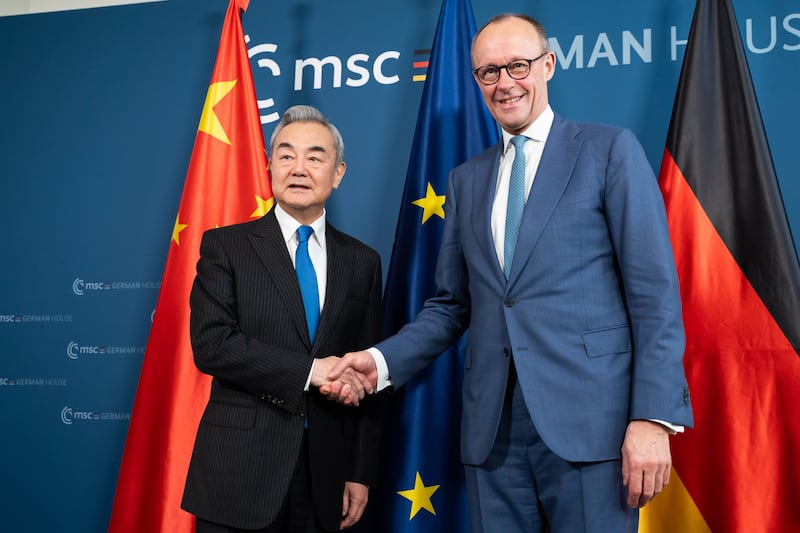 Chinese foreign minister Wang Yi shakes hands with German chancellor Friedrich Merz. Photograph: Michael Bihlmayer/Pool/Getty Images
“But we live in a multipolar world, and need to practise true multilateralism,” he said, suggesting Europe should “make the right choices in the face of challenges.”
Translation: choose China as Europe’s best partner for the future.
It was a firm, if low-key response to Rubio’s more robust claim that failing to follow US reassertion of western cultural and economic supremacy would leave Europe “vulnerable to extortion from other powers”.
On Sunday afternoon, departing European delegates walked down Munich streets paved with old historical choices and mulled the best path ahead. An ally’s embrace, submission to a bully, or go it alone? But which path is which?