
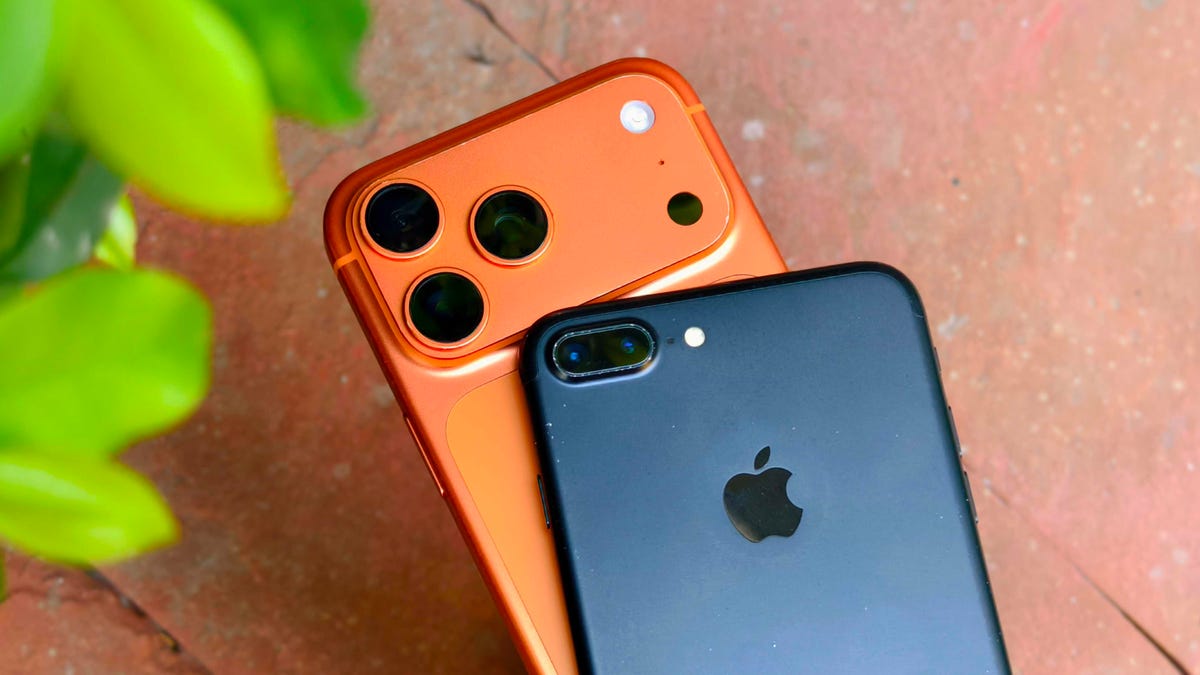
Many remember the iPhone 7 as the first Apple phone without a dedicated headphone jack. It’s been nearly a decade since the company removed our beloved (and still missed) 3.5mm port, which emboldened most of the smartphone industry to do the same. But the 2016 iPhone and its larger Plus version had an even greater impact on future phones beyond forcing us all to use dongles or buy AirPods.
Apart from being the first water-resistant Apple phones, the iPhone 7 and 7 Plus ushered in the era of having a telephoto camera in your pocket.
Prior to 2016, Apple distinguished the Plus variant from its smaller sibling with a bigger display, larger battery and more RAM, but both still had a single rear camera. However, the 7 Plus was the first iPhone to have multiple cameras on its back, helping Apple create a premium photography setup that elevated phone cameras into must-have features.
A decade later and today’s iPhone 17 Pro and 17 Pro Max have a trio of rear cameras with 48-megapixel sensors and different lenses: a wide-angle, a 4x telephoto and an ultrawide.
I love the in-hand feel of Apple’s decade-old iPhone 7 Plus.
The iPhone 7 Plus has two 12-megapixel rear cameras: one with a wide-angle lens and the other with a 2x telephoto lens. Together, they enable depth-of-field blur effects through Portrait mode — a new feature at the time and another iPhone 7 Plus exclusive that the standard iPhone 7 lacked. It took Apple another two years with the help of AI (in the form of machine learning) to introduce Portrait mode on an iPhone with a single rear camera (iPhone XR). Yep, AI was a thing in 2018. Loosely, you can credit the iPhone 7 Plus for popularizing Portrait mode despite the 2014 HTC One M8 using a depth sensor for bokeh effect photos two years prior.
As part of the 10-year challenge that’s been filling my social feeds since January, I took the 2016 iPhone 7 Plus and its 2026 counterpart, the iPhone 17 Pro Max, on a photowalk to compare their cameras head-to-head. As expected, the iPhone 17 Pro Max easily outperformed the 7 Plus. But the biggest leap isn’t just about more megapixels or even smarter computational photography — it’s the far more versatile camera system that delivers a noticeably better shooting experience.
Technical note: Except where noted, I shot using the default modes on both phones for a fair comparison. These images are compressed for the web.
The iPhone 7 Plus’ ‘portrait’ mode does background blur better
See all photos 12MP vs. 48MP shots: More details, brighter colors and a better dynamic range
Two 12-megapixel cameras from 2016 take on a 48-megapixel camera from 2026.
Prakhar Khanna/CNET
The iPhone 7 Plus’ primary lens has a narrower field of view than the 17 Pro Max’s main camera. I could capture more of a scene in the frame from the same distance with the 17 Pro Max than I could with the 7 Plus.
Although, I find myself shooting most photos in my daily life at 1.2x or 1.5x magnification on my iPhone 17 Pro Max, tapping the 1x button to cycle between them. I wouldn’t mind modern phone cameras defaulting to 1.2x or 1.5x (a 28mm or 35mm equivalent) for everyday shooting. You can change the default magnification on some newer iPhone models by going to Settings > Camera > Fusion camera.
But let’s get into the comparison. I took photos with each phone standing in the same spot, doing my best to keep the framing consistent.
The 10-year-old iPhone holds up better than expected. Take a look below at the images I took of a tomb. The iPhone 7 Plus’ photo has pleasing colors and the quality is good enough for social media. It’s only when zooming in that you notice many of the fine details on the tomb’s walls become soft or smudged. The higher-resolution sensor in the iPhone 17 Pro Max, combined with Apple’s modern image processing, means its photo has more details than the older phone.
Apple’s color characteristics have more or less stayed the same. Look at the photos below of some red flowers. Images from the 2016 iPhone have a strong pinkish hue and softer look. Today’s camera sensors are capable of shooting sharper, more detailed images with a wider dynamic range than before — notice the texture in the flower petals in the 17 Pro Max’s image.
That applies to the ability to capture photos in raw formats, which include greater dynamic range than the default shooting modes. The iPhone 7 and 7 Plus were the first to support shooting in raw — specifically DNG — but only as an option in third-party camera apps. Apple didn’t add native raw support to the Camera app until it introduced its ProRaw format in 2020 with the iPhone 12 Pro, which combines computational processing with the editing flexibility of raw.
These 2x photos below best show the strides iPhone photography has made in 10 years. The iPhone 17 Pro Max’s 2x digital zoom image has more details than the 2x optical zoom shot from the 7 Plus. Look closer on the tomb’s pink stones at the center and you can really notice the differences.
The dedicated 2x telephoto camera from 2016 just doesn’t compete with the 2x zoom of 2026’s iPhone 17 Pro. Today’s iPhone takes advantage of its larger and higher resolution 48-megapixel sensor by cropping in to where the 2x zoom would be and then applying software optimizations. To no one’s surprise, an iPhone Air with its single-rear camera would beat an iPhone 7 Plus’ dedicated 2x zoom.
The iPhone 7 Plus holds its own when shooting closeup photos.
Prakhar Khanna/CNET
The iPhone 7 Plus doesn’t have a dedicated macro mode, but it did well capturing rich colors and a good amount of detail in the closeup shot below. The yellows pop in direct light and I love it. By comparison, the iPhone 17 Pro’s image retains more detail in the bumblebee’s wings. But the difference between these photos isn’t as big as I’d have expected. The image on the right was shot using the 17 Pro Max’s macro mode, which actually is just a crop of the ultrawide camera.
I love this shot because I was able to capture a flying bee without any blur, thanks to iPhone 17 Pro’s fast shutter.
Prakhar Khanna/CNET
Autofocus on the Apple iPhone has been another tremendous area of improvement during the last 10 years. In the above shot, I turned off the macro mode on the 17 Pro Max and was surprised to get a flying bee in my shot without any blur. I tried replicating it using the iPhone 7 Plus but couldn’t get it to work — I got as close as I could without being afraid of being stung.
On its own, the iPhone 7 Plus tends to overexpose skin tones in daylight, resulting in the image above with blown highlights and overexposed patches on the skin. After my girlfriend tapped to focus, which also adjusts the exposure, the camera captured a better-looking photo with more true-to-life colors. My red sweater in the 17 Pro Max photo is darker than it really is and seems underexposed, but I like it much better than the 17 Plus image.
To take the comparison a step further, one feature the iPhone didn’t have 10 years ago was the ability to turn a photo into a Portrait mode image after it was taken — as you can see in the iPhone 17 Pro Max example below.
The Photos app turned on the Portrait mode automatically after this photo was shot.
Prakhar Khanna/CNET
The iPhone 17 Pro Max also struggles with highlights in strong light with HDR on (by default), but the majority of the time it captures better-exposed images with richer details and more accurate colors.
Also, notice that in the photo above, that Portrait mode was automatically applied to soften the background. Today’s Portrait mode offers better edge detection and a pleasing, natural-looking bokeh than when it was first released a decade ago. Below is a Portrait mode photo from the iPhone 7 Plus for reference:
The iPhone 7 Plus struggles with finer details in the portrait mode. I like the overall photo but if you look closely, it blurred my hair and the bokeh is too strong.
Prakhar Khanna/CNETIt’s about the experience, not the megapixels
Oof! I’m glad we don’t have those thick bezels anymore.
Prakhar Khanna/CNET
Before smartphones, the idea of taking a “selfie” was rare, but front-facing cameras have become a vital way millions of people document their lives. The 7-megapixel camera in the iPhone 7 Plus can capture spontaneous moments, but the photos are uneven and overexposed.
The iPhone 7 Plus had an impressive front camera in 2016 but doesn’t stand a chance against Apple’s latest selfie shooters on the iPhone 17 series. Both of these slefies are from the 7 Plus.
Prakhar Khanna/CNET
In the pair above, I can choose between blown-out highlights behind me (left image) or tapping to compensate for the bright background, which fixes the midtones but leaves me underexposed.
Apple’s new front camera is a game-changer for me. Both of these selfies are from the 17 Pro Max.
Prakhar Khanna/CNET
In the iPhone 17 series, Apple introduced a new selfie camera. All four new iPhone models, including the iPhone Air, have an 18-megapixel square sensor peeking out from inside the Dynamic Island. This camera improves the auto exposure, colors and dynamic range, giving me better selfies like the ones above.
That square sensor powers Center Stage, where you can hold the phone vertically and take a horizontal selfie. It can also use AI to automatically expand the framing in selfies when multiple people are in the shot.
iPhone 7 Plus vs. iPhone 17 Pro Max final thoughts
This is an image from Scott Stein’s original iPhone 7 Plus review from 2016.
Sarah Tew/CNET
Bringing the iPhone 7 Plus along for a photo walk made me appreciate a few things I’ve taken for granted when shooting with today’s iPhone 17 Pro Max.
Some of the improvements stem from technological advances, such as faster autofocus for capturing moving subjects, enhanced telephoto capabilities and significantly better low-light performance. I also appreciate the creative flexibility I have when I edit raw photos in Lightroom, thanks in large part to the cameras’ modern image sensors. All the shots in this story were unedited and captured in the default formats, but in my other work, having more editing latitude has made my mobile photography experience more enjoyable.
However, my biggest takeaway comes from the front camera. The benefits of that new square sensor go beyond the selfie shooting experience. It also helps stabilize the image when recording videos or making FaceTime video calls.
I love this feature because I have a nervous disorder that causes constant tremors in my hands. On other phones it often makes my selfie photos and videos blurry. But with the iPhone 17 Pro Max, I can record myself without worrying about jittery footage and just enjoy the moment.
This was such a wonderful 10-year challenge. And I look forward to doing it again in 2036 — or will we be doing a 20-year challenge then?
Watch this: Can I Shoot a Movie With an iPhone 17 Pro? | Prove It
08:07