
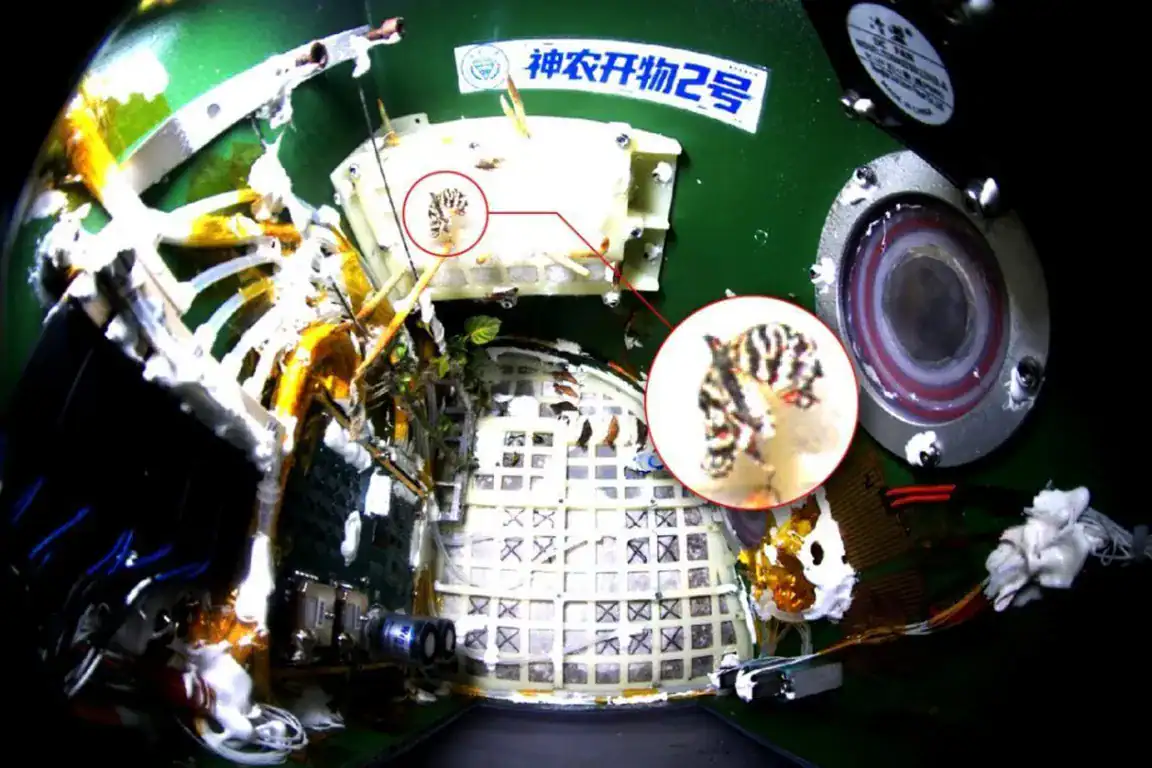
 The arthropod astronaut during his mission. Credit: Chongqing University
On December 13, a rocket rose from the Jiuquan Satellite Launch Center in northwestern China carrying an unusual passenger: a butterfly inside a chrysalis, mid-transformation.
Weeks later, images transmitted from orbit confirmed that the insect had completed its normal metamorphosis. It emerged from its chrysalis, unfolded its wings, and moved within a small sealed chamber.
The experiment came from a team at Chongqing University in China, which built a small “space ecosystem payload” called ShennongKaiwu 2 and sent it up aboard a Kuaizhou-11 Y8 carrier rocket. After launch, the payload entered low-Earth orbit and began its “biotest mission,” the researchers said.
Thermal controls within the sealed payload kept the chamber near 30 °C, allowing the pupa to complete metamorphosis. The adult butterfly lived for several days in a 14.2-liter chamber that weighed 8.3 kilograms, moving around freely, fluttering its wings, and sometimes resting on leaves placed in its tiny habitat in space.
The result is easy to romanticize, but the researchers describe the experiment in practical terms. Their goal was to determine whether a small, closed-loop test ecosystem can remain stable in orbit long enough to support one of the most complex transformations of life.
Building Ecosystems for Spaceflight
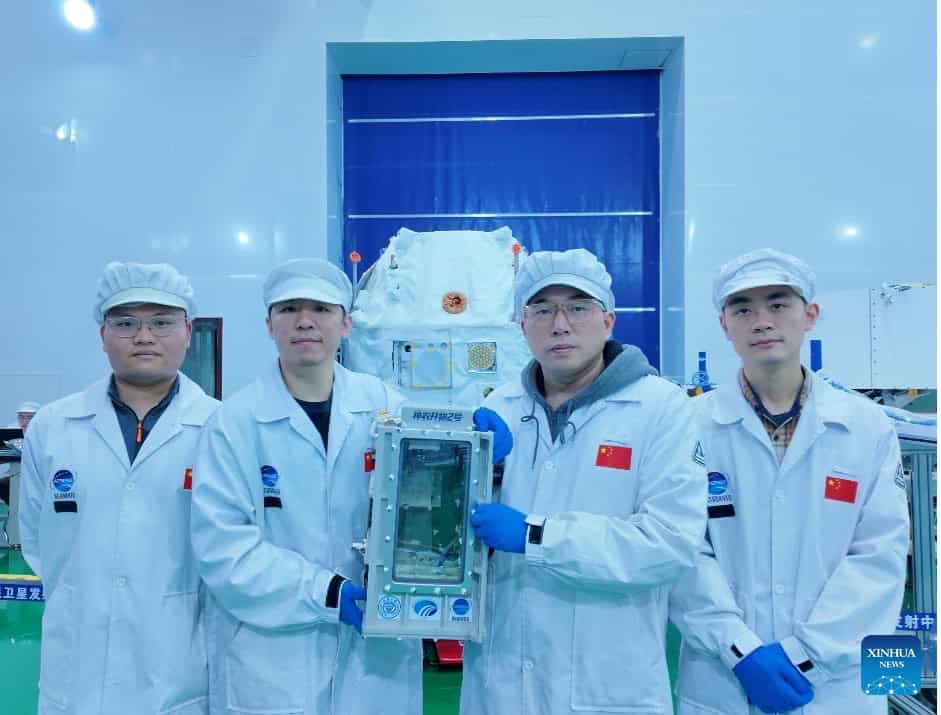 The researcher team holding the butterfly astronaut’s quarters. Chongqing University
ShennongKaiwu 2 was designed to mimic the basic cycling that keeps life going on Earth. Plants inside the capsule generated oxygen and could serve as food, while microorganisms processed waste and helped keep the air stable. Sensors monitored oxygen, carbon dioxide, pressure, light, and humidity.
Professor Xie Gengxin, director of Chongqing University’s Space Science and Technology Research Institute and chief designer of the payload, said the butterfly’s behavior defied a common assumption.
“Many people thought the butterfly wouldn’t be able to fly in microgravity, but what we observed was that it quickly adapted to the new environment,” he said.
×
Thank you! One more thing…
Please check your inbox and confirm your subscription.
Microgravity alters the physical conditions that living systems depend on. The team reported changes in body-fluid distribution, disruptions in the transport of materials, and exposure to radiation as key challenges for both the butterfly and its surrounding ecosystem. In orbit, even the movement of air, moisture, and nutrients can become difficult to regulate.
The engineers also had to face structural challenges. Xie said the team had to prevent oxidation and corrosion in magnesium-alloy components of the sealed capsule caused by high humidity. This problem had previously limited how long such habitats could operate. Addressing it helped create what he described as a “safety barrier” that protected the miniature ecosystem and allowed it to function in orbit.
To better reflect real spaceflight conditions, the team operated the capsule without additional radiation shielding, active temperature control, or full-spectrum lighting. Qiu Dan, deputy chief designer of the payload and head of its biological system, said they designed the experiment to proceed entirely on its own. “The transformation process was entirely unmanned, unlike previous experiments (of other countries) aboard the International Space Station,” she said.
Preparing for Deep Space
 Visitors photograph a butterfly specimen at the Center of Space Exploration of the Ministry of Education at Chongqing University. Credit: Chongqing University
Space agencies have long relied on studies of plants and microbes to support systems that remove carbon dioxide, generate oxygen, and recycle water for astronauts. Future deep-space missions aim to go further by developing self-sustaining ecosystems in which living organisms help maintain these essential functions.
The butterfly experiment extends that trend by testing development, not just survival. Under microgravity, the experiment showed that an organism could pass through a full stage of development while exposed to altered gravity.
China has been building experience with closed ecosystems in orbit. In 2024, zebrafish survived 43 days aboard the Tiangong space station inside a closed aquatic ecosystem, according to Aerospace Global News. The same source reported that four laboratory mice were later sent into orbit. Two mice later gave birth on Earth, part of China’s first spaceflight study examining mammalian reproduction after orbital exposure.
“The successful emergence of the butterfly is not just about having an insect in space,” Xie said. “It marks a solid step forward in verifying the feasibility of long-term operation of complex life support systems in orbit.”
Xie has tested life in unusual places before. In 2019, he served as chief designer on an experiment in which a cotton seed briefly germinated inside a sealed biosphere carried by China’s Chang’e 4 mission.
He now connects these experiments to a future in which ecosystems travel with astronauts. “True ‘space farming’ aims to utilize space resources for agricultural production,” Xie said, envisioning butterflies pollinating plants in space farms. “Lunar and Martian farms will become a reality in the future,” he added.