
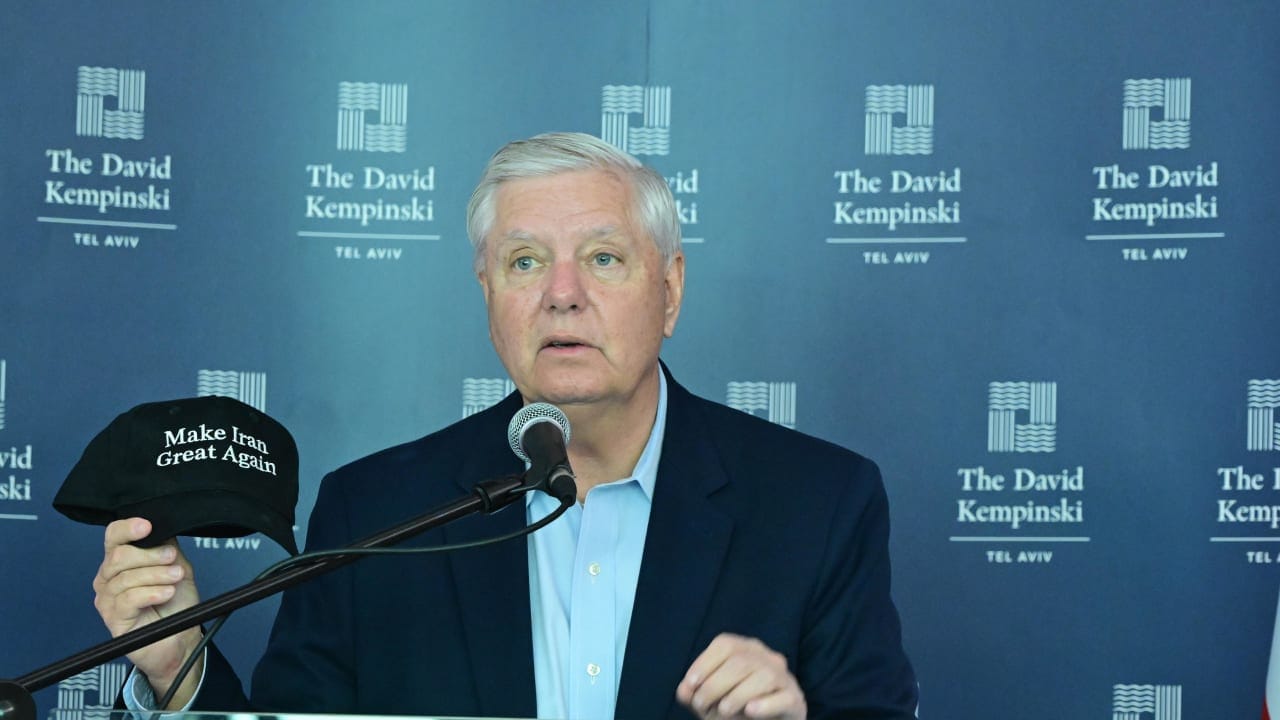
The Iranian regime is teetering on the edge of collapse, the US must follow through on its promises to aid the Iranian people or risk facing a catastrophe “worse than Afghanistan,” and risks facing the fall of the Abraham Accords if the Islamic Republic regime survives, US Senator Lindsey Graham told The Jerusalem Post in a Monday interview.
Following meetings with Prime Minister Benjamin Netanyahu, opposition leader Yair Lapid, and other senior officials, and after participating in a rally of 250,000 anti-Iranian regime protesters, Graham described a historic window of opportunity that he believes could reshape the Middle East for a long time to come.
“Without the October 7 massacre happening, I don’t believe Iran would be on the verge of regime collapse,” he said.
“The determination of the Israeli people to make sure ‘Never Again’ has meaning has weakened Iran and their proxies, unlike any time since the founding of the religious-Nazi state in 1979,” Graham said, linking the current vulnerability of the ayatollahs to Israel’s military response.
“The sacrifice of the people who have died in droves for their freedom in Iran and the determination of Israel to strike back after the massacre… those two things have led to this historic moment,” he added.

Graham painted a grim picture of the world should the current uprising in Iran fail.
“If after all this, [Iranian Supreme Leader Ayatollah Ali] Khamenei is still standing, then I think the Abraham Accords will eventually fall, and Hamas, Hezbollah, and the Houthis will get stronger,” he said.
“The Arabs will go back in their corner, and [Russian President Vladimir] Putin will not take us seriously,” he added. “I think China will be more likely to take Taiwan.”
Graham issued a stark warning regarding the Trump administration’s pledge that “help is on the way” for Iranian protesters. He insisted that if the West falters now, American credibility will be shattered.
“Once you tell the protesters to keep protesting, and that help is on the way, if you don’t then deliver on that promise, then it will be a generational disaster,” he said. “It would be worse than Afghanistan. Nobody will trust us in the future.”
Graham compared current Iranian regime to 1930s Nazi Germany
Graham dismissed concerns about the instability of regime change, comparing the situation to Germany in the 1930s.
“People probably asked in 1935: ‘What’s the downside of killing [Adolf] Hitler?’ And I wish somebody would say it’s worth it,” he said. “Let’s take him out. To me, it’s not even a close call. Trading the ayatollah for the protesters is a good trade for America.”
Asked about different positions taken by the US and Israel, Graham said: “I believe there is no daylight between Israel and the US when it comes to regional threats, particularly Iran. I sense there are two lines in the water from [US President Donald] Trump: a diplomatic line and a military option line, and we’ll see which one catches the biggest fish.”
Asked whether there is a deadline for the current diplomatic track, he said time is short.
“We’re in the area now where we have got to make some strategic decisions about diplomacy and military action in the coming weeks, not months,” he added.
“I think there has to be some understanding that the longer the negotiations go, the more the consolidation of power the regime will use,” Graham said.
Any Iran deal “has to go through the Senate,” he said. “I think there will be a lot of senators skeptical about any deal that leaves the ayatollahs in power without some assurance that the regime actually changed. That’s going to be a tough sell.”
Despite the risks of an Iran deal being reached, Graham expressed confidence in Trump’s strategy.
“President Trump is one of the smartest guys I know about [being] strong without getting entangled,” he said.
“When they write the history of these times, I think Trump and Netanyahu and me and others, we can hold our heads up high and say that we listened to the people in the streets, telling them that help is on the way, and as a result of that help, the largest state sponsor of terrorism is no more,” Graham said.