
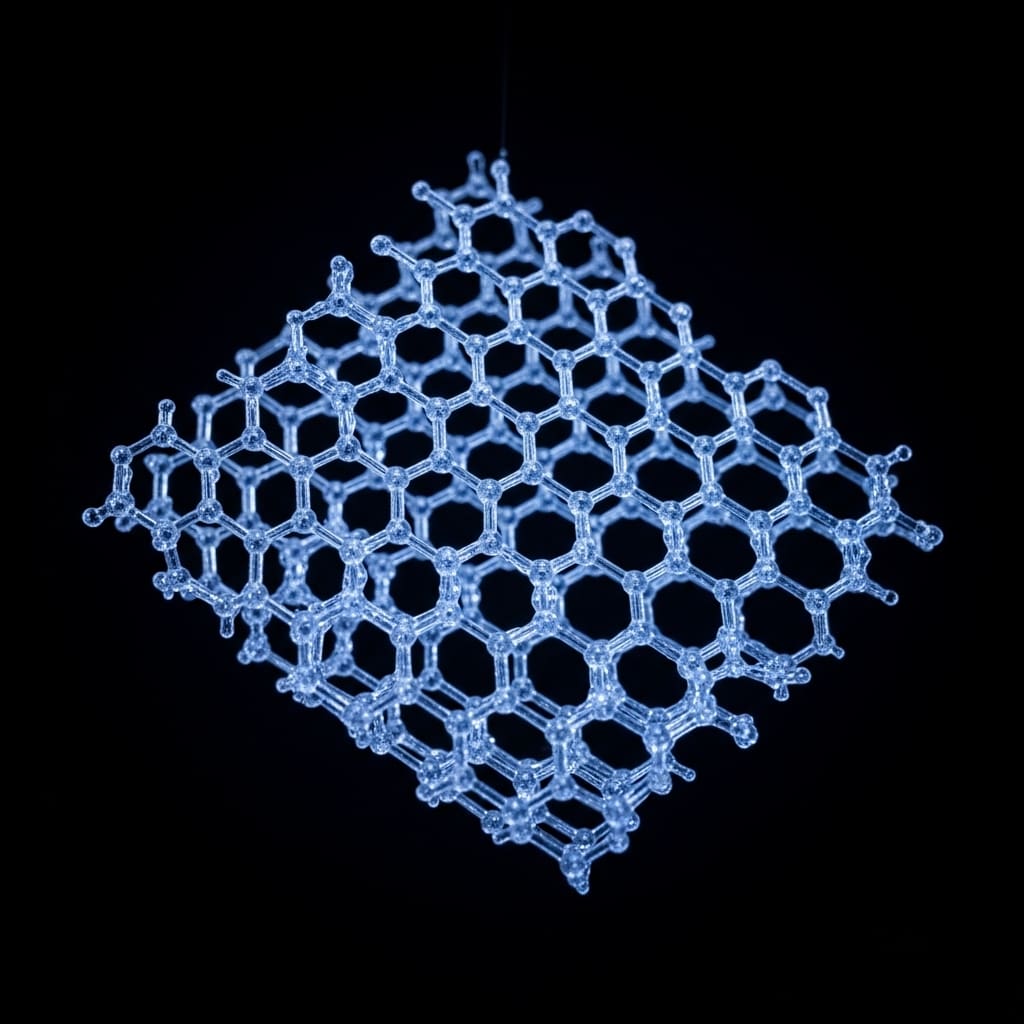
Scientists are increasingly focused on accurately modelling two-dimensional materials for potential technological applications, and this research details an efficient method for simulating penta-silicene using machine learning potentials. Le Huu Nghia, Pham Thi Bich Thao, and Truong Do Anh Kha, all from the College of Natural Sciences, Can Tho University, working with colleagues Vo Khuong Dien and Nguyen Thanh Tien at the same institution, have developed a molecular dynamics simulation employing machine learning interatomic potentials from the DeepMD package to describe interactions within penta-silicene sheets. Their findings demonstrate improved accuracy in predicting melting points, 632 K and 606 K in NVT and NPT ensembles respectively, and a more detailed radial distribution function compared to classical Tersoff potential methods. This high-precision, cost-effective approach provides valuable insights into the thermodynamic properties and structural stability of penta-silicene, furthering the prospects for its experimental synthesis and future use in materials science.
Researchers have developed a new computational strategy for simulating the behaviour of penta silicene, a two-dimensional material with potential applications in advanced electronics and energy storage. This work addresses a critical challenge in materials science, accurately modelling complex systems at the atomic level over extended timescales.
Traditional methods, relying on density functional theory (DFT), are often computationally prohibitive for large-scale molecular dynamics (MD) simulations. To overcome this limitation, the team employed machine learning interatomic potentials (MLIPs), specifically utilising the DeepMD package, to achieve near-quantum mechanical accuracy while significantly reducing computational cost.
The study focuses on determining the thermodynamic properties of penta silicene sheets, structures composed of silicon atoms arranged in a pentagonal lattice. By combining MLIPs with classical potentials, researchers performed MD simulations to predict the melting points of this material under different conditions.
Results indicate melting temperatures of 632 K in a constant volume-temperature (NVT) ensemble and 606 K under constant pressure (NPT), offering valuable data for guiding experimental synthesis. Furthermore, analysis of the radial distribution function, a measure of atomic spacing, revealed a more accurate representation of the material’s structure compared to conventional Tersoff potentials, which only captured one key interatomic distance of 2.375 Å while the MLIP accurately predicted distances of both 2.275 Å and 2.375 Å.
To further validate the structural stability of penta silicene, the researchers performed on-the-fly machine learning calculations over a 10 picosecond timescale. This approach, combining ab initio methods with machine learning, allows for dynamic evaluation of the material’s behaviour without sacrificing accuracy.
The findings contribute to a growing body of evidence supporting the feasibility of synthesizing penta silicene and pave the way for exploring its potential in future technologies. This high-precision, cost-effective method represents a significant advancement in computational materials science, offering a powerful tool for designing and discovering novel two-dimensional materials.
Machine learning accurately predicts penta silicene melting points and atomic structure
Melting point temperatures reached 632 K and 606 K within the canonical NVT and isobaric NPT ensembles, respectively, when employing the machine learning interatomic potential (MLIP) derived from the DeepMD package to simulate penta silicene. These values represent the temperatures at which the material transitions from a solid to a liquid state under constant volume and constant pressure conditions.
In contrast, simulations using the classical Tersoff.SiC potential yielded comparatively higher melting points, indicating a discrepancy in the description of interatomic interactions. The MLIP approach, therefore, provides a more accurate representation of the thermal behaviour of penta silicene. Further analysis of the atomic structure revealed characteristic peaks in the radial distribution function at interatomic distances of 2.275 Å and 2.375 Å.
These peaks signify the preferred separation distances between silicon atoms within the penta silicene sheet, reflecting the material’s bonding arrangement. Notably, the Tersoff.SiC potential only accurately describes the 2.375 Å distance, failing to capture the shorter interatomic spacing observed in the MLIP simulations.
This suggests the MLIP more faithfully reproduces the material’s structural characteristics at the atomic level. To assess structural stability, penta silicene was subjected to on-the-fly machine learning simulations for a duration of 10 picoseconds. This allowed for real-time refinement of the interatomic potential based on quantum mechanical calculations, ensuring a high degree of accuracy throughout the simulation. The resulting data confirms the dynamic stability of the penta silicene structure, providing further evidence supporting its potential for experimental synthesis and future applications.
Development of a DeepMD force field for penta silicene thermodynamic modelling
DeepMD’s machine learning interatomic potentials (MLIPs) underpinned the methodology used to explore the thermodynamic properties of penta silicene. This work leveraged the DeepMD package to construct a highly accurate force field derived from Density Functional Theory (DFT) data, bridging the gap between quantum mechanical precision and the scale required for molecular dynamics (MD) simulations.
The initial step involved training the MLIP on a dataset generated from DFT calculations, effectively allowing the model to learn the complex relationships between atomic positions and potential energy. Subsequently, MD simulations were performed using both the trained MLIP and the classical Tersoff potential for SiC, providing a comparative benchmark.
The simulations were conducted using the LAMMPS package, a widely used molecular dynamics simulator, allowing for the modelling of atomic interactions and the evolution of the penta silicene sheet over time. This dual approach was chosen to validate the MLIP’s accuracy and demonstrate its computational efficiency compared to purely DFT-based methods.
To assess structural stability, an on-the-fly machine learning approach was implemented, integrating ab initio molecular dynamics (AIMD) simulations for a duration of 10 picoseconds. This involved continuously retraining the MLIP during the simulation, ensuring that the potential accurately reflected the evolving atomic configurations.
The choice of on-the-fly learning addresses the limitations of static potentials, which may degrade as the system deviates from the training data. Radial distribution functions were then calculated to characterise the atomic arrangement and compare the performance of both potential methods.
The Bigger Picture
Scientists are increasingly reliant on computational methods to explore materials beyond the reach of conventional experimentation. This work represents a significant step forward in accurately modelling two-dimensional materials, specifically penta silicene, by combining the power of machine learning with established molecular dynamics techniques.
For years, a key bottleneck has been the computational cost of accurately describing interatomic interactions, traditionally reliant on density functional theory which struggles with both accuracy and scale. The application of machine learning interatomic potentials offers a compelling solution, promising near-quantum mechanical precision at a fraction of the computational expense.
The demonstrated ability to accurately predict the melting point of penta silicene, and to capture subtle structural details missed by simpler potentials, is noteworthy. It’s not merely about achieving a number close to what might be observed in a lab; it’s about building a reliable predictive framework for designing and optimising novel two-dimensional materials.
This has implications for areas like flexible electronics, advanced sensors, and potentially even energy storage. However, the true test of any computational model lies in its predictive power beyond the specific conditions studied. The 10-picosecond simulations, while valuable, represent a relatively short timescale for assessing long-term structural stability.
Furthermore, the accuracy of the machine learning potential is inherently tied to the quality and breadth of the training data. Expanding the dataset to encompass a wider range of temperatures, pressures, and defect configurations will be crucial. Looking ahead, the integration of these MLIPs with multiscale modelling approaches, linking atomistic simulations to continuum mechanics, could unlock a deeper understanding of material behaviour and accelerate the discovery of truly groundbreaking materials.
👉 More information
🗞 Efficient molecular dynamics simulation of 2D penta-silicene materials using machine learning potentials
🧠 ArXiv: https://arxiv.org/abs/2602.11548