
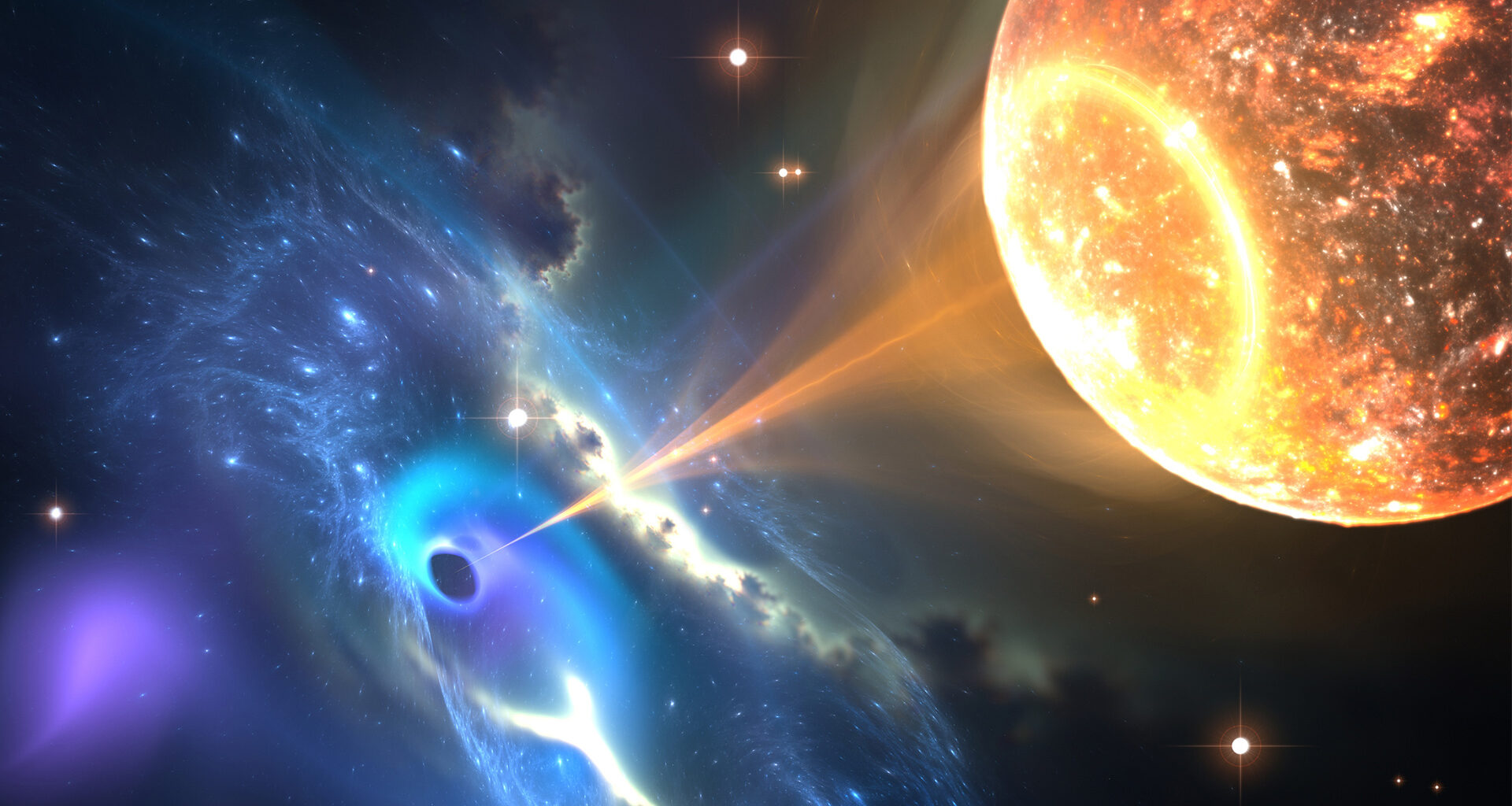
Astronomers are used to dramatic endings. When a massive star dies, it usually explodes in a spectacular supernova, briefly shining brighter than its entire galaxy. However, in the nearby Andromeda galaxy, a giant star seems to have taken a very different path.
Instead of exploding, it quietly faded away and collapsed into a black hole. This rare and surprising vent is possibly some of the clearest evidence yet that certain stars can skip the supernova stage entirely.
“The dramatic and sustained fading of this star is very unusual, and suggests a supernova failed to occur, leading to the collapse of the star’s core directly into a black hole,” Kishalay De, lead researcher and an astronomy professor at Columbia University, said.
If confirmed, it could change how scientists count stellar deaths and understand black hole formation.
Signals hidden in old records
The story began in 2014, when NASA’s space telescope from the NEOWISE mission recorded something unusual. A massive star in Andromeda began glowing more brightly in infrared light.
Infrared light is invisible to our eyes but can reveal warm dust and gas. Over about three years, the star’s infrared emission steadily increased. Then it dramatically faded in visible light, dimming by roughly a factor of 10,000 by 2023, and effectively vanished, leaving behind a shell of dust.
At the time, no one realized what had happened. The data sat quietly in public archives for years. Later, the authors of the current study decided to systematically search archival infrared data for signs of direct collapse.
They carried out the largest study ever done of variable infrared sources, tracking changes in brightness for stars in the Milky Way and nearby galaxies.
Their research was guided by a prediction from the 1970s: if a star collapses directly into a black hole, it should briefly glow in infrared light as it sheds its outer layers and becomes wrapped in dust, before fading away. What they found shocked them.
“This has probably been the most surprising discovery of my life. The evidence of the disappearance of the star was lying in public archival data, and nobody noticed for years until we picked it out,” De said.
The star that fit the prediction
They identified a perfect candidate, a star named M31-2014-DS1. This star was a hydrogen-depleted supergiant located about 2.5 million light-years from Earth in Andromeda. When it first formed, it had about 13 times the mass of our Sun.
Over its lifetime, powerful stellar winds stripped away much of its material. By the time it died, it had only about five times the Sun’s mass. According to the researchers, the star’s long, steady fading is highly unusual and does not match the pattern of a normal supernova.
Instead of blasting its outer layers into space in a bright explosion, its inner core appears to have collapsed inward completely, forming a black hole directly. The outer layers drifted away more gently, creating the dusty shell seen in infrared light.
The remaining faint infrared glow is now thought to come from dust and gas heated by material surrounding the newly formed black hole.
There was a possible earlier case around 2010 in the galaxy NGC 6946. However, that object was about 10 times farther away and 100 times fainter, and the available data were not as detailed. As a result, its true nature has remained uncertain. In contrast, M31-2014-DS1 provides much clearer and higher-quality evidence.
“We’ve known that black holes must come from stars. With these two new events (NGC 6946 and M31-2014-DS1), we’re getting to watch it happen, and are learning a huge amount about how that process works along the way,” Morgan MacLeod, co-author of the study and an astronomy lecturer at Harvard, said
This one discovery can change many things
Black holes were first predicted more than 50 years ago. Today, astronomers know of dozens in our galaxy and have detected hundreds more through gravitational waves from distant cosmic collisions.
However, there is still no clear agreement on exactly which stars become black holes and under what conditions. Stars with masses similar to M31-2014-DS1 were long believed to always explode as supernovae.
This case suggests that such stars may sometimes fail to explode, depending on how gravity, gas pressure, and shock waves interact in the chaotic final moments of stellar life.
If direct collapse happens more often than previously thought, it could change estimates of how many supernovae occur in the universe. That, in turn, affects models of how elements are spread through galaxies, since supernovae are major sources of heavy elements like iron.
It also influences predictions of how many black holes should exist and how frequently they might merge and produce gravitational waves.
However, scientists need more observations to determine how common this process truly is. The team plans to continue mining archival data and to use future infrared surveys to search for more disappearing stars.
The study is published in the journal Science.