
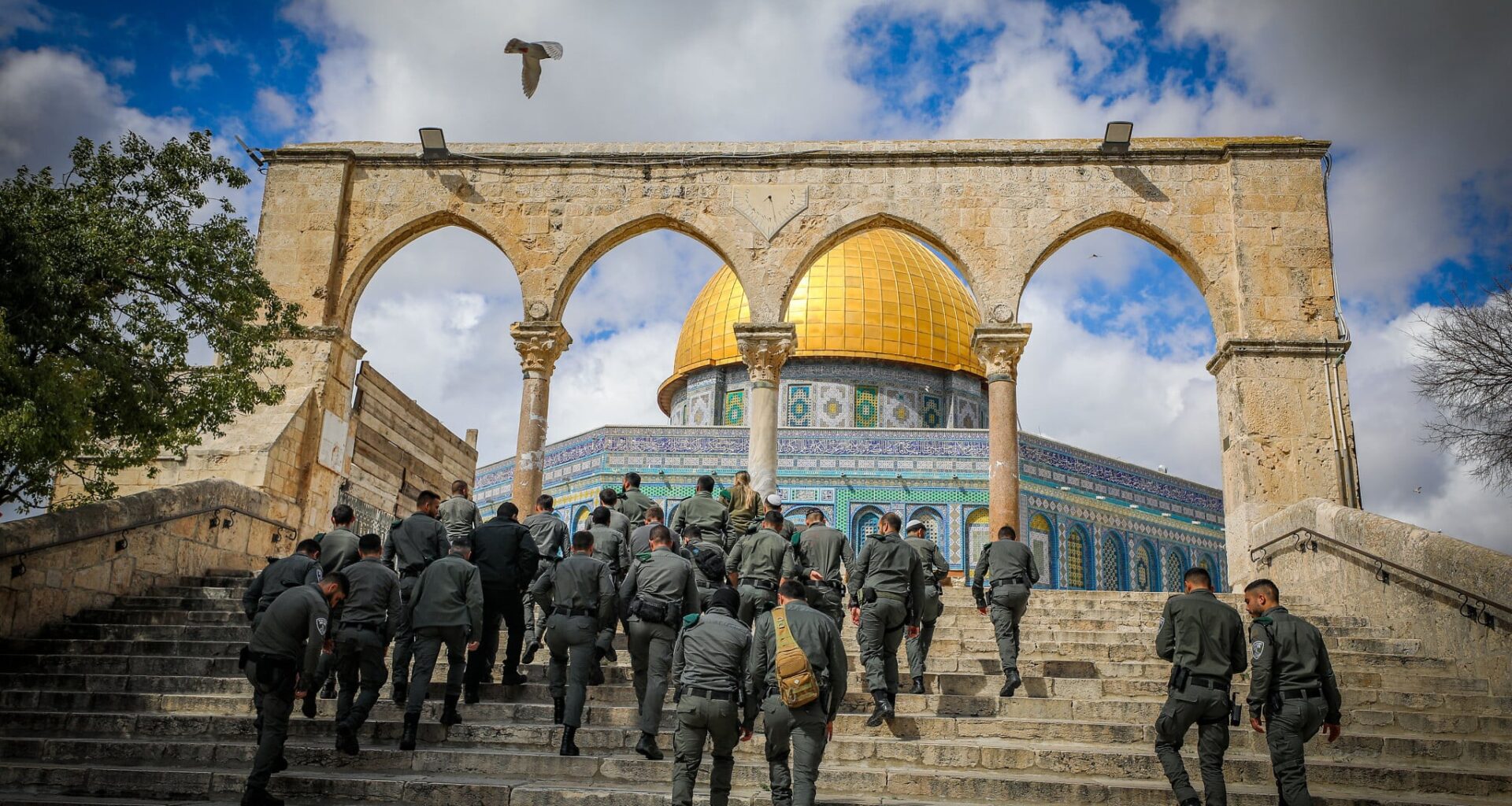
Israel Police said Monday that they would deploy in force around Jerusalem’s Al‑Aqsa Mosque during the Muslim holy month of Ramadan, which begins this week, as Palestinian officials accused Israel of imposing restrictions at the compound.
Over the course of the month of fasting and prayer, hundreds of thousands of Palestinians traditionally attend prayers at Al‑Aqsa — Islam’s third-holiest site, located in East Jerusalem, which Israel captured in 1967 and later annexed. Israel refers to the compound as the Temple Mount, as it housed both ancient Jewish temples, making it the religion’s holiest site.
Arad Braverman, a senior Jerusalem police officer, said forces would be deployed “day and night” across the compound, known to Jews as the Temple Mount, and in the surrounding area.
He said thousands of police would also be on duty for Friday prayers, which draw the largest crowds of Muslim worshippers.
Braverman said police had recommended issuing 10,000 permits for Palestinians from the West Bank, who require special permission to enter Jerusalem.
Get The Times of Israel’s Daily Edition
by email and never miss our top stories
By signing up, you agree to the terms
He did not say whether age limits would apply, adding that the final number of people would be decided by the government.
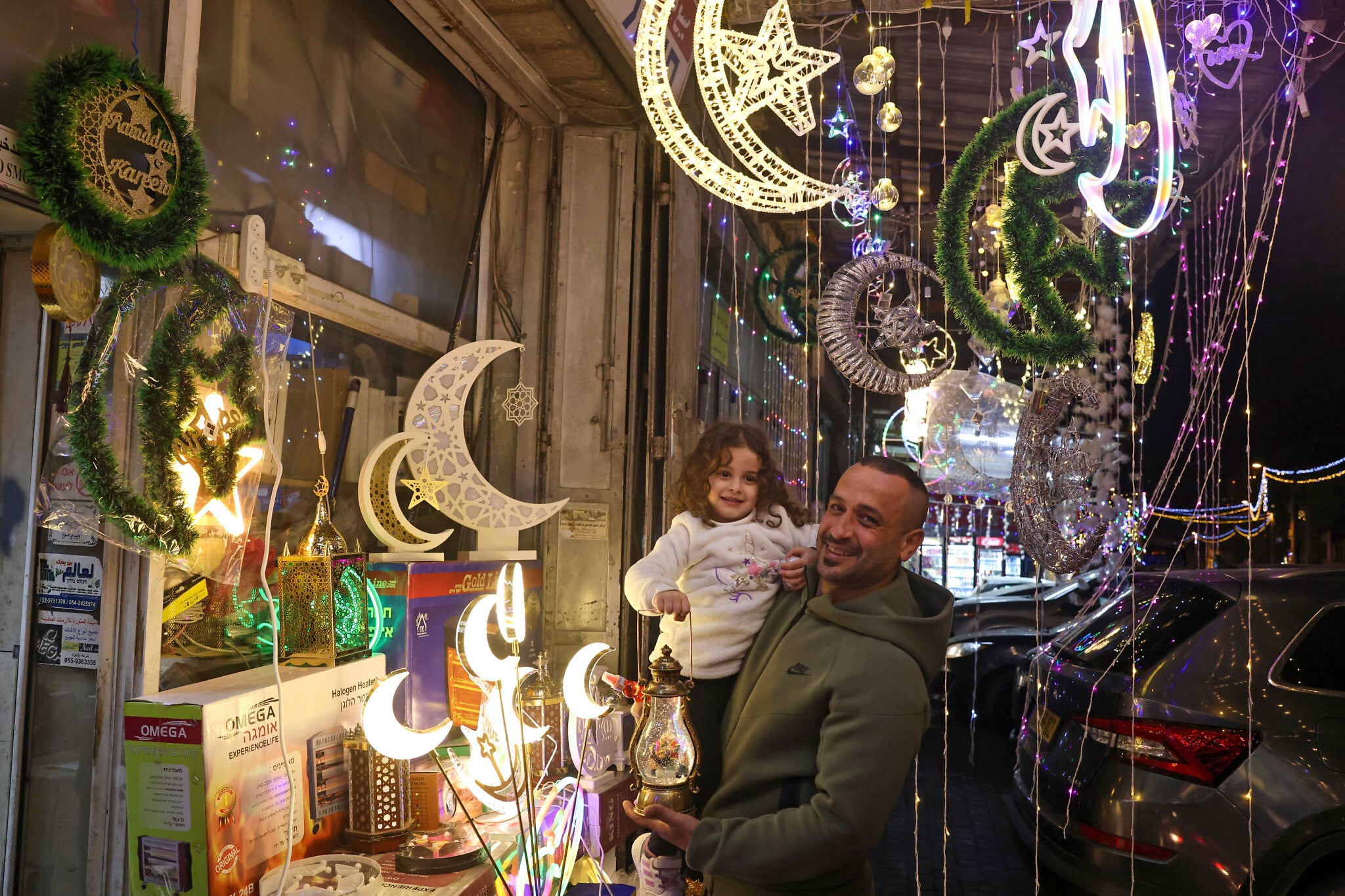
A Palestinian man holding his daughter pose for a picture as they shop for decorative lights at a shop in east Jerusalem on February 16, 2026, as Muslims prepare for the holy fasting month of Ramadan. (AHMAD GHARABLI / AFP)
The Palestinian Jerusalem Governorate said in a separate statement it had been informed that permits would again be restricted to men over 55 and women over 50, mirroring last year’s criteria.
It said Israeli authorities had blocked the Islamic Waqf — the Jordanian‑run body administering the site — from carrying out routine preparations, including installing shade structures and setting up temporary medical clinics.
A Waqf source confirmed the restrictions and said 33 of its employees had been barred from entering the compound in the week before Ramadan, which is slated to begin on Wednesday evening.
The Al‑Aqsa compound is a central symbol of Palestinian identity and also a frequent flashpoint.
Under long‑standing arrangements, Jews may visit the compound but are not supposed to be allowed to pray there — a policy that has been gradually ignored in recent years by Israeli authorities.
A growing number of Jewish ultra-nationalists have challenged the prayer ban, including far‑right National Security Minister Itamar Ben Gvir, who prayed at the site in 2024 and 2025.
Braverman insisted Monday that no changes to the so-called status quo governing the site were planned.
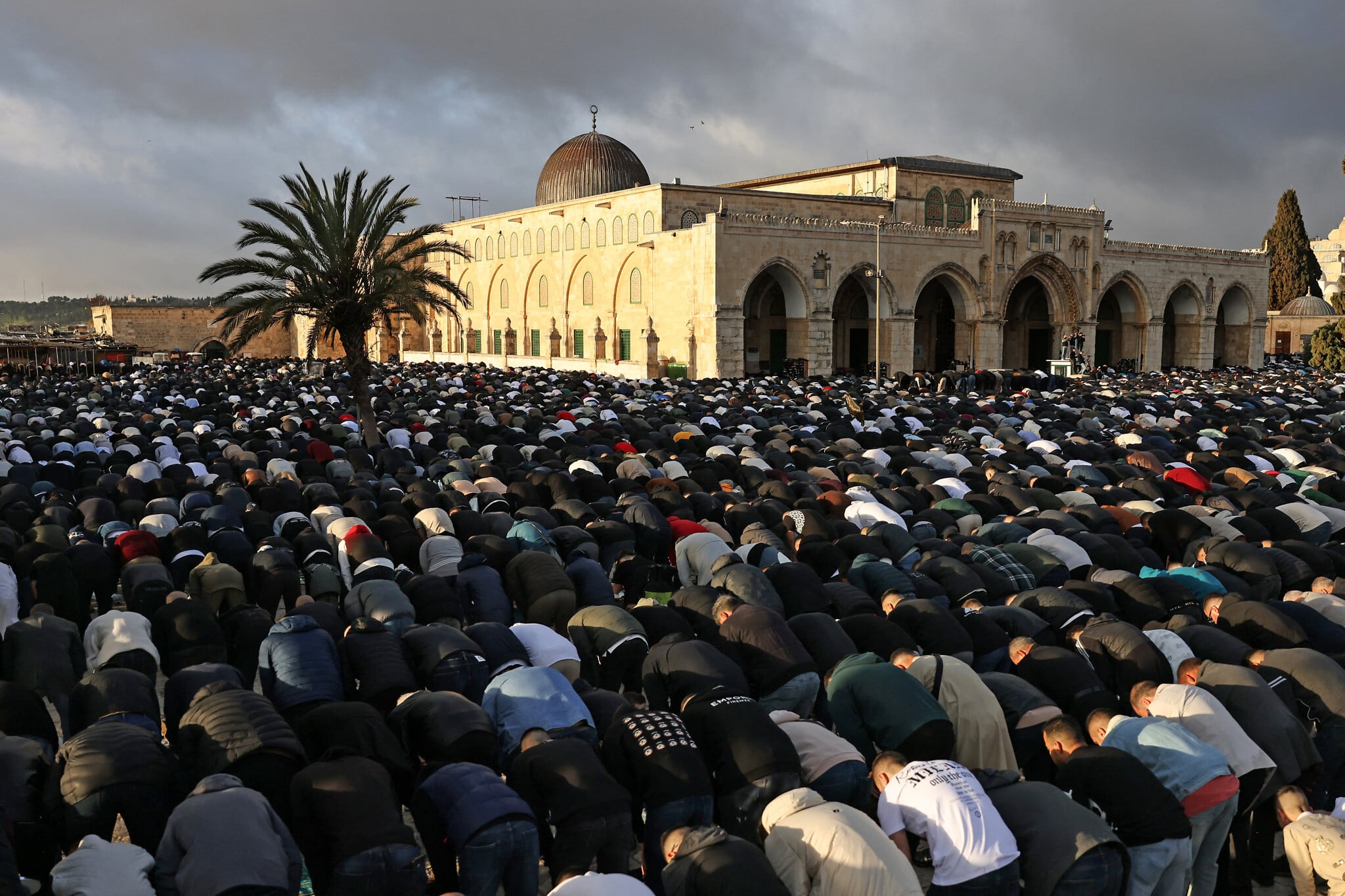
Muslims perform the morning prayer in front of the Al-Aqsa mosque at the start of the Eid al-Fitr which marks the end of the holy fasting month of Ramadan, in Jerusalem on March 30, 2025. (Photo by AHMAD GHARABLI / AFP)
IDF launches West Bank operation ahead of Ramadan to ‘ensure security and stability’
Ahead of Ramadan, the Israeli military said Monday that it had begun an operation across the West Bank aimed at arresting Palestinians “advancing incitement and terror on social media.”
“In preparation for the blessed month of Ramadan, and as a step to ensure security and stability and combat terrorism, IDF troops have in recent days begun an operation across Judea and Samaria against elements advancing incitement and terror on social media networks,” said Lt. Col. Ella Waweya, the IDF’s Arabic-language spokeswoman, in a statement.
She said the operation is expected to continue throughout Ramadan.
“The message is clear: Ramadan is a month of family, community and unity. Do not allow terror organizations to ruin it for you, and do not be drawn after incitement on social media networks,” Waweya said.
Police shut East Jerusalem road near security barrier amid infiltration fears
Meanwhile, Border Police forces on Monday closed off a road next to the West Bank security barrier in a Palestinian neighborhood of East Jerusalem and seized security cameras from residents, in an effort to clamp down on the unlawful entry of Palestinian workers.
Law enforcement came last week with a truck carrying large concrete blocks, placing them along a road directly adjacent to the Israeli side of the barrier, creating a buffer zone where only security forces are permitted to operate. As part of the same operation, Border Police began collecting security cameras in the area.
“The forces identified that there were a lot of cameras on poles pointed towards the direction of the barrier, that is to say, observing [the border],” a Border Police spokesman told The Times of Israel.
According to the spokesman, the cameras were used to track the location of security forces, signaling whether the coast is clear for West Bank Palestinians to cross into Jerusalem.
The raid last week was launched as part of a larger operation to combat “infiltration, strengthen the barrier and change the security reality in the area,” police say in a statement.
יממה לאחר חסימת הצירים בבטונדות, המשטרה הסירה היום מאות מצלמות אבטחה של תושבי שכונת דאחיית אל בריד בירושלים. חלק מהמצלמות, כך על פי המשטרה, נועדו לעקוב אחר תנועת כוחות המשטרה באזור, ובמשטרה מעריכים כי הן שימשו ללימוד דפוסי הפעילות של הכוחות במטרה לסייע בהברחת שוהים בלתי חוקיים pic.twitter.com/5lsxYmeekM
— לירן תמרי | Liran Tamari (@liran__tamari) February 11, 2026
“We’re creating another layer of protection in order to reinforce Israeli citizens’ security and allow us to operate with more freedom,” Ch. Supt. Eli Tubul, a Border Police officer involved in the operation, told the Ynet news site. He says police are shifting gears from a “defensive” mode to an “offensive” one.
The Jerusalem District’s recently appointed commander, Deputy Commissioner Avshalom Peled, accompanied forces during the initial raid last week. Officers mapped the area and towed vehicles within the newly formed buffer zone.
In addition, Border Police and IDF soldiers seized weapons and arrested a suspect during a nighttime raid in Kafr Aqab, police announced on Monday.
Although it is a part of the Jerusalem municipality, the Palestinian neighborhood lies beyond the West Bank security barrier and is largely neglected by Israeli municipal authorities.
You appreciate our journalism

You clearly find our careful reporting valuable, in a time when facts are often distorted and news coverage often lacks context.
Your support is essential to continue our work. We want to continue delivering the professional journalism you value, even as the demands on our newsroom have grown dramatically since October 7.
So today, please consider joining our reader support group, The Times of Israel Community. For as little as $6 a month you’ll become our partners while enjoying The Times of Israel AD-FREE, as well as accessing exclusive content available only to Times of Israel Community members.
Thank you,
David Horovitz, Founding Editor of The Times of Israel