

The musician Dave Stewart isn’t a fan of big business, particularly music labels, but he doffs his hat to the bank manager from Barclays who gave him and Annie Lennox their big break with the Eurythmics.
“Annie and I lived in a squat on £8 a week between us. We wanted to make music together but we had nothing. We had a record company and made an album called In the Garden, but it didn’t sell and the record company thought we were nuts and wanted to drop us,” Stewart, 73, says.
“I said, ‘Why don’t I go and see the bank manager at Barclays [in Crouch End, north London] and explain that I want this equipment and we can make a record on that, and then make the next record too’. Annie said, ‘The bank manager will think we’re nuts’, and we did look quirky.”
This was 1982. The list of second-hand recording equipment came to £4,800, Stewart says. “We went to see the bank manager, he was a youngish manager. He listened and said ‘Ok, we’ll lend you £5,000’. We made the album Sweet Dreams.”
The album sold well over a million copies, with the single bearing the same name many more. It made their music careers. Stewart says he sent gold and platinum albums to the bank manager — called Geoff Williams — for years afterwards. “On his 65th birthday I sent him a message. Without him nobody would know who we were.”
Decades later, Stewart is looking to recreate that kind of gatekeeper support for a new generation. The team at Stewart’s new creative venture building company, called Rare Entity, says banks today are likely to refuse requests for loans for creative projects. Dominic Joseph, co-founder of Rare, alongside Stewart and Rich Britton, says: “Creatives can’t get any kind of bank support because there are no fixed assets that the banks can understand.”
One remaining source is the British Business Bank’s Start Up Loans initiative. Since 2019 it has lent cash to 949 people operating in the performing arts or the act of artistic creation. The only requirement is a credible business plan, which can be a catch.
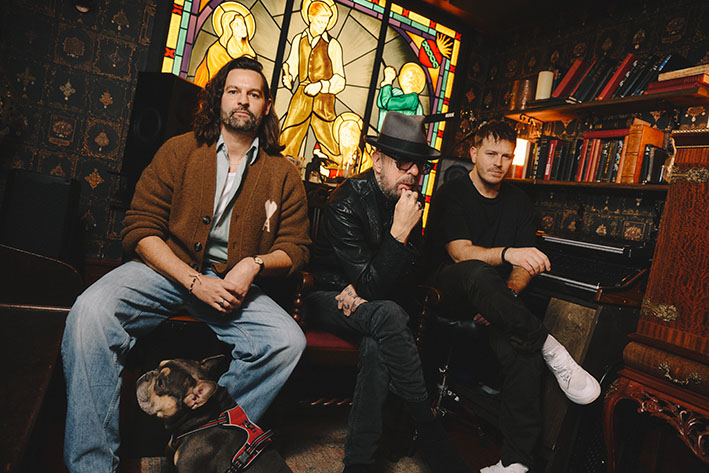
Rich Britton, left, Dave Stewart, centre, and Dominic Joseph
To improve things further, Stewart has one eye on the government’s industrial strategy, which has the creative industries as a key pillar. “I have many times hammered on the door,” he said, highlighting the creative successes that Britain continues to produce. “Italy is so proud of its opera singers, its music, theatre and dance. It is ‘We have something that nobody else has’. But it has always been hard in Britain. Pushing [creativity] up the list a bit [would] make a difference.”
Joseph, 41, adds that more tax-efficient schemes for investors to back creative ideas would be helpful, in a similar way that the Enterprise Investment Scheme supports technology start-ups. Stewart would also like to see a global marketing push, similar to “Cool Britannia” under New Labour in the late 1990s.
His comments coincide with the launch on Tuesday of a creative industries investment summit in London, organised by Creative UK, a trade body for the cultural and creative industries.
The summit aims to act as a catalyst for bringing together leading British creatives with investors keen to back them. The industry generates £124 billion for the economy and supports over 2.3 million jobs, according to the latest official figures.
Peter Kyle, the business secretary, describes the creative industry as the “cornerstone of our modern industrial strategy”. Ian Murray, the creative industries minister, adds: “We are committed to making the UK the best place to run a creative business, no matter where you’re based, and a crucial part of that is ensuring there are ample investment opportunities up and down the country.” Stewart counters that governments has been good at saying the right thing but less effective at turning those words into action.
Creative UK says the term “creative industries” refers to 16 distinct industries: advertising; architecture; visual art; crafts; fashion and textiles; design; performing arts; music; photography; film and video; computer games; radio and TV; writing and publishing; heritage; software and electronic publishing; and cultural education.
A new funding model for intellectual property
Stewart set up Rare Entity to try to address a “crisis” in the ability of most creative people to make money. Its main focus is helping artists, writers and performers to bring their creative ideas to life, in a commercially sustainable way. A large part of its focus is to help existing artists and intellectual property (IP) owners build their engagement with fans. The deal for the IP owner is that they retain majority ownership of any revenues that result from the idea. “I have been looking to have something like this company for 25 years,” Stewart said. “The owners of the IP and the creativity remain the owners. It is not owned by Universal or Sony, like my stuff is.”
He explained that Rare would examine the concept, perhaps a piece of theatre or another form of immersive entertainment, and put a team together to make it happen. The creative sells a minority stake in the venture to get it off the ground, which Stewart said is a much better deal than is typically available. He said he and Lennox retained 15 per cent of the royalties from the music they created as the Eurythmics. Rare brings in outside investors for each project to co-finance it. Once the project is live then Rare takes a share of the royalties. “The IP owner probably would never have less than 75 per cent,” Stewart said. “Think about my deal, the label had 85 per cent, Annie and I had 15 per cent between us, minus the manager, and this and that.”
Dominic Joseph, a serial entrepreneur, said artists, as well as other IP owners such as theatre writers and sports teams, had become more willing to invest in their brand. “It is realising who your customer is, capturing the data, using technology … that is a relatively new thing.”
Rich Britton, who has founded several businesses supporting creatives to execute on their ideas, said they frequently come across artists and writers who could get projects off the ground but then struggled. “You have a brilliant story, a venue, some IP, great. It runs for a year and then the [operational expenditure] and [capital expenditure] goes up, they try to raise the prices too high and people don’t go. This brilliant thing then stops.”

Sonic Sphere, which featured in the Burning Man music festival
Rare says it provides the support to avoid this decline. It looks at the financial model, advises on international rollouts and pricing. “By wrapping our arms around that creative person and the product we are able to accelerate it, derisk it, so we can walk into venture capital … and say why audiences will love it,” Britton, 42, said.
One of Rare’s next projects is a “mad concept… zombie” immersive show that will run in London’s Soho in October. The script is co-written by Stewart and the Swedish director Jonas Åkerlund. Another is with Sonic Sphere — a 3D audio-visual venue — that featured in the Burning Man music festival in the United States. Various different sized spheres are planned. Rare has become an investor and will also earn fees as the spheres are installed and content is created and performed.