

When Liz got a call from a salesman suggesting she move her retirement savings out of an APRA-regulated fund into a less-regulated managed investment scheme, alarm bells went off.
Liz, who only wanted to be identified by her first name, told ABC News she was “looking to get some financial advice” when she got the call about two years ago.
She said the salesman initially asked her questions about her super.
“Basically, they were giving me just some free advice around how I’d set up my super,” she said.
“It sounded OK. Until they wanted a lot of details and I was just a bit worried because obviously what initially goes through your mind, you’re handing over all this personal information, [I thought], ‘Am I going get scammed?'”
Liz googled the business the salesman said he was from — Clear Sky Financial — and saw its head office was in Mermaid Beach on the Gold Coast.
Clear Sky’s website says the business has $540 million in assets under management.
Its website says it is licensed under InterPrac, the licensee being investigated by the Australian Securities and Investments Commission (ASIC) in relation to the Shield and First Guardian collapses, which left 12,000 Australians at risk of losing more than $1 billion of retirement savings.
Do you know more? If you have more information about this story please contact Nassim Khadem at khadem.nassim@abc.net.au or nassimkhadem@protonmail.com
InterPrac told ABC News it expected all its authorised representatives to act ethically and in line with the Corporations Act in their dealings.
“Separately, InterPrac Financial Planning confirms that it has ceased use of lead generation services,” it said.
It said Clear Sky was a financial planning firm, licensed with InterPrac, and used to use lead generating firms to build a client base, but that “in December of 2025, InterPrac issued a notice to all its financial advisers that they may not use lead generation firms for marketing purposes, i.e new clients”.
As part of its review, ASIC is publishing a list of known entities involved in lead generation, those acting as referral partners, and advice licensees or corporate authorised representatives that have acquired leads since July 1 2024.
ABC News is not alleging that Clear Sky has acted illegally, only that it is one of the companies that ASIC is investigating as part of its review. The company has been contacted for comment.
“We’re doing this work because we’ve seen the significant harm that can come from lead generation in relation to superannuation switching,” ASIC commissioner Alan Kirkland said.
“We’ve seen thousands of cases where consumers have been lured in through a social media ad and a series of phone calls, they’ve often been misled about how their current super fund performs and they’ve been convinced to switch their super from a relatively good fund into a high-risk investment, and many of them have lost their entire retirement savings.”
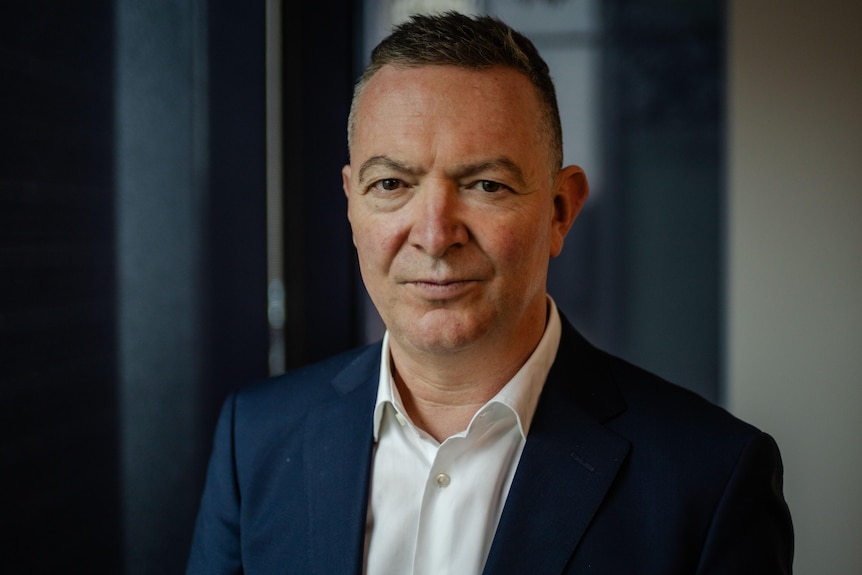
Alan Kirkland says he has seen consumers experience significant harm. (ABC News: Liam Patrick)
ASIC said it would continue to update its list of lead generators throughout the course of its review.
It said in a statement that the “naming of the entities in this list should not be construed as an indication by ASIC that a contravention of the law has occurred, nor should it be considered a reflection upon any person or entity”.
But it suggested that “consumers should exercise additional caution when engaging with businesses that use lead generation”.
Why ASIC is looking into lead generators
Lead generators are often paid “marketing fees” by licensed financial advisers for generating leads.
That was what happened in the cases of the First Guardian and Shield managed investment schemes, which later collapsed.
In those cases, after being called by sales representatives from various lead generation companies, consumers decided to move thousands to hundreds of thousands of dollars of their super savings from Australian Prudential Regulation Authority (APRA)-regulated super funds to Shield and First Guardian.
Investors in First Guardian, many of whom switched from highly regulated super funds into the product, face little prospect of recovery directly from the fund, with liquidators in December saying $1.6 million of $446 million had been recovered — not enough to pay their fees.
Deep flaws in Australia’s $4.3 trillion system exposed
Liz recalled that during the initial phone conversation, she told the salesman to give her time to think over his proposal and that she would get back to him.
“They were really pushy. Like, ‘No, you have to make a decision now’. I was like, ‘No, how? Like, let me have a think about it,'” she said.
“And then, I swear, every week the same guy was calling me to the point where I thought, OK, this doesn’t seem right.”
Liz recalled the salesman boasted the team had, at the time, a staff member who had appeared on “MAFS” ( TV program Married At First Sight).
Liz said she decided she would not move ahead with the firm or switch her super.
ASIC says it wants to stop ‘inappropriate’ practices
Regulation of Australia’s major superannuation funds is overseen by APRA.
Total superannuation assets increased by 3 per cent over the quarter to $4.5 trillion as at September 2025, of which $3.2 trillion was in APRA-regulated funds.
But there is now more than $1 trillion in self-managed superannuation funds, which means a big chunk of money is not regulated by APRA, leaving ASIC as the only investment watchdog to protect consumers.
Mr Kirkland said ASIC wanted to address practices that “inappropriately or unnecessarily” encouraged consumers to switch their superannuation.
Mr Kirkland said licensees faced “very serious legal obligations” and that “anybody providing financial advice in Australia needs to ensure that that advice is in the client’s best interests, that it’s appropriate advice and that they put the interest of the client ahead of the interest of the advisor or the licensee”.
“We will be wanting to understand how those particular firms are going about complying with their legal obligations,” he said.
He noted ASIC had already commenced legal action in the federal court against one lead generation firm, Imperial Capital Group, “and if we identify serious harm through this further work that we’re doing, we’re happy to use the full range of enforcement tools that we have at our disposal”.
ASIC says any financial advice in Australia must be provided in the client’s best interests. (Supplied: ASIC)
ASIC also warned lead generators that “mislead consumers, utilise high-pressure tactics or provide financial services without a licence will risk contravening the law”.
It said licensed persons or entities that engaged the services of lead generators acting in this way shared this risk.
“ASIC is putting participants on notice and will consider taking enforcement action where we detect evidence of contraventions of the law,” it said in a statement.
Consumers urged to look for ‘red flags’
ASIC suggested consumers hang up on unsolicited calls when feeling pressured into moving their super.
Who pays when super funds collapse?
Mr Kirkland said “red flags” to look out for included being pressured to act immediately and claims by the lead generator that their existing fund was underperforming.
Often, consumers receive a call after clicking on an advertisement on social media or filling out a form on a super comparison website. Lead generators may offer a free “super health check” or help find lost super.
ASIC also warned consumers to look out for the involvement of unlicensed people in the advice process, predominant engagement over the phone with limited client contact with a licensed financial adviser, poor or no product disclosure, and promises of high or unrealistic returns.
“Consumers should be on the lookout for any of those signs that somebody they’ve never met is trying to convince them over the phone to switch their super, and if they feel under any pressure or have any doubt, they should feel very comfortable to just hang up,” Mr Kirkland said.
He said “check your super” or “find your lost super” social media ads often looked “fairly innocuous”.
“They offer to help you compare your super, see how it compares to other funds or to help consolidate your super,” he said.
“Then those ads are used to get people to hand over their details, which are then handed over to telemarketers who pepper them with phone calls.
“These people often don’t start with a hard sell there. They’re very friendly and persuasive and are happy to keep people on the phone for hours.
“They’ll often then introduce somebody to a financial advisor who’ll have a very brief conversation with them. But at the end of the day, they try to get you to sign forms that agree to switch your super.
“And that is the ultimate warning sign.”
Call for ‘ban’ on lead generation for super and financial advice
Mr Kirkland said ASIC would undertake its review over the course of the year.
He said there were “regulatory gaps that have allowed lead generation to flourish in relation to superannuation switching”.
“We welcome the government’s announcement that it is looking at a range of reforms to address those regulatory gaps,” Mr Kirkland said.
Last month, Assistant Treasurer Daniel Mulino also announced a crackdown on managed investment schemes.
Super Consumers Australia is calling for a ban on lead generation for superannuation and financial advice, as well as closing the loophole that allows “cold calling” offering financial advice.
Chief executive Xavier O’Halloran said lead generators had been behind the increase in super switching schemes.
“These schemes are highly effective; they prey on people who are just looking to do the right thing and get on top of their super,” Mr O’Halloran said.

Xavier O’Halloran says lead generators often have convincing sales pitches. (ABC News: Scott Preston)
Mr O’Halloran said lead generation business sales representatives often gave “a very convincing sales pitch”.
He said he had received a call from one.
“If I hadn’t worked in superannuation for the last decade, I wouldn’t have known the red flags,” he said.
He said the cost of poor consumer protections was “currently falling on everyone, through direct losses, compensation scheme funding and increased Age Pension costs”.
“Super is often people’s second biggest source of wealth outside of the family home, and the consumer protections need to match that,” he said.