

As lunar missions ramp up with the goal of establishing a permanent human presence on the Moon, scientists are facing an age-old question: how will astronauts breathe on a celestial body with no atmosphere?
Researchers are exploring ways to extract oxygen from the Moon’s surface dust, or regolith. This breakthrough could pave the way for long-term stays on the Moon and, in time, missions to other planets.
In-Situ Resource Utilization: A Game Changer for Lunar Habitation
One promising way to achieve this is through something called In-Situ Resource Utilization (ISRU), which is essentially the idea of using the resources already available on the Moon to make the essentials needed for human survival like oxygen, water, and even fuel. According to Sylvain Rodat, a specialist in solar energy technologies and thermal processes, this concept is gaining momentum as nations push to settle on the Moon. As explained by the ESA:
“Lunar regolith, the thin layer of dusty rock that blankets the Moon, is not so different from the minerals found on Earth. By weight, it contains about 45% oxygen which is bound to metals such as iron and titanium, making it unavailable.”
However, this oxygen isn’t readily available in its gaseous form, like on Earth. Instead, it’s locked up in compounds called oxides, which are bound to elements like silicon, iron, and calcium. To release the oxygen, scientists need to break these chemical bonds. This is where pyrolysis, a high-temperature process, comes into play. Pyrolysis uses heat to break down materials, and in this case, it can separate the oxygen from the rest of the minerals in the regolith.
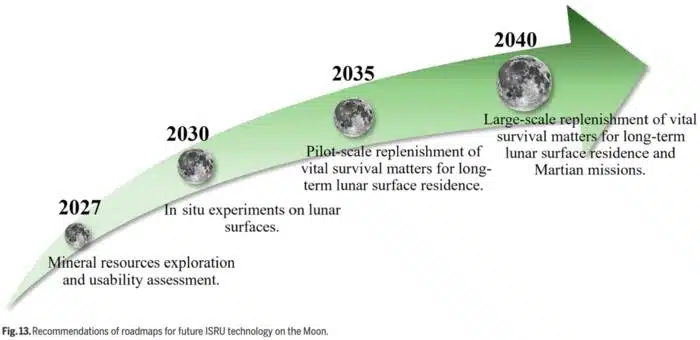 Timeline of ISRU technology milestones on the Moon, from exploration in 2027 to large-scale resource replenishment by 2040. Credit: Space: Science & Technology
Using Solar Energy to Extract Oxygen
The Moon’s lack of atmosphere and its constant exposure to sunlight in certain regions, especially near the poles, make it a perfect place to experiment with solar-powered techniques. One such technique is called solar pyrolysis, which is essentially using concentrated sunlight to heat regolith samples to extreme temperatures.
According to a study, published in Acta Astronautica, this method with large solar concentrators that replicate the conditions found on the Moon. These solar furnaces focus sunlight into a concentrated beam, capable of reaching temperatures over 3,000°C, enough to break down the oxides in the regolith.
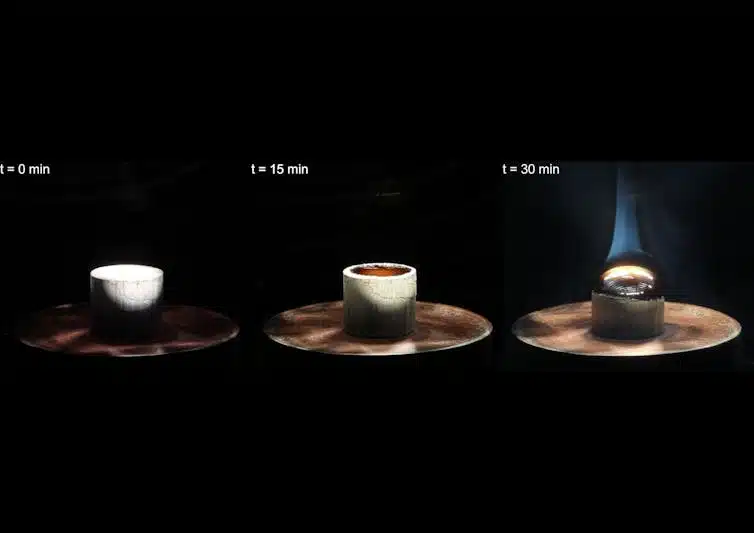 Photos of the regolith simulant disc during pyrolysis. Credit: The Conversation/Jack Robinot/CNRS
Since there’s no atmosphere to diffuse sunlight, the Moon receives direct and intense solar radiation. In fact, certain areas of the Moon’s poles are bathed in sunlight for up to 90% of the time. If solar pyrolysis works as hoped, it could drastically reduce the amount of energy needed for oxygen extraction and make the entire process more sustainable.
Overcoming Technical Barriers
While the concept of extracting oxygen from lunar regolith is promising, there are still many challenges to overcome. Early experiments have shown that the oxygen yield is relatively low, with only about 1% of the sample mass being converted into oxygen. According to Rodat, the next steps include optimizing the process by reducing the pressure in pyrolysis reactors to better simulate the Moon’s vacuum-like conditions. This could lower the temperatures needed for the process and improve oxygen yield.
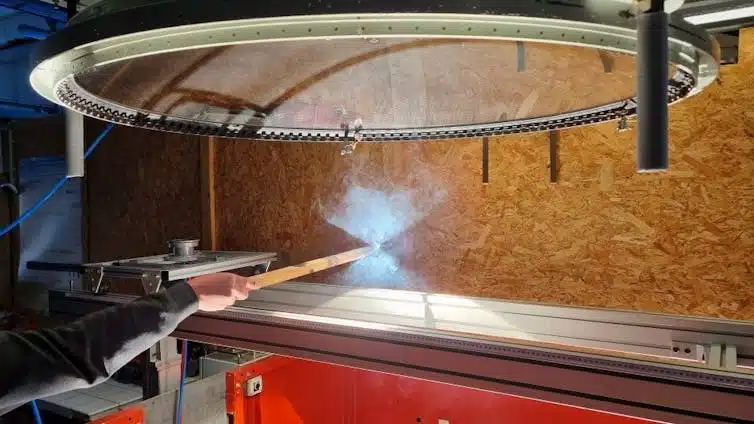 The pyrolysis experiment with a two-meter parabolic dish. Credit: The Converation/Jack Robinot/CNRS
Another challenge is the durability of equipment in the harsh lunar environment, which features extreme temperature fluctuations, abrasive dust, and constant radiation exposure. Researchers are working on enhancing the resilience of solar furnaces and pyrolysis reactors to withstand these conditions.
“In the future, if we want to travel extensively in space and set up bases on the Moon and Mars, then we will need to make or find the things required to support life – food, water and breathable air,” Sue Horne, head of space exploration at the UK Space Agency, commented.