
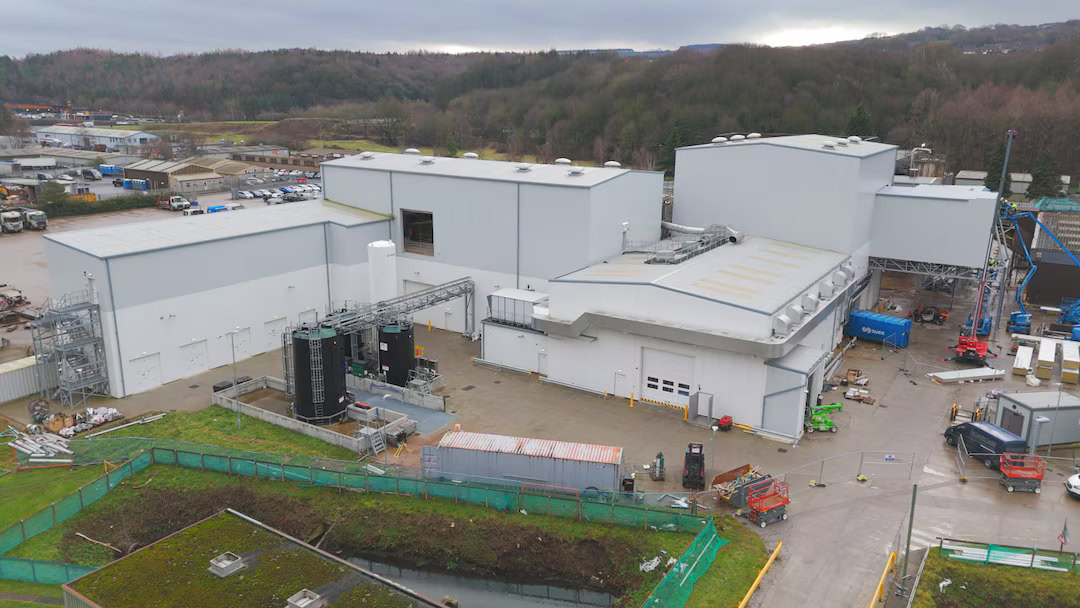
The Swedish hygiene and tissue manufacturer has confirmed that its new £30 million recycled paper facility at its Prudhoe manufacturing site will officially open on 9 April 2026, with start-up testing scheduled to begin in early March, around four weeks ahead of the formal launch.
Initial operations will focus on commissioning and process optimisation as the plant ramps up to full production.
Once fully operational, the facility will process a wide range of recovered paper grades to produce recycled pulp for use in consumer tissue products.
The company said the plant will aim to expand its recycled fibre capacity to more than 100,000 tonnes per year.
Replacing 50-year-old plant
Construction work on the new plant began in 2023 after planning permission was granted by Northumberland County Council in late 2022.
The scheme represents Essity’s single largest investment across its six UK sites in the past decade.
The project replaces an existing 50-year-old recycling plant with a new installation housing what the company describes as the latest paper-recycling technology.
Central to the upgrade is a modern pulper designed to handle a broader mix of lower-grade materials, including significant volumes of cardboard and printed papers.
Commenting on the construction, an Essity spokesperson said: “Our old Unifibres facility was at the end of its working life – and this scale of investment helps secure the future of the mill, helps us to continue meeting demand for our products such as Cushelle, Velvet and Tork and, importantly, provides a more attractive and safer working environment for our 420 employees.”
Low-grade paper and board recycling
Traditionally Essity’s main feedstock for the recycled pulp it uses in tissue making had been from office waste paper.
However, the decline in office paper arisings – driven by digital working and increased home working – has reduced availability.
The Essity spokesperson added: “The importance of this multi-million-pound investment cannot be overstated.
“It reduces our dependence on virgin pulp, will enable us to recycle lower-grade paper and board, enhances our ability to segregate plastic and metal contaminants, reduces waste sent to landfill and improves energy efficiency.”
The new facility is designed to adapt to this shift by processing mixed household and household-like paper streams, subject to tight contamination controls. Additional lower grade sources may also be targeted.