
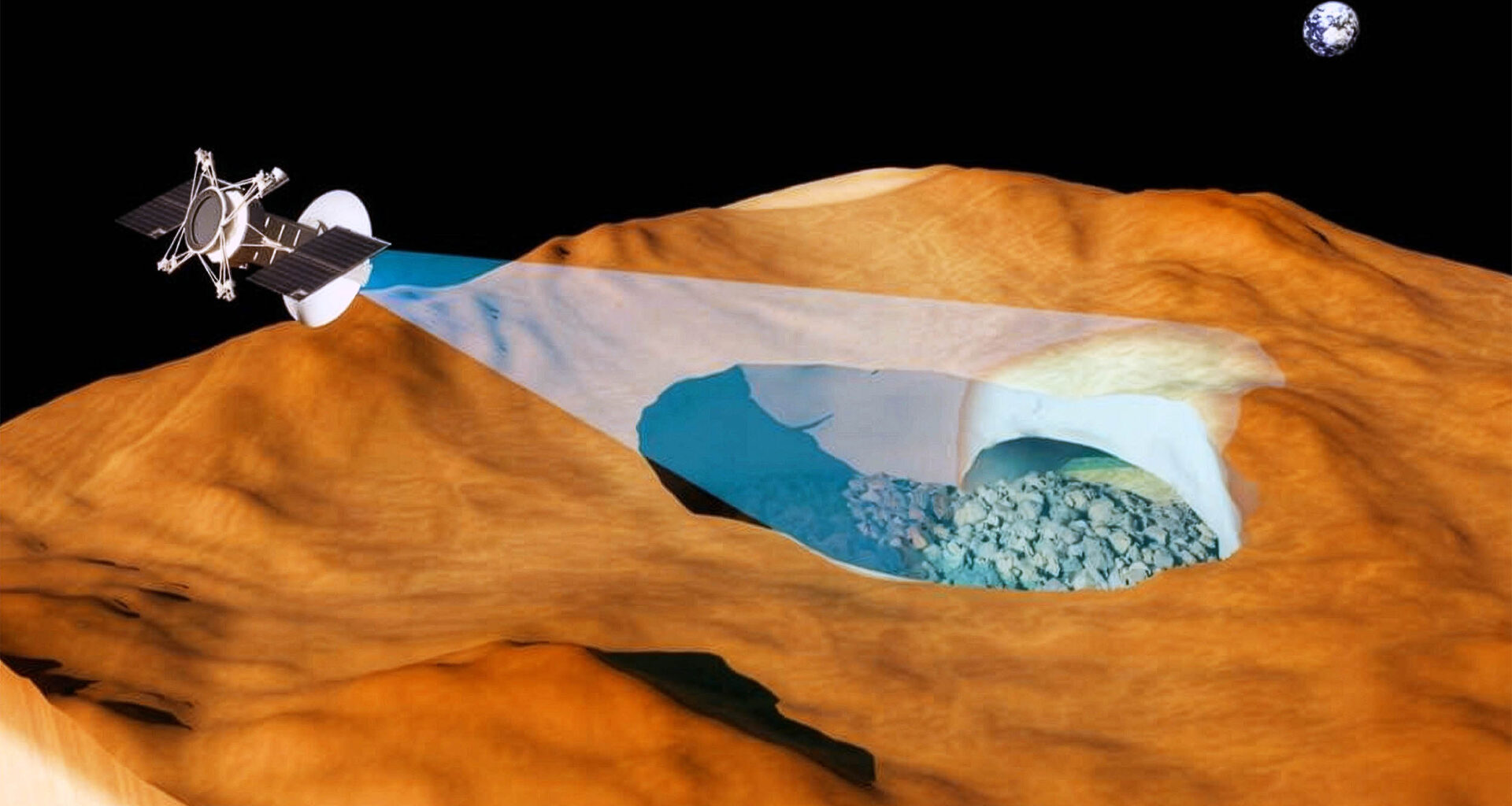
For decades, scientists suspected that Venus might hide massive lava-formed tunnels beneath its scorched surface, but clear evidence had remained elusive.
Now, a newly analyzed radar signal has confirmed what researchers long suspected: an empty volcanic tunnel lies beneath one of the planet’s collapsed surface pits.

The discovery offers the first direct indication that Venus hosts intact underground lava tubes, turning a long-standing geological hypothesis into an observable feature of the planet’s landscape. It also opens a new window into how Venusian volcanoes once shaped the crust.
Collapse pit exposes tunnel
Near Nyx Mons, a volcanic rise on Venus, one collapse pit displayed a radar signature unlike any other in its chain.
Analyzing that anomaly, a team led by Lorenzo Bruzzone at the University of Trento documented a hollow conduit extending beyond the pit’s rim.
Instead of a simple crater with steep walls, the structure produced a prolonged interior echo that signaled open space beneath the crust.
Because only the portion closest to the opening can be confirmed, the discovery establishes the tunnel’s presence on Venus while leaving its full extent to be determined.
Radar spots the hidden tunnel
Venus’s thick cloud cover blocks visible-light cameras, leaving radar as the primary way to map the planet’s surface.
Between 1990 and 1992, NASA’s Magellan spacecraft used Synthetic Aperture Radar – a technique that converts reflected radio waves into images – to chart much of the planet. Decades later, scientists still rely on those maps because no later orbiter has matched their near-global coverage.
Within one standout collapse pit, the radar image showed an unusual bright streak extending beyond the rim instead of stopping sharply at the surface.
Bruzzone’s team interpreted that glow as strong backscatter – radar energy bouncing from interior walls that the beam briefly illuminated.
A deep shadow beside the streak suggested part of the roof had collapsed, leaving an opening large enough for radar signals to penetrate.
Similar bright-and-dark signatures appear over lava-tube skylights on Earth, strengthening the case that the Venusian pit connects to an underground cavity rather than being a simple surface depression.
Massive cavity beneath Venus
Measurements from Venus indicate the opening spans about 0.6 miles across, far wider than most volcanic tunnels on Earth.
The roof above the cavity appears at least 490 feet thick, helping the structure resist collapse, while the empty chamber below rises at least 1,230 feet, creating a vast interior space.
Even with these dimensions, researchers classify the structure as a candidate lava tube, similar to ones previously suggested on Mars and the Moon.
Such tunnels form when flowing lava develops a hardened surface crust while molten material continues moving beneath it. When the lava supply later drains or shifts course, the hollow channel remains.
On Venus, the planet’s lower gravity and dense atmosphere may allow thicker crusts to form more quickly, helping unusually wide conduits stay open.
The new discovery fits that scenario, though scientists note that tunnel size likely depends on local volcanic conditions rather than planet-wide rules.
Evidence supports lava tube
Not every collapse pit leads to an underground tunnel, so the researchers asked whether this feature could be something else.
Steep-walled craters and volcanic vents produce radar brightening that hugs the rim, not a long return from inside.
“The identification of a volcanic cavity is therefore of particular importance, as it allows us to validate theories that for many years have only hypothesized their existence,” said Bruzzone.
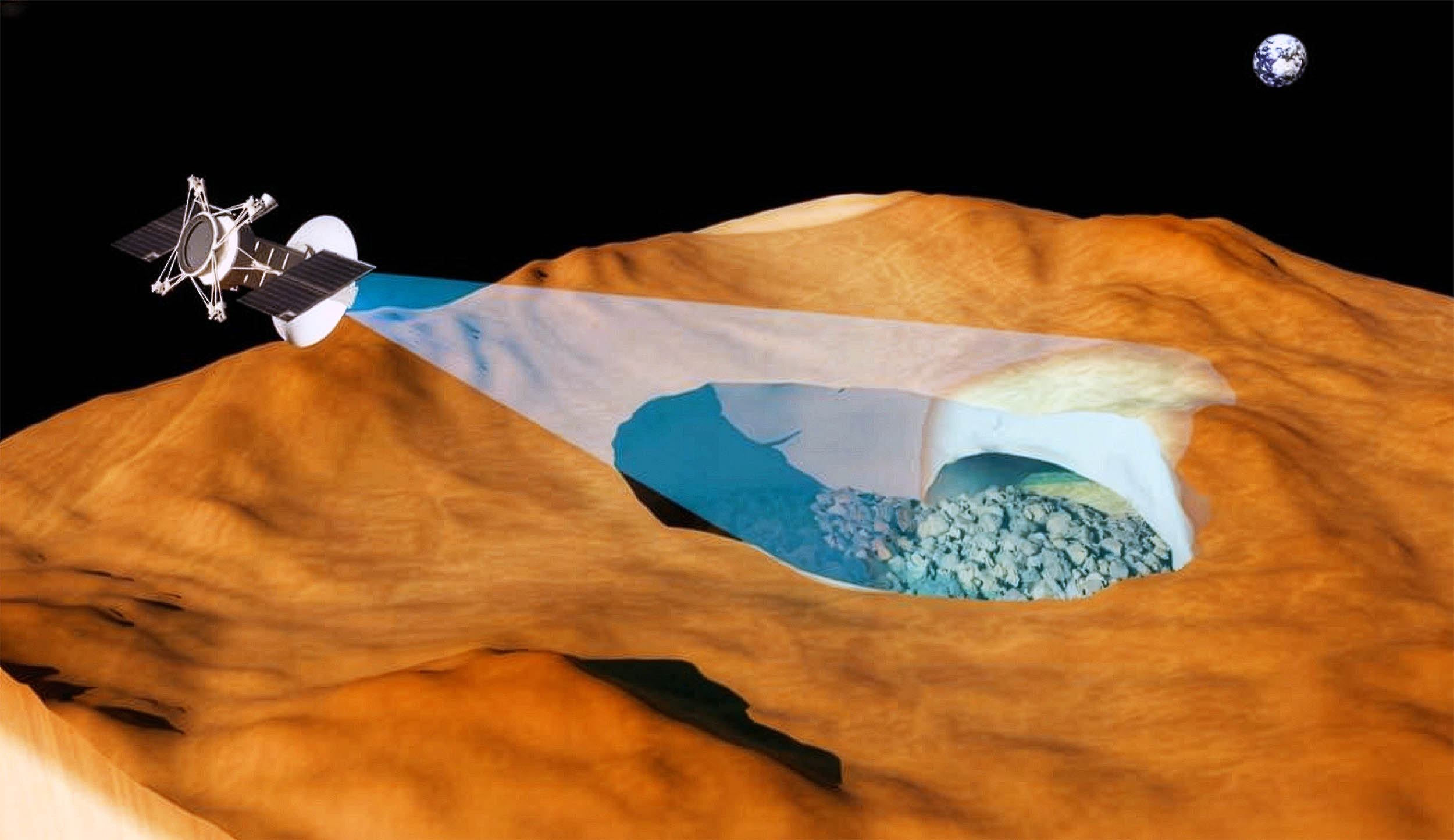 Venus skylight in the Nyx Mons region reveals a subsurface cave, hypothesized to be a lava tube. The feature was identified through analysis of radar images acquired by the SAR instrument aboard the NASA Magellan mission. Credit: University of Trento. Click image to enlarge.Older radar limits detail
Magellan’s radar pixels were relatively large, allowing only the biggest collapse pits to stand out clearly. Each pixel covered roughly 250 feet, meaning smaller skylights – roof-collapse openings into underground tunnels – could easily disappear at that scale.
Because the radar illuminated only part of the opening, researchers confirmed the tunnel near the skylight but could not determine how far the conduit extends or whether rubble blocks sections farther inside.
Upcoming missions aim to fill those gaps. ESA’s EnVision orbiter plans to use ground-penetrating radar capable of probing roughly 3,300 feet below the surface, while NASA’s VERITAS mission will deliver far sharper radar maps and detailed topography.
Together, these missions could reveal additional hidden tunnels, trace collapse chains more precisely, and determine whether the newly identified conduit is part of a larger underground network.
Tunnel chains under Venus
Long chains of collapse pits run for hundreds of miles across Venus, and the Nyx Mons feature lies along one such chain.
Nearby terrain slopes and surrounding pits suggest the could extend about 28 miles beyond the confirmed opening, while other pits in the same chain lack this distinctive pattern – a sign that collapse debris may have sealed their entrances.
Future surveys can trace these chains and flag the rare locations where the same signal appears, pointing to possible open underground spaces.
For Venus science, the discovery means that a surface pit now connects directly to an underground tunnel, transforming long-standing speculation into a specific exploration target.
Sharper radar maps should reveal whether additional conduits remain hidden beneath the crust or whether this tunnel formed under unusually rare local conditions.
The study is published in Nature Communications.
—–
Like what you read? Subscribe to our newsletter for engaging articles, exclusive content, and the latest updates.
Check us out on EarthSnap, a free app brought to you by Eric Ralls and Earth.com.
—–