
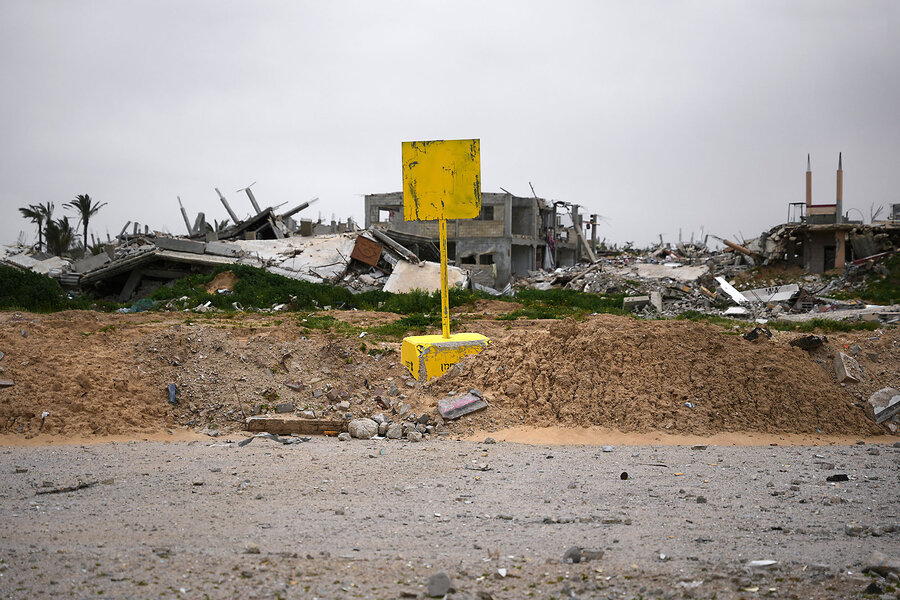
For Palestinian residents of Gaza, a string of concrete yellow boxes now demarcates where Israeli-occupied land begins – a barely visible border that, for Palestinians who cross it, marks the line between life and death.
It also marks a shrinking amount of space in which displaced Gazans can live.
The blocks – some with yellow poles – mark the so-called Yellow Line, which residents say is steadily being moved further west and south by Israeli forces.
Why We Wrote This
The yellow cement blocks demarcating Israeli-held territory in Gaza were supposed to mark a temporary armistice line. But with the ceasefire process stalled, the blocks keep moving deeper into Gaza, making Palestinians feel more closed in, and trapped.
A temporary makeshift armistice line, the Yellow Line was to disappear and Israeli forces were to withdraw from Gaza as the Trump peace plan progressed. Yet the peace plan is struggling.
As part of the initial phase of the Hamas-Israel ceasefire, brokered by Qatar, Egypt, Turkey, and the United States, the Israeli army withdrew in October from deep within the Gaza Strip, back to a perimeter well within the territory, carving out a temporary buffer zone within only about 50% of the enclave.
Yet Hamas refuses to disarm, an international stabilization force has not materialized, and Israel refuses to leave.
Temporary line or permanent border?
And this temporary zone, Gazans fear, might be becoming permanent.
“They put down the line, and every period they push it further,” says Mohammed Abu Sahweel, a lawyer whose home in Beit Hanoun in northern Gaza now lies under Israeli military control and out of reach.
“They are squeezing us,” says Mr. Abu Sahweel, who lives in a displacement camp in central Gaza.

Mohammed Abu Sahweel stands in front of his tent in the middle of Gaza City, Feb. 16, 2026. His home in Beit Hanoun, northern Gaza, now lies under Israeli military control and is out of reach.
It is not only the geography that shrinks, displaced Gazans say, but choices: fewer safe roads, fewer possible livelihoods, fewer schools, less water, less certainty.
The Yellow Line prevents tens of thousands of Gazans from returning to their homes in Rafah and eastern Khan Yunis Governorate in the south; and in eastern Gaza City and the towns of Beit Lahia and Beit Hanoun in the north.
Israel says its ongoing occupation up to the line is part of its dismantling of Hamas’ infrastructure.
While visiting Israel-held territory last week, the Israel Defense Forces chief of staff, Lt. Gen. Eyal Zamir, said the Israeli military was “overseeing the crossings to the Gaza Strip, and is precisely dismantling terror infrastructure” – particularly Hamas-dug tunnels.
Yet General Zamir has also described the zone as a “new border line, a forward defensive line for the [Israeli] communities, and an offensive line.”
Israel says it has destroyed several tunnels using Israeli forces and Israel-backed Gazan militias, and has confiscated weapons stockpiles and equipment. Its operations have erased entire neighborhoods, satellite imagery reveals.
The Israeli army is also killing Palestinians attempting to cross the line on a near-daily basis, alleging the individuals are Hamas operatives. Palestinian sources and eyewitnesses say the vast majority are civilians, including many children, trying to return to their damaged homes to retrieve items or collect firewood.
Meanwhile, the moving Yellow Line has created a new division between haves and have-nots in Gaza; those from communities on the Israeli side are twice as vulnerable and doubly dispossessed, not knowing whether they can ever return.
Home beyond reach
Hiba Abu Ajwa, a mother of five from eastern Shujayya, says her family’s life has not changed since the Trump peace plan.
“Everything is the same. We’re still displaced. We are still living under hard conditions,” says Ms. Abu Ajwa from her tent in Gaza City, while asking her son to fan a cooking fire fed by large melting plastic sheets.
“I had hoped to return back to my home, even if it’s destroyed, to my land. But I am afraid I am losing it forever,” she says.
During a previous Israel-Hamas ceasefire, between January and March last year, Ms. Abu Ajwa managed to return to her home in Shujayya and erected a tent over the rubble – before a resumption in fighting pushed them out.

Hiba Abu Ajwa, from eastern Shujayya on the other side of Israel’s Yellow Line, poses with four of her children in Gaza City, Feb. 16, 2026. She says the Trump peace plan has not changed their lives.
Now, her family home is unreachable. For her, the Israeli-maintained boundary is reinforcing fear and the displacement of war; what exists today in Gaza is not a ceasefire.
“You feel as if you do not understand if this is a peace or war. It is not ending. Life is expensive, and the airstrikes are continuing,” she says.
When the ceasefire was announced in October, “we did not return to our places. We did not return to peace. We are still displaced,” she says. “We want to look to our children’s future, but the drones have not left the sky,” she says, pointing to Israeli military drones buzzing overhead.
And yet, despite the risk of death, many attempt to return.
“They go there because that is their homeland. Our souls are there next to our homes and lands,” Ms. Abu Ajwa says of friends and neighbors who made the risky journey.
Her eldest son, Yousuf, tried to return to Shujayya, she says. When he reached Salahaddin Road, a main artery in central Gaza west of the Yellow Line, Israeli quadcopters started to fire. He returned to their tent, unable to make the journey.
“He longed for the area. He wanted to bring some stuff for us,” says Ms. Abu Ajwa, who works as a baker for residents in her displacement camp.
Risking lives
Gazans are aware of the risks. “Whoever goes doesn’t come back safe from the shooting,” she says. ”Many took the risk, and they died. Why did they go? Because life in displacement drains meaning from us, from the inside.”
The yellow blocks can appear overnight in a neighborhood.
Mr. Abu Sahweel, the Beit Hanoun lawyer, is one of thousands of Palestinians who have been forced to uproot, pack, and move since the ceasefire began, due to the encroaching Yellow Line.
At the beginning of the current ceasefire, his family erected tents in Jabalia.
“Then, we started to see the yellow blocks approaching us. Then, we moved a little bit to the south of Jabalia, and then to the middle of Gaza, as we were afraid of being hit” by Israeli fire, he says.

Hiba Abu Ajwa does laundry next her tent in Gaza City. She says the idea of returning home is disappearing.
But, he points out, Israeli strikes continue west of the Yellow Line.
“I am afraid that this is the new geography. They mean to destroy Gaza, to choke us. Gaza was already an overpopulated area. Now, it is more, as we are forced into smaller areas,” he says.
“We’re afraid we’ll end up refugees like ’48 and ’67 [the mass displacement of Palestinians following the 1948 and 1967 wars] – but we’ll still keep trying to return to our land,” says Mr. Abu Sahweel.
“When will we go back?”
Gazans tell The Monitor they are eager to see their homes, retrieve something from beneath the rubble, and walk their streets once more.
Ms. Abu Ajwa’s son scrolls through photos of Shujayya on his phone and asks, “When will we go back?” He gets no answer.
When the line is pushed “a hundred meters, 200 meters,” it is not only land that disappears, but also the idea of returning home, says Ms. Abu Ajwa.
Fayez Hussein Awaja is separated from his farm close to the Gaza-Israeli border, where he had 60 acres of olive and citrus groves, land he has barely seen since the start of the Israel-Hamas war in October 2023.
“I used to farm near the border, and I see the tanks. There is still shelling,” he says from his displacement tent in Gaza City.
“Some people go because they want to see their home – maybe fix something, or retrieve something,” says Suad Awaja, Fayez’s wife. “No one is allowed to go back to our area. No one goes.”