
Unlock the Editor’s Digest for free
Roula Khalaf, Editor of the FT, selects her favourite stories in this weekly newsletter.
Ever since he first crawled, batlike, down his castle walls in Bram Stoker’s gothic novel, Count Dracula has, in keeping with his nature, refused to die. Now it’s the turn of Cynthia Erivo to sink her teeth into the myth as she delivers the novel single-handedly in Kip Williams’ fabulously sophisticated cine-theatre adaptation, which deploys the director’s trademark fusion of film and live action to reanimate the story for a 21st-century eye.
It’s an outstanding performance: Erivo, a tiny, mercurial figure, ricochets between 23 characters including the multiple unreliable narrators of Stoker’s epistolary novel. Initially she’s Jonathan Harker, the suited-and-booted naive young solicitor, buzzing with the importance of his mission, as he journeys to Transylvania to conduct a real-estate transaction, and imparts his bizarre observations and tumultuous sensations.
Recommended

But a switch of wig, a shift in stance, a lacy skirt or a pair of spectacles, and suddenly she’s someone else. There’s sweet, wide-eyed Mina, Jonathan’s fiancée, and Lucy, Mina’s more vivacious friend, all ringlets and giggles. There’s the prim, precise Dr Seward and his strange insect-eating patient, Renfield. And, of course, there is the Count himself, looming up in doorways or on to screens, flame-haired and dubiously seductive.
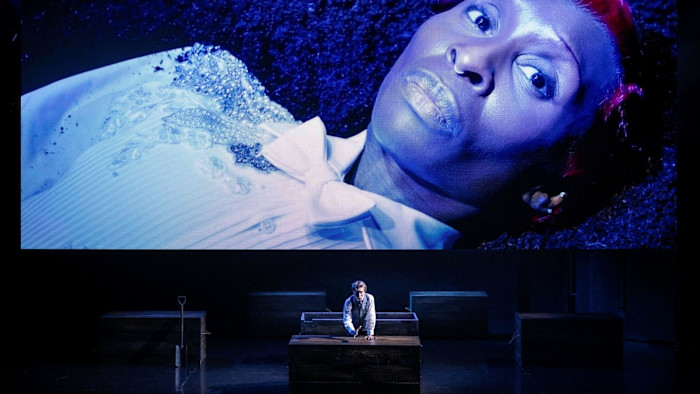
As with Williams’s knockout production of The Picture of Dorian Gray (staged in London in 2024 and starring Sarah Snook), the intricate mix of live action, live video and pre-recorded film enables Erivo to multiply before us and interact with other versions of herself. At one point, several of her characters stand watch over another’s deathbed; at another, she soars above herself onscreen.
 An ingenious mix of live video, pre-recorded film and live action places Erivo at the heart and periphery of the scene © Daniel Boud
It’s clever, technically. But it’s also an ingenious contemporary response to the themes of death, desire, transgression and identity running through the novel, and to prejudiced attitudes to outsiders. In a haunting prologue, Erivo writhes on the floor, filmed from above, her image splintering into multiple selves which crawl away, as if escaping a grave. Thereafter, spinning all the characters out of one actor blurs the edges between them: Dracula, here, exerts his grip because he, and whatever he represents, is buried within each of them.
On one level, Dracula feels like a stage evocation of the slippery nature of consciousness, folding us in and out of the dark byways of the imagination. Meanwhile, the archly gothic, camp style reacts knowingly to its place in the history of the tale. It is peppered with mischievous references to previous versions — capes, spindly limbs, fangs galore — while Clemence Williams’s score throbs and surges suggestively.
As the plot rumbles on, the text itself becomes a drag and the show begins to feel overlong. It doesn’t match the dazzling immediacy and playfulness of Dorian Gray, which so cleverly fused style and story to critique our own image-obsessed age. But then it wows you with a gorgeous image of Erivo, alone in a snowstorm centre stage. Not the best of Williams’s ingenious gothic spectacles, but bloody good all the same.
★★★★☆
To May 30, draculawestend.com