
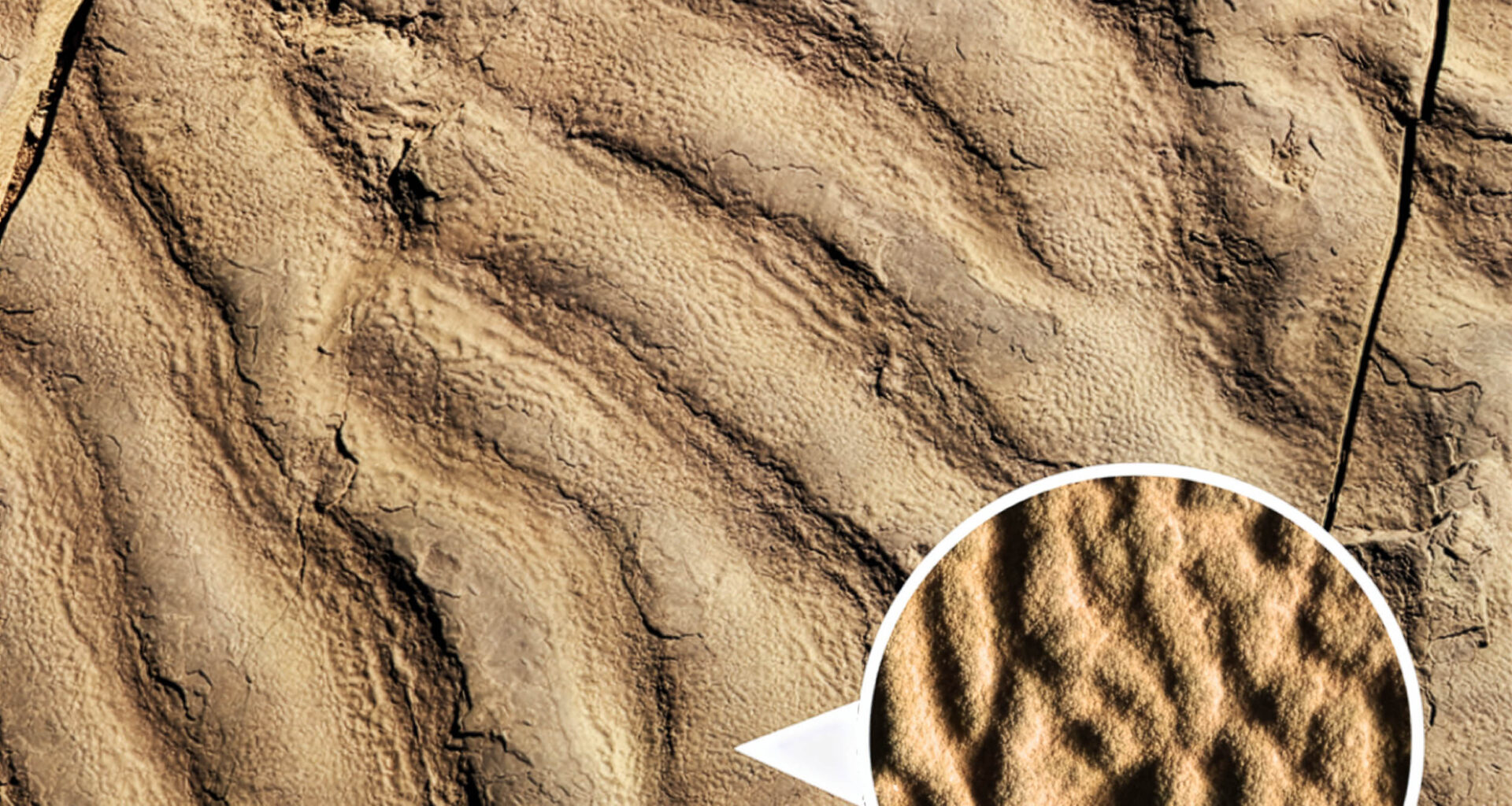
A wrinkled slab of rock in Morocco is prompting scientists to rethink where ancient microbial life could survive.
Instead of forming only in shallow, sunlit seas, these unusual textures hint that rich microbial ecosystems may once have thrived deep underwater, sustained by chemical energy rather than sunlight.

The mystery began in 2016, when geologist Rowan Martindale from The University of Texas at Austin noticed sedimentary layers covered in folds that looked like elephant skin.
The patterns seemed out of place for the type of rock she was studying – an observation that set off a closer investigation into how the structures formed.
Wrinkled rocks in deep seabeds
Researchers studied wrinkle structures from lower Toarcian turbidites in the Tagoudite Formation of Morocco.
Turbidites form when underwater landslides, called turbidity currents, carry sand and mud down a slope into deeper water.
Scientists reconstructed a paleodepth of about 656 feet (200 meters) for that setting. At such a depth, light would not reach far enough for photosynthetic mats to survive.
Murky water from repeated sediment flows would block even more light. So, if sunlight was not available, how did microbes grow?
Microbes without sunlight
Martindale and co-authors proposed a new explanation. Instead of using light, ancient microbes may have used chemicals for energy.
Such organisms are called chemolithoautotrophs. A chemosynthesizing microbial community depends on chemical reactions rather than sunlight.
Modern deep oceans host large chemosynthetic mats. Such mats often form where reduced chemicals like sulfide meet oxidants such as oxygen or nitrate.
In modern seas, similar mats live at depths from about 492 feet (150 meters) down to 3.1 miles (five kilometers).
Common members of such communities include sulfur oxidizing bacteria such as Beggiatoaceae and Thioploca species.
Like cyanobacteria in shallow water, filamentous bacteria trap and bind sediment. As a result, surface wrinkles can form.
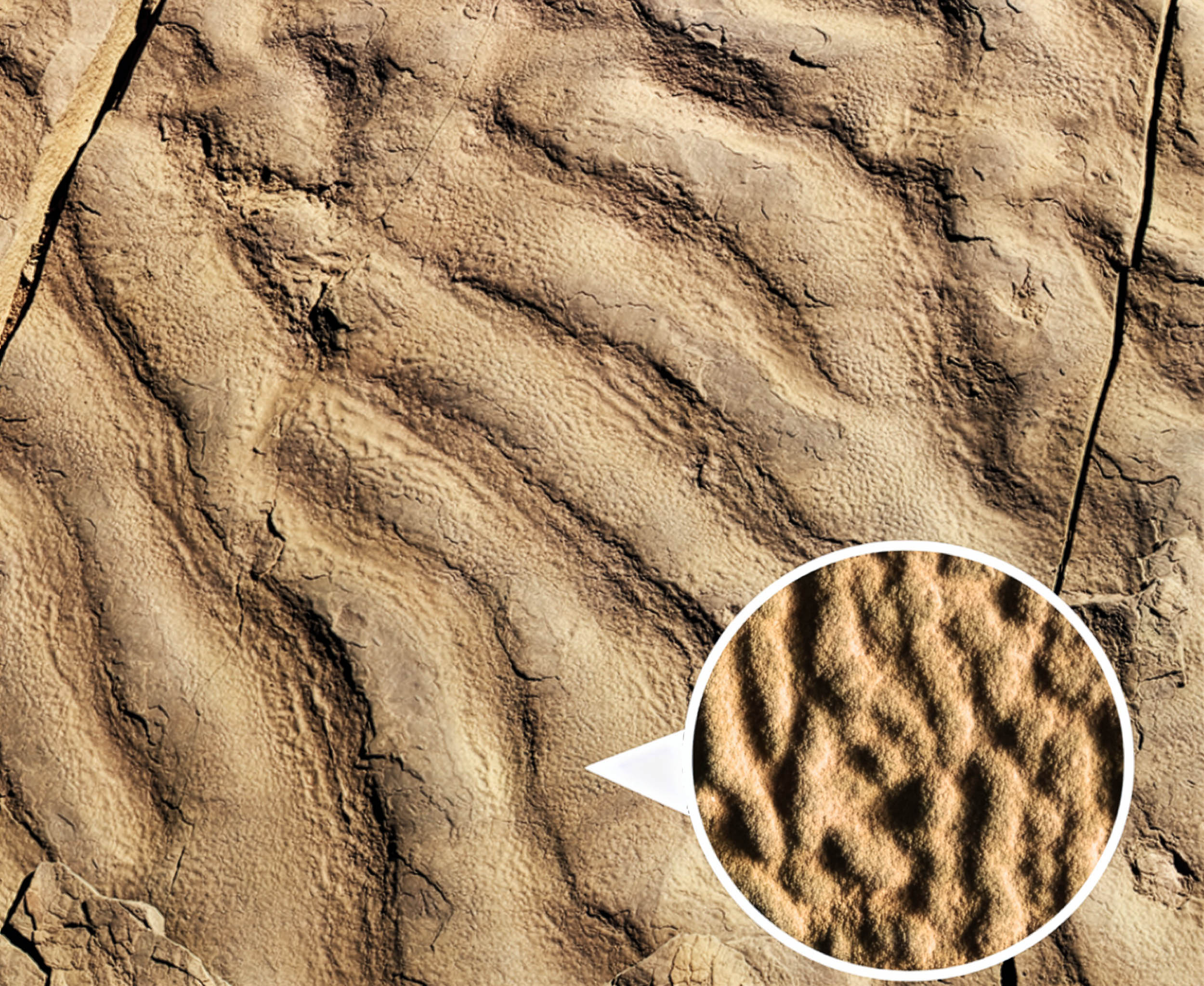 Preserved seabed ripples on an outcrop in Morocco covered with wrinkle structures thought to be formed by an ancient microbial community from the Early Jurassic. The inset shows a close-up of the wrinkle structures covering the ripples. Credit: Rowan Martindale/Jackson School of Geosciences. Click images to enlarge.Sediment flows shaped wrinkles
Turbidity currents did more than move sand. Rapid burial of organic material created chemical conditions ideal for chemosynthesis.
When organic matter breaks down in buried sediment, microbes reduce sulfate to sulfide or produce methane.
Woody debris in Tagoudite rocks likely released hydrogen sulfide during decay. Hydrogen sulfide can fuel sulfur-oxidizing bacteria.
As sulfide and other reduced compounds moved toward the sediment-water boundary, microbes formed thick mats.
Such chemical byproducts can also harm animals. High sulfide levels limit or exclude grazers that would normally disturb sediment. With fewer animals feeding on microbial layers, wrinkle structures had a better chance of preservation.
The researchers also found concentrated carbon just below wrinkled surfaces, which supports a biological origin. Rounded crests and troughs on bed tops match known microbial textures from much older rocks.
Rethinking ancient wrinkles
Wrinkle structures appear often in very old rocks from Precambrian and Cambrian times. After that, such features became rare in normal marine settings because animals disturbed mats before burial.
Some wrinkles formed after mass extinctions when grazing animals disappeared.
Now, turbidites offer another explanation. Gravity-driven sediment flows create alternating sand and mud layers and water movement at the seafloor. Such conditions can destabilize mats or move microbial clumps, shaping wrinkle patterns.
Chemosynthetic microbes can colonize fresh turbidite deposits within weeks or months in modern oceans. Growth continues until another sediment flow arrives. As a result, turbidites may serve as special preservation windows for microbial structures.
Similar wrinkle features have been reported from Cambrian, Silurian, Devonian, and Jurassic gravity deposits. Many such examples likely formed below light-rich zones. Some may have been misinterpreted as purely physical structures.
Evidence supports microbial origi
Scientists warn that not all wrinkled surfaces come from microbes – physical forces can also deform sediments, making clear diagnostic criteria essential for separating biological marks from flow-induced patterns.
Even so, multiple lines of evidence – including wrinkle shape, carbon enrichment, burial depth, and surrounding sediment context – strongly support a biological explanation for the Tagoudite structures.
For Martindale, the discovery marked an unexpected turn from her usual work on coral reefs and mass extinctions.
“It’s really cool to have gone in this direction that I totally wasn’t expecting,” she said, noting that there was no original hypothesis predicting microbial mats in this setting.
Instead, the finding came from “being in the right place at the right time” and persistently investigating what others might have overlooked.
Today, a wrinkled rock on a Moroccan hillside points to a once-hidden deep-sea world.
The research suggests that ocean floors once thought too dark for extensive microbial mats may have supported thriving chemosynthetic ecosystems – and that ancient turbidite deposits may record far more life than scientists previously imagined.
The study is published in the journal Geology.
—–
Like what you read? Subscribe to our newsletter for engaging articles, exclusive content, and the latest updates.
Check us out on EarthSnap, a free app brought to you by Eric Ralls and Earth.com.
—–