

February 18, 2026 — 2:00am
Save
You have reached your maximum number of saved items.
Remove items from your saved list to add more.
Save this article for later
Add articles to your saved list and come back to them anytime.
Got it
AAA
Marisa Gallo and her husband, Guido, trusted Richmond-based accountant Christopher Edwards with the profits from properties they sold. They were so convinced of his bona fides, their initial investments were rolled into a self-managed super fund.
In early 2024, Gallo sent Edwards formal notification she was seeking to dissolve the family fund. Two years later, she has not seen any of the estimated $900,000 she claims they are owed. Gallo is one of Edwards’ clients who allege they are collectively owed nearly $25 million.
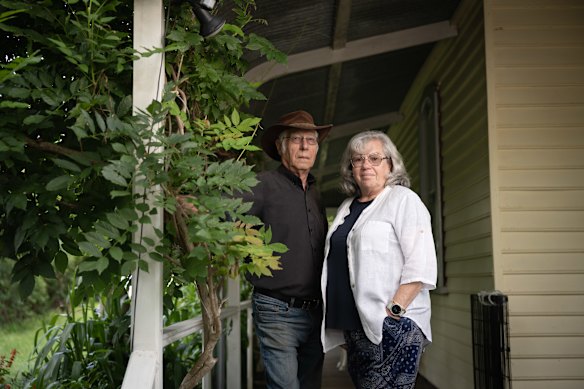 Guido and Marisa Gallo have spent the past two years trying to recover an estimated $900,000 they allege Christopher Edwards owes them.Wolter Peeters
Gallo has been in and out of hospital with stress-related conditions over the past nine months, which she alleges has been caused by Edwards’ refusal to pay them back. Instead, he says she owes him money. Gallo claims that is farcical.
Many clients of Edwards, also a solicitor, say a considerable portion of their trust in him is because of his standing as a lawyer.
That professional pedigree convinced them to invest their life savings with him. Sometimes they convinced their family to invest, too.
Alongside his list of qualifications and specialties – accountant, tax agent, licensed real estate agent, solicitor and barrister – Edwards’ business card displays the scales of justice, the symbol of fairness, balance and objectivity before the law.
The Australian Securities and Investments Commission (ASIC) said in September the vintage-Jaguar-driving 65-year-old is likely to have contravened a financial services law, and banned him from providing financial advice for 10 years.
“ASIC has reasons to believe that Mr Edwards does not have the judgment, skill or character to participate in the Australian financial services industry,” it said.
Approached near his office on Windsor Street, Richmond, this month, Edwards said he had not done anything wrong.
How it came undone
The point when Edwards’ operation veered off track is difficult to pinpoint. But two clients, speaking on the condition of anonymity, believe the problems began after Edwards’ long-time business partner Christopher Hawkins had a medical episode several years ago.
Hawkins – described by one source as Edwards’ “financial wizard”, numbers man and skilled developer – exited Great Northern Developments, their joint development company, as a shareholder and director in early 2022, according to corporate records.
“When he was in charge of developments, nothing went wrong,” the source claimed.
Three investments – a solar farm in Gunnedah in NSW and two property developments in Queensland – show little sign of nearing completion. That raises significant doubts about Edwards’ capacity to repay his clients any time soon.
Most of the 20 clients and staff who spoke to the Herald as part of the months-long investigation question whether their funds have propped up Edwards’ sinking investment empire.
One client, who spoke on the condition of anonymity because she had not told her broader family about their financial plight, said she had taken a loan of $565,000 – $265,000 was for her son’s university fees and to purchase a car, the remainder to invest with Edwards in a property development in Queensland.
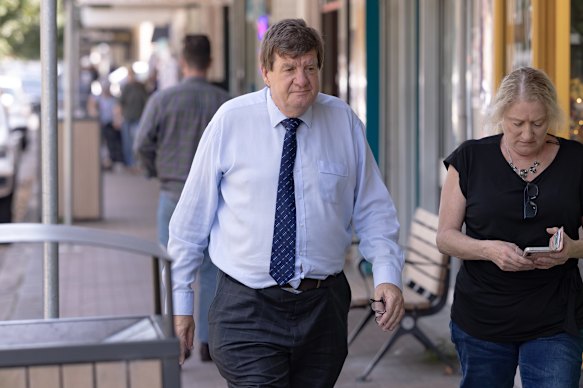 Christopher Edwards’ clients are demanding answers.Wolter Peeters
Edwards told her to invest the entirety of the funds with one of his development companies, on the proviso the money would be returned when needed. Instead, the solicitor deposited the funds in his Gunnedah solar farm investment – something she alleges she never gave him permission to do.
In an email in January, Edwards claimed he would provide $65,000 for her car, but requested she sign a deed of agreement with Ironbark Holdings, another company owned by Edwards with control of the Gunnedah development.
“You are being paid good interest on your investment, and this is largely because the money is out working and not sitting [in] the bank as it would be earning less than what I am paying you! Obviously if your money was at call you would be paid much less interest,” he wrote in an email.
“For this reason, under the agreement I am not obliged to pay you anything. As stated to you however I am prepared to help out if I am able and for you still being able to earn the high interest.”
Related Article
Times were good for Edwards around the early 2000s. Edwards and his wife, Albette, purchased residential and commercial properties across Sydney’s north-west. Title searches reveal the pair have property holdings across NSW, Queensland and Victoria.
The couple spent $1.6 million on a four-bedroom, four-bathroom Woollahra home in late 2003. Their son owns another three properties, including a five-bedroom house in Blaxland purchased for $1.4 million in 2022, and a villa in Ettalong Beach for $750,000 in 2020.
The regulatory system
The architect of the nation’s superannuation system, former prime minister Paul Keating, said self-managed funds were “almost an afterthought”. Regulation of these funds was fairly relaxed, designed for people who were active and engaged in their investments while receiving sound financial advice, explains Jessica Spence, the director of advocacy at Super Consumers Australia.
“The problem is if you have someone who is vulnerable, it is easier to take advantage of them in the SMSF space,” she said.
“We have seen, generally, quite a lot of harm using SMSFs for scams, domestic abuse, financial abuse, elder abuse, because of those fewer protections and checks and balances.”
The lack of checks and balances has bewildered Edwards’ clients. They have asked why it took the corporate regulator so long to intervene, and why the only repercussion for operating without a financial licence was to ban him from providing financial advice – something he was not allowed to do.
“It’s a bit unsatisfactory from a consumer perspective. We would like to see stronger penalties in line with the scale of the harm people are causing,” Spence said.
In a statement, an ASIC spokesman said: “ASIC’s investigation into Mr Edwards remains ongoing. We cannot comment any further on an ongoing investigation.”
Because Edwards does not have a financial services licence, his clients are not covered by professional indemnity insurance or have access to the compensation scheme of last resort.
“We would like to see stronger penalties in line with the scale of the harm people are causing.”
Jessica Spence, Super Consumers Australia
The existence of “one-stop shops” – entities which establish SMSFs, roll over existing superannuation funds into the fund, and invest in property developments, among other things – is not new. ASIC was warning about these kinds of operators functioning without a financial licence as far back as 2014.
Related Article
Vulnerabilities have been exposed by what ASIC defines as high-risk superannuation switching – schemes set up to entice investors from retail funds with the promise of higher returns. Spence believes regulators need to make it harder for people to be pushed into self-managed funds if they are unsuitable products.
She fears many SMSF investors lack the financial literacy to understand and question the investment products they are sold.
Those problems have been exacerbated by rising risk tolerance in the superannuation sector, Joe Longo, the head of ASIC, told The Australian Financial Review last month.
“I think it’s inevitable there’ll be more losses. We, as a system, we almost choose to encourage risk-taking,” he said.
Start the day with a summary of the day’s most important and interesting stories, analysis and insights. Sign up for our Morning Edition newsletter.
Save
You have reached your maximum number of saved items.
Remove items from your saved list to add more.
 Max Maddison is a state political reporter at The Sydney Morning Herald.From our partners