
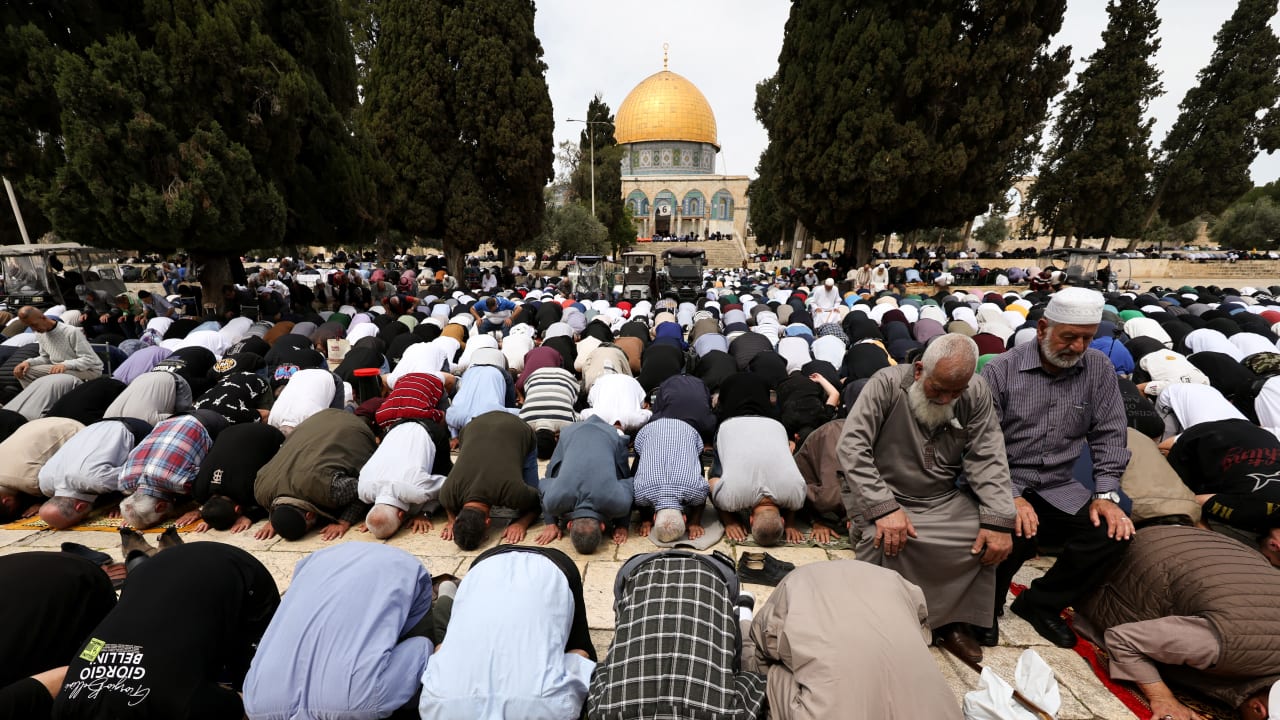
The IDF’s COGAT on Wednesday announced that it will facilitate up to 10,000 Palestinians per day visiting the Temple Mount during the Muslim month of Ramadan.
Strategically, Israel tends to try to facilitate significantly increased visiting capacity for Palestinians to the Temple Mount during Ramadan both in terms of its commitment to providing free access to place of religious worship in its territory to all religious groups as well as to calm any potential Israeli-Palestinian tensions which might spike during the period of elevated religious awareness.
Ramadan started on Tuesday and runs until March 19.
A statement from COGAT said, “Following a security situation assessment, the political echelon has accepted the recommendation of the defense establishment regarding the framework for the entry of Palestinian worshippers to the Temple Mount / Al-Aqsa Mosque compound during the month of Ramadan. This is intended to allow and facilitate freedom of worship and religion for the public, subject to maintaining security stability.”
“Under the framework, 10,000 Palestinian worshippers will be permitted to enter the Temple Mount for Friday prayers throughout the month of Ramadan, subject to obtaining a dedicated daily permit in advance. Entry for men will be permitted from age 55, for women from age 50, and for children up to age 12 when accompanied by a first-degree relative,” said the statement.
Despite the general policy of increased visitation, during this period, Israel often prohibits men and women viewed as being in the potential security risk age range of persons who sometimes commit crimes in order to reduce the potential of public order disruptions and security events.
Consistent data has shown that minors under the age of 12 and grandparent-age persons in their 50s are almost never involved in ideological Israeli-Palestinian conflict related crimes.
COGAT added that, “all permits are conditional upon prior security approval by the relevant security authorities. In addition, residents traveling to prayers at the Temple Mount will be required to undergo digital documentation at the crossings upon their return to the areas of Judea and Samaria at the conclusion of the prayer day.”
The defense establishment has been especially worried that, absent Israel being perceived as positively facilitating religious worship, Palestinians in the West Bank could boil over into major security events this Ramadan due to a mix of the ongoing suffering of Palestinians in Gaza as well as two recent government decisions which could expand the Israeli-Jewish presence in disputed areas of Judea and Samaria.