
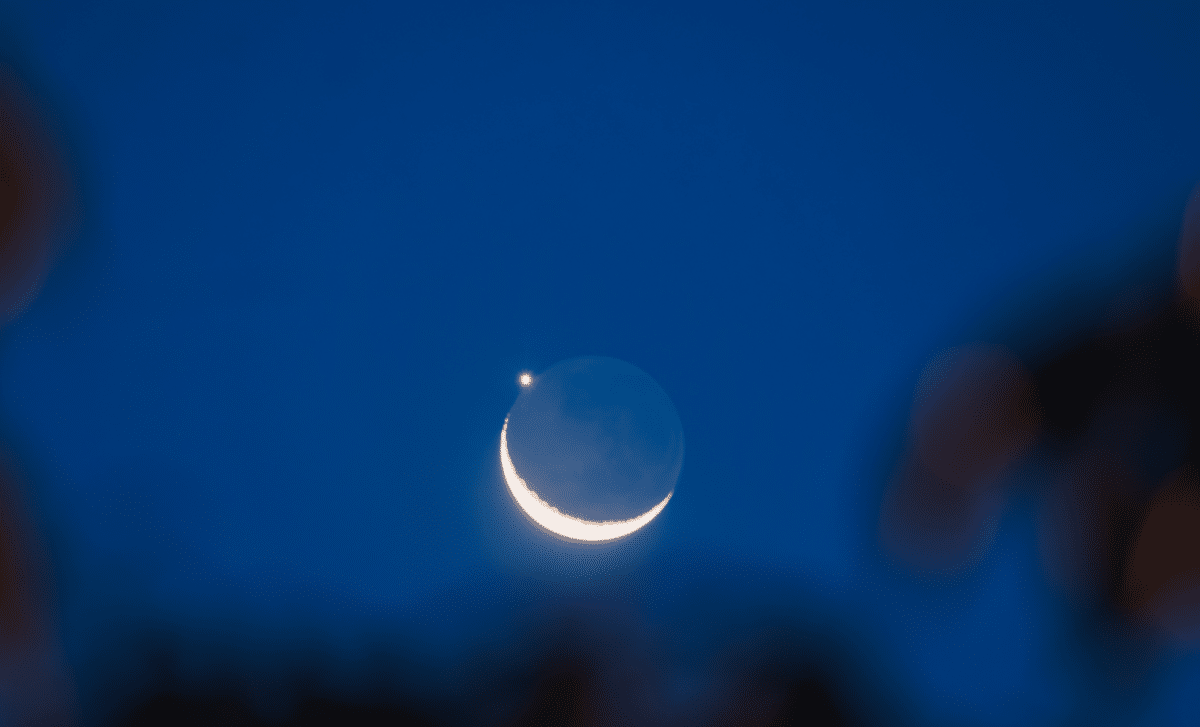
Tonight, the skies will offer some fascinating celestial events, featuring a special rendezvous between the crescent Moon and the planet Mercury. If you’re lucky enough to catch the show, you’ll see the Moon gliding by the tiny planet in the early evening sky, creating a stunning sight in the western sky just after sunset. In addition to this, the dazzling Venus will be shining below, adding to the spectacle. A notable event for skywatchers will be the rare occultation of Mercury by the Moon for certain locations, a moment not to be missed by those eager to spot this elusive planet.
The Thin Crescent Moon Joins Mercury in a Sky Show
As the day turns to night, the sky will treat us to a celestial alignment worth watching. The Moon, now in its waxing crescent phase, will join Mercury in the western sky. The two objects will appear close together, with the Moon positioned just above Mercury. For observers across the U.S., this will be an excellent opportunity to catch a glimpse of the otherwise elusive Mercury, a planet known for its quick motion across the sky. Though Venus is bright and easy to spot, it will be lower in the sky, while Mercury will be higher, closer to the Moon.
This event offers an ideal chance for both seasoned skywatchers and newcomers to astronomy to view two of the inner planets in a close grouping. According to Astronomy Magazine, the Moon will not only pass near Mercury, but for some observers, it will also occult Mercury. This means that the Moon will briefly pass directly in front of Mercury, temporarily obscuring it from view, adding a unique twist to the evening’s events. Depending on where you are, the Moon’s position relative to Mercury will vary. On the East Coast, Mercury will appear to the north of the Moon, while the West Coast will see Mercury to the lower right of the lunar crescent.
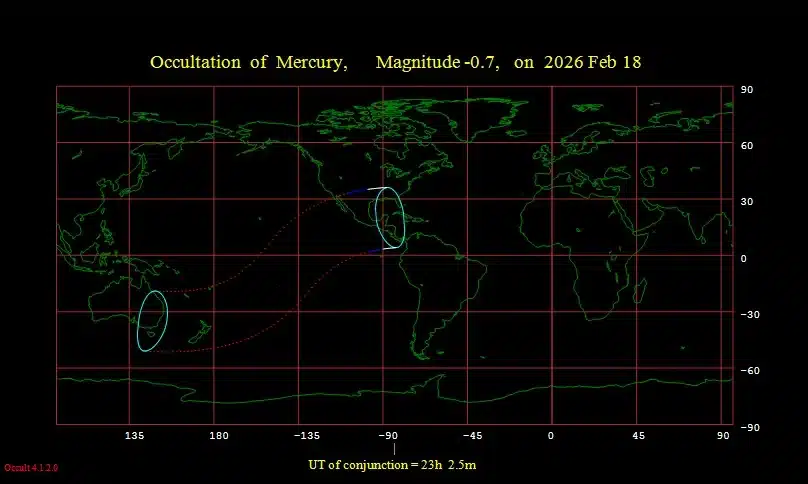 The occultation footprint for Wednesday night’s occultation of Mercury by the Moon. Credit: Occult 4.2.
Venus Shines Brightly Just Below the Moon and Mercury
Adding to the spectacle on the evening of February 18, Venus will also be visible, though slightly lower in the sky than the Moon and Mercury. With a magnitude of –3.9, Venus will be one of the brightest objects in the evening sky. Although it will be positioned just 12 degrees above the horizon half an hour after sunset, Venus’s brightness should make it easy to spot, even in the twilight. This is a great opportunity to observe the second planet from the Sun in its full glory, outshining even the fading sunlight.
However, due to its low position in the sky, Venus may be more difficult to spot in areas with obstructed horizons, such as regions near mountain ranges or large buildings. Regardless, anyone with a clear view of the western sky should be able to observe this dazzling planet, offering a fantastic contrast against the dimming backdrop of twilight.
Jupiter’s Moons Put on a Show: Ganymede’s Transit and Shadow
While the Moon and Mercury take center stage in the western sky, Jupiter will be offering an exciting celestial event on the opposite side of the sky. Around 9 p.m. EST, the moon Ganymede will be transiting Jupiter’s disk, which means it will be passing in front of the gas giant, blocking out a small portion of its cloud tops. This transit will be visible across most of the U.S., with some locations witnessing the event as darkness falls.
However, the spectacle doesn’t stop there. Shortly after Ganymede transits Jupiter’s disk, its shadow will begin to appear, creating an intriguing phenomenon. The shadow will start to cast a “bite” on the southeastern limb of Jupiter, making it look as though the planet is being partially “eaten” by darkness. The shadow transit will last for several hours, continuing until nearly midnight. This is a remarkable event for observers with telescopes, as it offers a clear view of one of Jupiter’s most iconic moons and its shadow passing across the planet’s massive atmosphere.
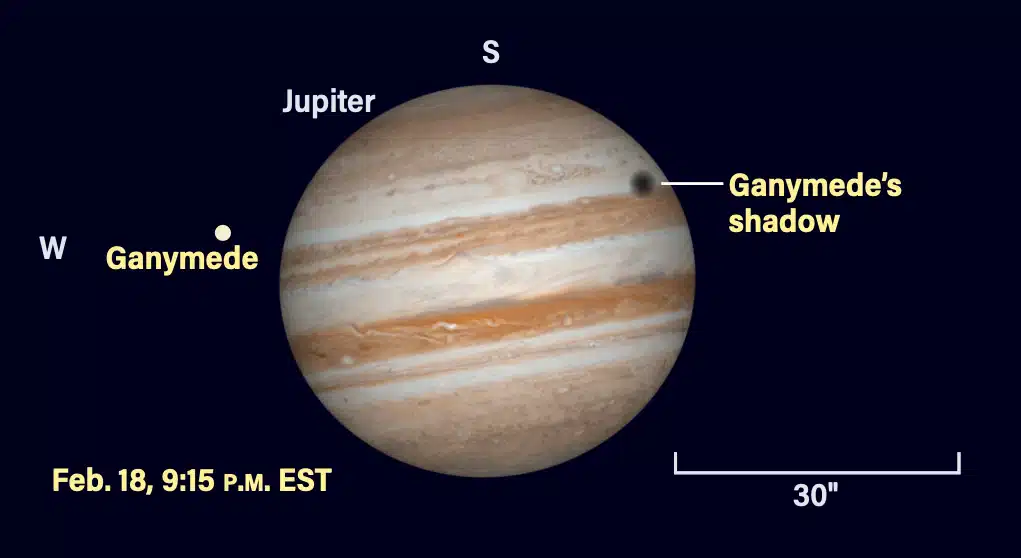 Shortly after 9 p.m. EST on Feb. 18, Ganymede has completed a transit and its shadow has appeared on Jupiter’s cloud tops for a transit of its own. Callisto is to the west, while Io and Europa lie to Jupiter’s east, outside this field of view. Credit: Astronomy: Roen Kelly
How to Catch the Best Views of These Events
For those hoping to witness both the Moon’s encounter with Mercury and the moon Ganymede’s transit of Jupiter, timing will be key. Mercury and the crescent Moon will be best viewed just after sunset, so plan to head outside early in the evening to catch a glimpse of this pairing. You’ll need a clear western horizon to see Venus and Mercury in all their glory. For the Jupiter event, you’ll want to observe later in the evening, preferably around 9 p.m. EST or later, to catch Ganymede’s transit and the subsequent shadow crossing.
While many of these events can be viewed with the naked eye, those with telescopes or binoculars will have a much better chance of seeing the finer details, such as Ganymede’s transit and the shadow on Jupiter’s disk. This is also an excellent opportunity for beginner astronomers to practice identifying planetary features and familiarizing themselves with the positioning of major celestial objects.